

- Furniture
- Translated with AI
Process safety in the cleanroom: Why ESD protection and workplace design must be considered together
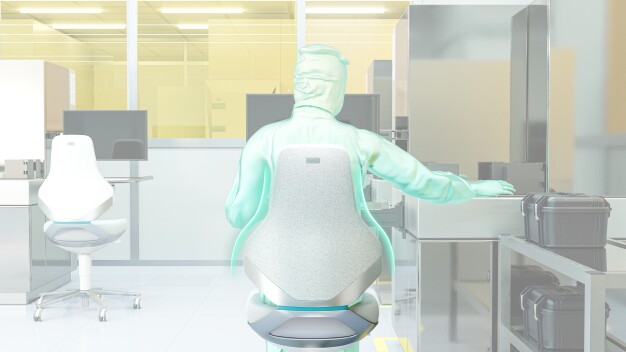
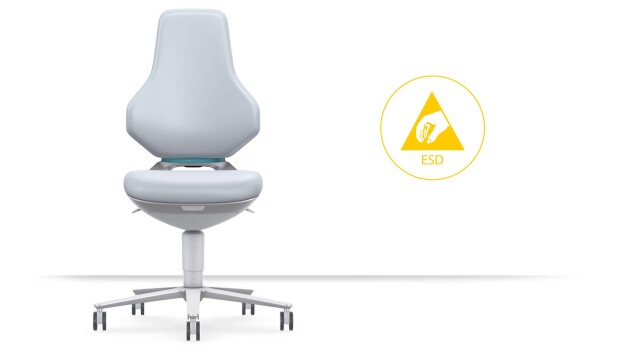
Cleanrooms can already be significantly affected by the tiniest influences. Particles, electrostatic discharges, or unsuitable materials can impair sensitive products and processes. Especially in semiconductor manufacturing, microelectronics, medical technology, or other high-tech fields, controlled environmental conditions are therefore crucial.
It is not enough to consider individual components in isolation. A safe cleanroom is created through the interplay of room technology, clothing, flooring, work tools, furniture, and the people. Even the office chair is part of this system. It must meet requirements for low particle emission, ease of cleaning, and – if necessary – electrostatic discharge capability, while also enabling ergonomic work.
Cleanroom and ESD: Two requirements, one overall system
Cleanroom technology aims to keep the concentration of airborne particles within defined limits. ESD protection targets a different aspect: it aims to prevent electrostatic discharges from impairing sensitive components or processes.
In many high-tech applications, both requirements directly intersect. Semiconductors, wafers, or electronic components can already be damaged by discharges that are imperceptible to humans. At the same time, the tools used must not themselves be sources of unacceptable particles.
The challenge is therefore to combine both protection concepts. For example, a work chair that is electrostatically dissipative does not automatically meet the requirements of a cleanroom. Conversely, low particle emission alone is not sufficient for ESD protection.
For workplace design, this means: each component must be selected for the specific application and integrated into the respective protection concept.
The office chair as part of the controlled environment
People are a key influencing factor within a cleanroom. Every movement can release particles. Accordingly, it is important to also consider those components that are in constant close contact with employees.
In the case of a cleanroom chair, this concerns the entire construction. Surfaces, padding, mechanics, casters or gliders, and other parts must be tailored to the specific application.
Closed and as seamless as possible surfaces reduce areas where particles or contaminants can accumulate. At the same time, hygienic design facilitates regular cleaning. Materials must withstand the cleaning and disinfection procedures used without losing their functional properties.
For particularly sensitive areas, controlled particle emission is additionally required. The suitability of a seating solution for cleanroom use should therefore not be derived from individual material properties but qualified for the intended application.
ESD safety does not end at the seat surface
Where additional ESD protection is required, the discharge capability must be considered throughout. It is not enough to simply use a conductive cushion. It is crucial that all relevant components of the seating solution are coordinated and that electrostatic charges can be reliably dissipated.
Among other things, padding and surfaces, construction, footrest, as well as casters or gliders play a role. The chair thus becomes a part of the entire ESD-protected area.
DIN EN 61340-5-1 is a central standard for ESD protection zones. However, it is not only the equipment compliant with standards at the time of commissioning that matters. ESD protection must function reliably throughout the entire service life.
Regular checks ensure process safety
In controlled environments, the current condition is critical. Mechanical stress, wear, contamination, or unsuitable cleaning agents can influence the properties of workplace components over time.
It is problematic that such changes are not always visually detectable. A surface may appear flawless externally, while its electrostatic properties have changed.
Therefore, regular inspections are part of the ESD protection concept. Depending on the process and risk assessment, suitable parameters can also be continuously monitored. Monitoring systems can, for example, record grounding states or relevant environmental conditions and provide early indications of deviations.
A systematic approach is essential: not just reacting to errors, but recognizing changes before they affect process or product quality.
Cleaning must not impair the protective function
Regular cleaning is indispensable in a cleanroom. At the same time, it can become a risk factor if the cleaning agents used are not compatible with the materials and functional properties of the equipment.
This is especially true where cleanroom and ESD requirements overlap. Cleaning processes must not negatively affect either the material surfaces or the electrostatic properties.
When selecting equipment, particle behavior and discharge capability should not be the only considerations. Equally important are resistance to the intended cleaning and disinfection agents, and a design that allows for as simple and thorough cleaning as possible.
Hygienic design thus becomes an important part of long-term process safety.
Ergonomics remains crucial even in the cleanroom
Despite all technical requirements, the human factor must not be overlooked. Many activities in cleanrooms require sustained concentration and precision. Microscopy, assembly, inspection, or working with delicate components often lead to static or forward-leaning postures.
Therefore, a cleanroom chair must do more than meet technical limits. It should also support the body ergonomically during demanding tasks.
Individually adjustable seat heights, appropriate back support, and dynamic seating mechanisms can help accommodate different body positions. For fine motor tasks, adjustable armrests can additionally relieve the shoulders and neck. At the same time, sufficient freedom of movement must be maintained.
This is why cleanroom ergonomics must be considered holistically: technical safety and healthy working are not mutually exclusive requirements.
The human remains part of the cleanroom concept
Even the best technical equipment can only fulfill its function if used correctly. In addition to selecting suitable workplace components, defined procedures and trained staff play an important role.
This applies to handling ESD protection measures as well as cleaning and ergonomic use. Using an inappropriate cleaning agent can be just as problematic as wearing unsuitable footwear in an ESD zone or using a seat solution not adapted to the user.
Process safety is therefore not achieved by a single technical measure. It is the result of a system in which space, equipment, processes, and people are coordinated.
Holistic planning of cleanroom workplaces
As product and process sensitivity increases, so do the requirements for cleanrooms. Areas that were previously considered separately are now coming together: contamination control, ESD protection, hygiene, and ergonomics.
Workplace design in particular demonstrates how closely these factors are interconnected. Materials must be particle-free and cleanable, ESD-relevant components must enable reliable discharge, and ergonomic design must support people during concentrated activities.
Those who plan cleanroom workplaces holistically from the outset not only ensure technical safety but also create working conditions that support people during precise and demanding tasks.
Conclusion: Process safety results from the interplay
A safe cleanroom is more than the sum of individual compliant components. Only the coordinated interplay of contamination control, ESD protection, suitable materials, regular testing, and ergonomic workplace design creates reliably safe conditions over the long term.
The office chair is also part of the overall system. Its task is to combine technical requirements for cleanroom and ESD with the needs of the person.
Thus, a single workplace component becomes a building block for long-term process safety – and for working conditions under which even demanding precision work can be performed concentrated and ergonomically.

Bimos - eine Marke der Interstuhl Büromöbel GmbH & Co. KG
Brühlstraße 21
72469 Meßstetten-Tieringen
Germany
Phone: +49 7436 8710
Fax: +49 7436 871110
email: bimos@bimos.com
Internet: http://www.bimos.com