




- Hygiene & Cleaning
- Translated with AI
Doris Schulz
Process-safe and efficient dry cleaning
quattroClean - Cleaning of plastic parts in medical technology
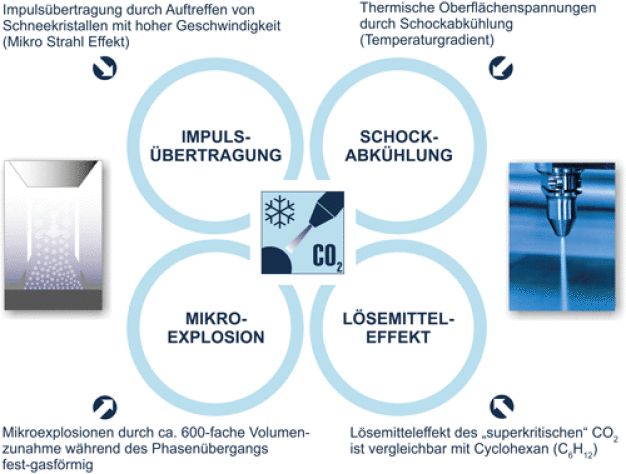
The patented technology with dual-material ring nozzle for the CO2 and compressed air jet ensures a consistent and uniform cleaning performance. This also reliably prevents freezing of the nozzle.
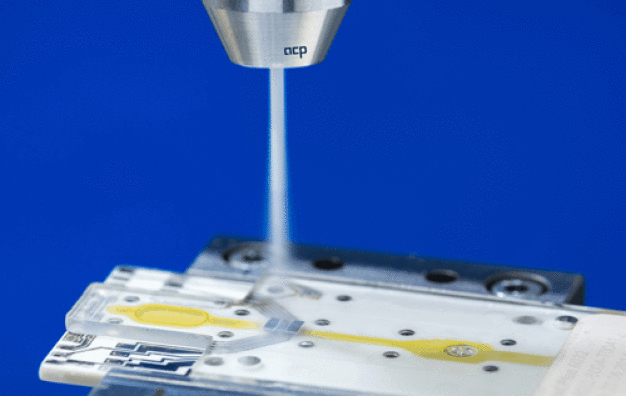
During the manufacturing of microfluidic lab-on-chip products, the quattroClean system can be used for simultaneous fine cleaning and decontamination of plastic injection-molded parts.
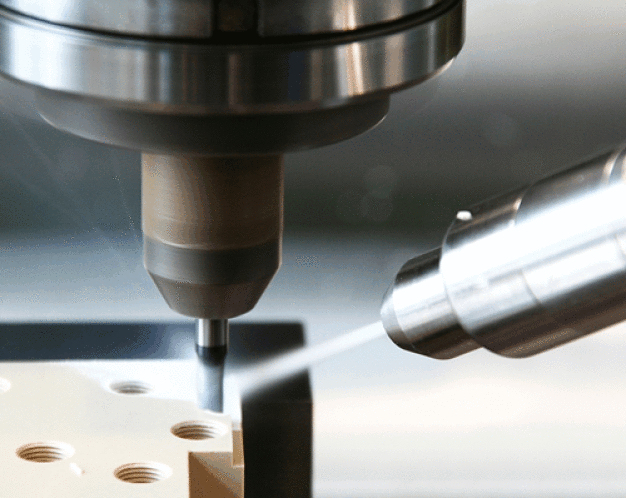
Simultaneous cooling and cleaning with CO2 during the machining of PEEK significantly reduces chip formation and markedly increases chip removal speed.
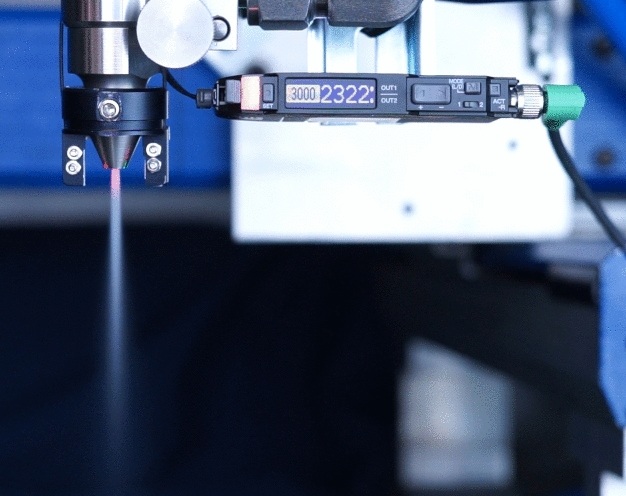
The quality of the CO2 snow jet can be continuously monitored with an innovative sensor system. The measured value is compared with the defined process window and automatically saved.
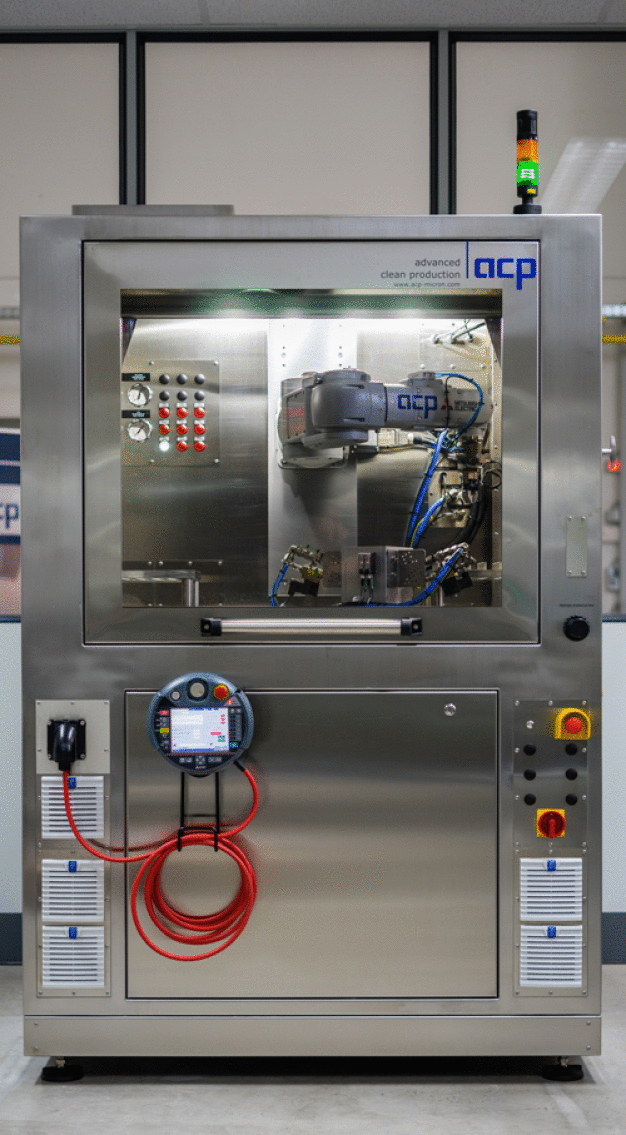
For cleaning in clean environments, the systems can be designed and equipped according to the required cleanroom class. (Image source: acp systems AG)
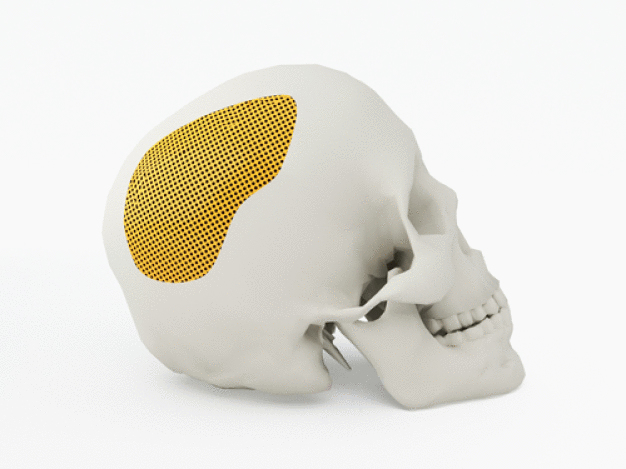
The quattroClean snow jet cleaning is also used for cleaning implants made of plastic. (Image source: istock)
In medical technology, plastics now play an important role. Depending on the application, different levels of cleanliness are required for the products. The dry quattroClean snow jet technology enables, across a very broad range of applications, the reproducible, validated, and cost-efficient removal of contaminants and fine burrs – even on geometrically very complex components. Small footprint, easy automation, as well as integration into cleanrooms and networked manufacturing environments are additional advantages of the process.
Housings of medical devices are made from plastics just like instruments, implants, aids, and laboratory diagnostics for human, dental, and veterinary medicine. The manufacturing of these products takes place using various traditional processes such as extrusion, injection molding, and machining, increasingly also in industrial 3D printing. In each of these processes, residues from manufacturing—such as release agents, particles, flash, dust, or residual powder—remain on the surfaces. Depending on the risk class into which medical devices are categorized, these contaminants pose different potential damages to patients. And this is true even when sterilized with the instrument or implant. But even for products that do not pose a direct risk, such as plastic housings or diagnostics, filmic and/or particulate contamination can interfere with subsequent processes, such as coating or painting, or distort laboratory results.
This highlights the influence of component cleaning on the safety, quality, and functionality of the product. It must reliably ensure that the specific cleanliness requirements and biological compatibility are met, and that no product properties or surfaces are adversely affected.
The traditional aqueous chemical final cleaning often reaches its limits—especially with parts featuring complex geometries, delicate contours, fine structures, or mechatronic systems with, for example, MID (molded interconnect device) circuit carriers.
Four effects for residue-free clean surfaces
The quattroClean snow jet technology from acp systems AG has proven to be effective, process-safe, and economical for these cleaning tasks. The process uses liquid, indefinitely storable, and non-corrosive carbon dioxide as the cleaning medium. It is produced as a byproduct in chemical processes and biomass energy generation, making it environmentally neutral.
A key component of the cleaning system is a wear-free two-component ring nozzle. This directs the non-flammable, non-toxic, and medically approved prepared carbon dioxide. It relaxes upon exiting the nozzle into fine CO2 snow, which is bundled by a separate, ring-shaped compressed air jet and accelerated to supersonic speeds. The patented technology ensures a consistent and homogeneous cleaning performance even in automated applications.
When the minus 78.5°C cold and well-focusable snow compressed air jet hits the surface, a combination of thermal, mechanical, sublimation, and solvent effects occurs. The interplay of these four mechanisms removes particulate and filmic contaminants such as chips, micro burrs, dust, abrasives, release agents, silicones, and smoke residues—such as those from laser structuring—in a process-safe and reproducible manner. At the same time, the CO2 snow jet cleaning has a bacteriostatic effect.
During cleaning, the crystalline carbon dioxide fully transitions into the gaseous state, so the cleaned item is immediately dry. Dislodged contaminants are carried away from the component surface by the aerodynamic force of the compressed air and suctioned out together with the sublimated carbon dioxide from the cleaning module. The cleaning process is gentle on materials, allowing sensitive and finely structured surfaces as well as delicate structures, such as additively manufactured components, to be treated.
Proven for a wide range of tasks
The quattroClean technology is used in medical technology for various tasks. This includes cleaning plastic housings before coating and painting. The process replaces the traditionally used aqueous chemical cleaning, which involves a multi-stage process where the plastic parts are repeatedly heated and cooled with high energy input. In comparison, the cold, dry CO2 snow jet cleaning requires significantly less production space and offers noticeable savings in investment and operating costs. The process also enables the fine cleaning and removal of contaminants from complex molded plastic parts in microfluidic Lab-on-Chip systems. Another application is the removal of contaminants from structures of PEEK-based additively manufactured implants.
Cooling and cleaning in one step
The high-performance plastic is also the base material for machined implants and medical components. To reduce chips generated during the dry machining of PEEK and the subsequent finishing work such as deburring, the acp process selectively cools during machining. This effectively prevents chip formation so that manual deburring under a microscope can be completely avoided. Any remaining chips are immediately removed by the cleaning effect. Furthermore, the selective cooling with the quattroClean system allows for a significant increase in machining speed, resulting in a clear productivity boost.
Cooling with CO2 snow also has the potential to open up new applications with PEEK. Initial tests on grinding plastics have shown that simultaneous cooling can prevent changes in material properties as well as the process-damaging deposition of particles on the grinding wheel.
Customized, validated processes tailored to the application
The scalability of the cleaning process allows it to be easily and space-efficiently adapted to different applications and component geometries for full-surface or partial cleaning. Process development takes place in the acp systems technical center. All process parameters—such as volume flows for compressed air and carbon dioxide, number of nozzles, spray area, and duration—are precisely adjusted through tests to the respective component, application, material properties, and contaminants to be removed. These can be stored as part-specific programs in the system control.
The stability of the snow jet density is one of the key parameters for consistent cleaning effectiveness and thus the quality of the cleaning process. This important parameter can be continuously monitored during each nozzle's operation with an innovative sensor system. It compares the measured value with the defined cleaning window for the component established during testing, so that irregular, too weak, or too strong snow jets are immediately detected, and only parts cleaned within the specified process window leave the station. At the same time, the measured value at the nozzle can be transmitted and stored in a higher-level control center, where all manufacturing data for a product are stored. This not only provides information on whether the cleaning took place within the defined window but also records the exact value. All other process parameters can also be automatically recorded, stored, and transmitted to a master computer for seamless documentation and traceability. This not only enhances process security but also simplifies any necessary process validation with a notified body.
Customized system design – also for cleanroom environments
The system design is tailored to customer-specific requirements, using standard modules to create manual, semi-automated, and fully automated quattroClean systems. Standalone solutions can be implemented as well as integrated systems within production lines and linked manufacturing environments.
For cleaning systems intended for use in a clean environment, the integration of appropriate treatment units for liquid carbon dioxide and compressed air is included. The air supply, extraction, and equipment—such as automation components and their placement—are each adapted to the respective cleanroom class. Optimal airflow conditions ensure the quick and reliable removal of contaminants. The adaptation of the system to specific cleanliness requirements and spatial conditions is achieved through various solutions, such as a cleanroom-compatible version or integration into an existing cleanroom.
The broad application spectrum and the ability to precisely adapt systems to specific component specifications and production environments enable process-safe and efficient cleaning of medical products—even under the new Medical Device Regulation (MDR).
acp systems AG
Berblingerstraße 8
71254 Ditzingen
Germany
Phone: +49 7156 480140
email: info@acp-systems.com
Internet: http://acp-systems.com



