


- In-house exhibition
- Translated with AI
Prime Minister Kretschmann visits Stuttgart Technology and Innovation Campus S-TEC
Innovative strength for a sustainable working world
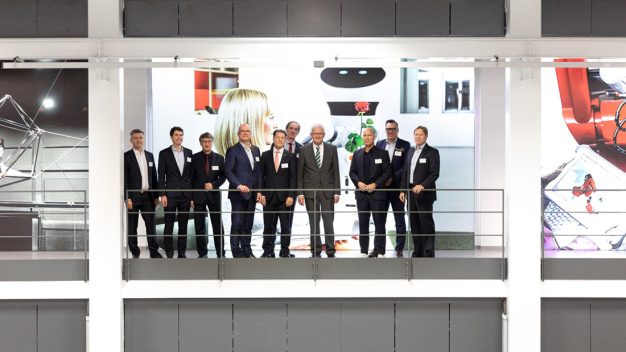
L. to R.: Prof. Dr. Alexander Sauer, Institute Director Fraunhofer IPA; Prof. Dr. Marc Rüger, Deputy Institute Director Fraunhofer IRB; Prof. Dr. Thomas Bauernhansl, Institute Director Fraunhofer IPA; Prime Minister Winfried Kretschmann; Prof. Dr. Philip Leistner, Institute Director Fraunhofer IBP; Dr. Markus Wolperdinger, Institute Director Fraunhofer IGB; Prof. Dr. Oliver Riedel, Institute Director Fraunhofer IAO; Prof. Dr. Steffen Rupp, Deputy Institute Director Fraunhofer IGB; Dr. Florian Herrmann, Deputy Institute Director Fraunhofer IAO; Dr. Kai Kohler, Department Head Fraunhofer IPA. © Fraunhofer IPA/Photo: Rainer Bez
Sustainability and climate protection are top priorities on the agendas of politics, business, and science. To get an idea of the innovations that enable resource-efficient economics, Prime Minister Winfried Kretschmann visited the Stuttgart Technology and Innovation Campus S-TEC at the Fraunhofer Institute Center Stuttgart on January 31, 2023.
Whether it's climate change, skilled labor shortages, or digital transformation: addressing these upcoming challenges requires a rethinking at many levels. This can only be achieved if politics, business, and science work together, collaborate across disciplines, and advance future-relevant research topics with high technical and organizational innovation potential – on a global level, but especially and primarily on a regional level. Baden-Württemberg has been one of Europe's leading innovation regions for decades. However, the state is in fierce competition for the world's most intelligent technologies, best ideas, and brightest minds.
»We have an outstanding research landscape in Baden-Württemberg focused on highly innovative and future-relevant technologies and topics with diverse emphases. Places like the S-TEC Campus here in Stuttgart are beacons with international influence in research and transfer to industry – and that makes Baden-Württemberg so special: industry and research work hand in hand«, said Prime Minister Winfried Kretschmann.
With the aim of gaining an understanding of the key areas of action on the way to a sustainable and resource-conserving future, Prime Minister Winfried Kretschmann visited the Stuttgart Technology and Innovation Campus S-TEC at the Fraunhofer Institute Center Stuttgart. Here, institutes of the Fraunhofer Society as well as the University of Stuttgart cooperate with startups and other regional companies to develop methods, processes, production systems, and business models in numerous centers focused on different themes and bring them into application.
»As a head of government, I have always remained a learner and am curious about everything that advances us. For example, here in Stuttgart, where clever minds work on the challenges of today and tomorrow, helping to shape the future-proofing of the country«, Kretschmann continued.
S-TEC as a 'Transfer Machine' Bringing Research into Industrial Application
»The S-TEC centers – there are now more than 10! – have been successfully contributing to the implementation of the state's research strategy for five years now. Whether through industry collaborations, such as Quick Checks, Exploring Projects, or CyberLänd, which will send Baden-Württemberg into the metaverse: the innovation campus is a 'transfer machine' that efficiently brings scientific results into companies and markets, thereby contributing to the state's economic future viability. I am very pleased that Baden-Württemberg's Prime Minister Kretschmann took the occasion of the five-year S-TEC anniversary to take a close look at our innovative research and transfer environment«, explained Professor Thomas Bauernhansl, head of the Fraunhofer IPA and spokesperson for the institute leadership council of the Fraunhofer Campus in Stuttgart.
Campus Tour: Using New Technologies for Sustainability and Resource Efficiency
The focus of the campus tour with five different stations was on technologies and digital tools related to sustainability and resource efficiency. Foremost among these were the applications of artificial intelligence (AI), which the Fraunhofer Institute for Industrial Engineering and Organization IAO, together with the Fraunhofer Institute for Production Technology and Automation IPA, researches at the AI Progress Center: from welding with cobots to AI-based digital field service assistants.
Under the title »Precision Medicine from Diagnostics to Therapy«, the Fraunhofer Institute for Interfacial Engineering and Biotechnology IGB and the Fraunhofer IPA presented the latest developments around rapid DNA-based diagnostics of sepsis pathogens, virus-based technologies to establish an oncolytic virus platform, and the standardized automated production of novel cell and gene therapies. The Fraunhofer Institute for Building Physics IBP showcased how smart product functions can make a product more sustainable and how the requirements of the EU taxonomy in mechanical engineering can be efficiently implemented; both topics from the new S-TEC Center for Climate-Neutral Production and Holistic Accounting. Using current examples, the Fraunhofer IGB demonstrated how wastewater and waste can be utilized through biorefineries to produce valuable products for industry and agriculture. The interdisciplinary and cross-sector collaboration enabling the production of personalized products was briefly introduced by the »Mass Personalization« competence center of the Fraunhofer Institutes IAO, IBP, IGB, and IPA, and the University of Stuttgart.
The possibilities of digitalization were the focus of the last two stations: »Digitized Battery Cell Production« and »Digital Tools for Resource Efficiency and Sustainability«. Digitalizing the value chain in battery cell production is one of the tasks of the Center for Digitized Battery Cell Production (ZDB) at Fraunhofer IPA. With the CAPE® system (Clean And Protective Environment), researchers developed a tent-like cleanroom system that allows cost-effective, quick, and flexible creation of a cleanroom environment.
How companies in Baden-Württemberg can be supported in their transformation to climate neutrality was demonstrated by Fraunhofer IAO at the final station: the »Ultra Efficiency Factory« project developed a tool that enables the identification of potentials in the fields of energy, materials, emissions, people, and organization, and their cross-company implementation. The goal of this joint project by Fraunhofer IAO and IPA is to achieve the vision of a symbiotic, loss-free production in a livable environment. Visualization and collaboration techniques play an important role in resource conservation and efficiency enhancement: using the example of the Multiviewer Collaboration Wall (CoLEDWall) developed at Fraunhofer IAO, Prime Minister Kretschmann was able to step into the role of a developer and experience and manipulate a realistic 3D model. Institute director Professor Oliver Riedel emphasized that collaboration in the virtual space has entered a new era: the real-time view of the same virtual 3D object from the individual perspectives of the people involved in the development process. The Virtual Reality demonstration of the airfield hospital showed how deeper insights into complex planning models are possible: a virtual tour of such a complex object reveals errors before they occur in reality. This not only saves time and taxpayer money but also resources – because retrofitting or rebuilding means waste and burdens our environment.
The Stuttgart Fraunhofer Institutes also use their tools for their own future projects. For example, Dr. Florian Herrmann, Deputy Director of Fraunhofer IAO, provided Prime Minister Kretschmann with a visionary glimpse of the climate-neutral campus at the conclusion. Prime Minister Winfried Kretschmann took many impulses and ideas from the interactive campus tour to continue his chosen innovation course and strengthen Baden-Württemberg's innovative capacity.

Fraunhofer-Institut für Produktionstechnik und Automatisierung IPA
Nobelstraße 12
70569 Stuttgart
Germany
Phone: +49 711 970 1667
email: joerg-dieter.walz@ipa.fraunhofer.de
Internet: http://www.ipa.fraunhofer.de