- Translated with AI
Precision in miniature: New diode laser modules for Raman analysis and quantum sensors in space
Wavelength diode laser
On the occasion of the Laser Optics trade fair, the Ferdinand-Braun-Institut, Leibniz Institute for High-Frequency Technology (FBH), presents selected laser modules under the radio tower. These will be showcased from March 18 to 20, 2014, at booth 405 in Hall 12. The FBH demonstrates, among other things, a diode laser for Raman spectroscopy, which alternately emits light at two different wavelengths. This allows the Raman signal to be measured even in the presence of strong ambient light, thereby improving the detection limit compared to conventional Raman spectroscopy. Additionally, the institute presents a diode laser module for operating quantum sensors, which are needed for precise time measurements. It meets the high optical requirements for operation in atomic clocks and is about 100 times smaller than conventional laser systems.
The FBH is also represented at the parallel scientific and technical congress of the Optical Society of America. Moreover, the institute-coordinated initiatives "Advanced UV for Life" and "Berlin WideBaSe" are displayed at the joint Berlin-Brandenburg stand in Hall 14.1, Stand 202.
Two-wavelength diode laser for portable Raman analysis systems
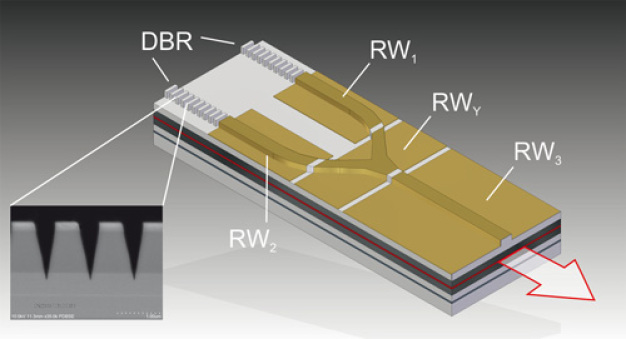
The FBH introduces a novel diode laser for SERDS (Shifted Excitation Raman Difference Spectroscopy). This technology allows for precise analysis of many substances. The special feature of the FBH chip is that it alternately emits light at two different wavelengths. These are defined via separately controllable sections in the laser and grating, which are implemented in the semiconductor chip. This makes it possible to measure the extremely weak Raman signals even in the presence of strong ambient light – such as daylight, room lighting, or fluorescence from samples. When a sample is irradiated at two wavelengths, the Raman lines follow the excitation wavelength, while the sources of interference do not change spectrally. In this way, Raman signals can be distinguished from ambient noise. The detection limit can thus be improved by more than an order of magnitude compared to conventional Raman spectroscopy.
A potential application of the two-wavelength diode laser is miniaturized, portable laser measurement systems for Raman spectroscopy. They are suitable for examining biological samples such as meat, fruits, or leaves and can also be used for medical diagnostics of skin.
Compact and robust diode laser modules for quantum sensors in space
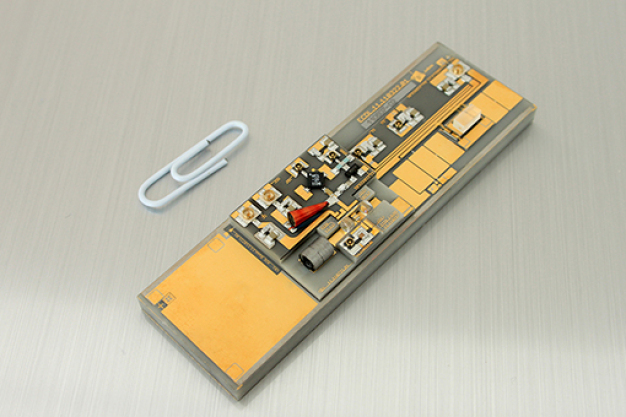
Quantum sensors based on cold atoms are gaining importance for various applications, such as precise time measurement, navigation, or fundamental physics questions. To operate such quantum sensors, a complete optical laboratory is currently required – until now, there were no suitable devices for outdoor or space applications. For several years, the FBH has been working on hybrid-integrated, highly robust diode laser modules, whose form factor of about 50 x 25 x 15 mm3 is approximately 100 times smaller than that of conventional laser systems. The modules integrate semiconductor laser chips and microlenses. They meet high requirements regarding spectral stability and purity – the linewidth for optical atomic clocks must be reduced to below 1 Hz. For example, the FBH has developed laser modules for Bose-Einstein condensation and atom interferometry with output powers of 1 W. They have successfully passed mechanical stress tests up to 20 g RMS and acceleration tests up to 50 g.
Ferdinand-Braun-Institut gGmbH
12489 Berlin
Germany