


- Translated with AI
Physicists observe individual atomic collisions during diffusion for the first time

Dr. Michael Hohmann, first author of the study (Photo: private)
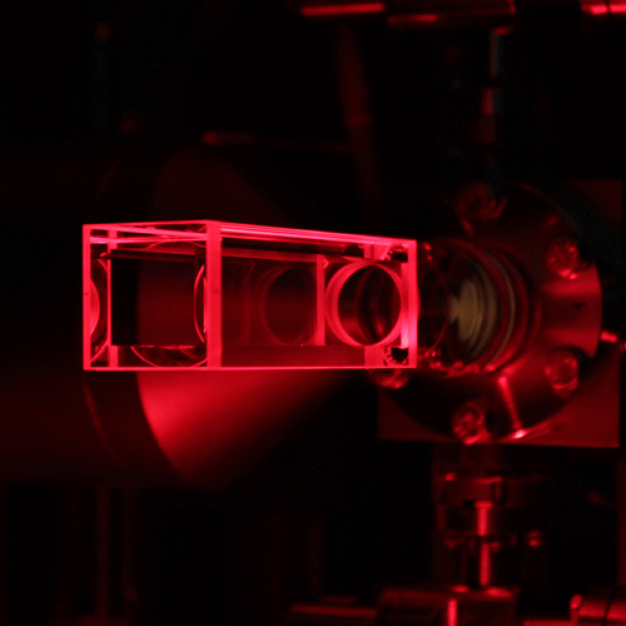
The picture shows a vacuum cell used by physicists to conduct their experiments. (Photo: AG Widera)
Research understands diffusion as a process in which tiny particles spread evenly in a gas or liquid. Although these media consist of individual particles, diffusion is perceived as a continuous process. Effects of a single collision between particles, the fundamental building block of diffusion, have not been observed so far. For the first time, physicists from Kaiserslautern and Erlangen have been able to observe and theoretically describe the fundamental steps of the diffusion of individual atoms in a gas. The study was published in the renowned journal Physical Review Letters.
Almost 200 years ago, Scottish doctor and researcher Robert Brown observed the jittery movement of pollen in a liquid. Similar to pollen, tiny particles, such as molecules or atoms, distribute themselves in gases and liquids. During this process, the individual particles collide, resulting in a pattern of zigzag movements and mixing of different substances. These jittery movements are known in science as "Brownian motion," while the spreading and mixing of different substances are called diffusion.
"Diffusion is of great importance in many areas and underlies many transport processes, for example in living cells or energy storage," says Professor Dr. Artur Widera, who researches quantum physics of individual atoms and ultra-cold quantum gases at the Technical University (TU) Kaiserslautern. "An understanding of diffusion processes is therefore important in almost all fields, from life sciences and natural sciences to technological development."
An easy understanding of diffusion in science is achieved when the individual collisions of particles are neglected. "In this context, we also speak of a continuous medium into which a larger particle diffuses, for example," explains Dr. Michael Hohmann, the first author of the study and research associate at Professor Widera. An everyday example is fog. It can be regarded as such a medium, although it consists of tiny individual water droplets.
For their experiment, the physicists around Widera altered the conditions that prevail in a continuous medium: "We used individual atoms instead of large particles, such as pollen, which have almost the same mass as the atoms of the gas. Additionally, we used a very cold, thin gas to drastically reduce the collision frequency," explains Hohmann. For the first time, the researchers from Kaiserslautern observed how cesium atoms diffuse in a gas made of rubidium atoms at nearly absolute zero temperature. "At these temperatures, refrigerators no longer work. We cooled and trapped the atoms in a vacuum apparatus using laser beams. This slowed down the diffusion to such an extent that individual steps of the diffusion could be observed," explains Professor Widera about the experimental setup.
In their theoretical description of the experiment, the Kaiserslautern researchers were supported by their colleague, theoretical physics professor Dr. Eric Lutz from Friedrich-Alexander University Erlangen-Nuremberg (FAU), who helped develop the mathematical modeling. "With this new model, we can now better describe the movement of the atoms," says the Erlangen researcher.
Together, they demonstrated that it is sufficient to change the friction factor in the theoretical calculation of the continuous model. This way, cases can also be described where, as in the above-mentioned experiment, it is not a continuous medium. This applies, for example, to thin layers of air in the upper atmosphere, interstellar space, or vacuum technology, where aerosols—a mixture of suspended particles—spread.
The researchers' findings could be of interest, for example, to better understand the spread of aerosols in the atmosphere or gases in vacuum systems.
The editors of the journal Physical Review Letters regard the study as a particularly interesting and worthwhile work and publish it as an Editor's Suggestion: "Individual tracer atoms in an ultracold dilute gas." DOI: https://doi.org/10.1103/PhysRevLett.118.263401
In addition to the publication, there is an English-language focus article in the online journal "Physics": https://physics.aps.org/articles/v10/76
Technische Universität Kaiserslautern
67663 Kaiserslautern
Germany