




- Translated with AI
Pfeiffer Vacuum Technology AG awards the Doctoral Prize together with GSI Helmholtzzentrum für Schwerionenforschung GmbH
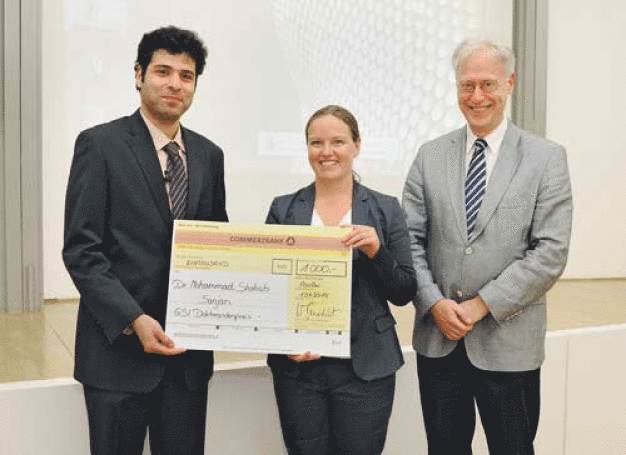
Dr. Mohammad Shahab Sanjari receives the doctoral award from Pfeiffer Vacuum Board Member Nathalie Benedikt and GSI Research Director Professor Karlheinz Langanke.
- Award for doctoral thesis on particle detection in storage rings
- Dr. Mohammad Shahab Sanjari develops new detector system for GSI and FAIR storage rings
- Vacuum indispensable for scientific investigations
Pfeiffer Vacuum Technology AG awarded a doctoral prize for the first time in collaboration with GSI Helmholtzzentrum für Schwerionenforschung GmbH. The recipient is Dr. Mohammad Shahab Sanjari, who received the award for his doctoral research on particle detection in storage rings. The €1,000 prize was presented by Nathalie Benedikt, Board Member of Pfeiffer Vacuum Technology AG, and GSI Research Director Professor Karlheinz Langanke during the GSI colloquium on July 1, 2014. Pfeiffer Vacuum is the founder of the prize, which will be awarded annually from now on.
For his doctoral thesis "Resonant pickups for non-destructive single-particle detection in heavy ion storage rings and first experiments," Dr. Sanjari developed a novel, non-destructive detector system for experiments with stored ions at Goethe University in Frankfurt and successfully implemented it in initial experiments at the GSI storage ring ESR. The new system is characterized by extremely high sensitivity, allowing the measurement of the revolution frequencies of individual ions and the investigation of dynamic processes. Due to its excellent detection sensitivity, the detector has already been implemented as a standard diagnostic element in ESR. Its use in the storage rings of the upcoming FAIR accelerator facility is also planned.
Pfeiffer Vacuum and GSI have a long-standing partnership. Pfeiffer Vacuum's vacuum solutions have been successfully used at GSI for decades. Nathalie Benedikt congratulated the awardee: "It is very important for Pfeiffer Vacuum to promote cutting-edge research and especially young scientists." The GSI doctoral prize was awarded for the first time this year for the best doctoral thesis of 2013 in a field of research and technological development for the future FAIR accelerator facility, which is currently being constructed in international collaboration and connected to the existing GSI accelerators. "FAIR already attracts young scientists from around the world," said Professor Langanke. "With their innovative research at HGS-HIRe, they make important contributions to the development of the new accelerator and detectors."
Eligible to participate were students who completed their doctorate in 2013 and were supported by GSI within the framework of strategic partnerships with the universities in Darmstadt, Frankfurt, Gießen, Heidelberg, Jena, and Mainz, or through the R&D program. Currently, over 350 doctoral candidates are working on their dissertations within the Helmholtz Graduate School for Hadron and Ion Research (HGS-HIRe) at GSI and FAIR.
Pfeiffer Vacuum+Fab Solutions
35614 Asslar
Germany



