


- R+D & Community of Interest
- Translated with AI
Personnel lock systems for cleanrooms: smaller is often more expensive
Cleanzone in Frankfurt focuses on the economic factors of cleanrooms
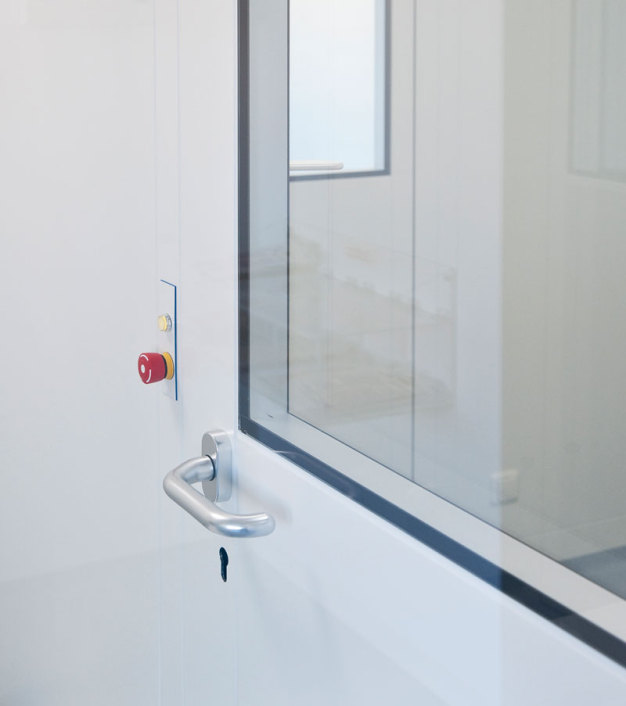
Personnel airlocks for cleanrooms: smaller is often more expensive
The pass-through system represents primarily an unwelcome cost factor for many cleanroom operators: because while the cleanroom provides economically measurable benefits, the controlled access mainly requires space and maintenance without being visibly productive. The solution to keep personnel doors as small as possible can, however, become costly for companies in the medium term. Florian Dittel, CTO of Dittel Engineering, demonstrates this in a scientific presentation. He will present the results and application areas at the Cleanzone Congress on October 24 and 25, 2012, in Frankfurt.
In his diploma thesis, awarded the Albert Tichelmann Prize by VDI, Dittel developed a formula to calculate the economically optimal size of personnel doors for cleanrooms. "The idea is obvious to minimize the basic area of airlocks for cost reasons as much as possible. To truly keep the annual expenses of a personnel door—whether operational or investment costs—low, it is necessary to identify, evaluate, and incorporate all influencing factors early in the planning stage," explains the expert.
Adjustable Parameter: Size
Although personnel doors are indispensable for the operation of cleanrooms and represent a significant cost factor, there has so far been no computational model for their efficient design, construction, and operation. Dittel now shows that the total costs of a personnel door can not only be mathematically represented but also that its size, which has a decisive influence on the optimal and most cost-effective operation, can be precisely calculated. The calculation of costs related to planning, construction, and operation generally includes the following points:
Investment costs
- General building rental costs
- Investment costs of individual trades
Operating costs
- Personnel-related costs
- Cleaning costs
- Maintenance costs
- Operating costs of the HVAC system (ventilation and air conditioning system)
Specific cost-relevant influencing factors of personnel doors
- Industry sector
- Cleanliness class
- Amount of supply air
- Consumables
- Number of persons
- Changing duration
- Size and basic area of the door
These factors influence the operation of the personnel door to varying degrees.
Main Factor: Personnel
The most significant cost component of any personnel door is the personnel itself. Regardless of the size and type of the door, this item primarily determines the annual operating costs. It is therefore particularly important for the design of a door. The costs arise from the duration of changing clothes and the associated waiting times. Factors such as the number of people also depend on the amount of cleanroom clothing and consumables, as well as the cleaning of the door.
Concrete examples illustrate how staffing levels and door size correlate: For example, in a Dittel-calculated operation with 130 users of a Class 8 cleanroom according to EN DIN ISO 14644-1, the ideal basic area of the airlock is between 95 and 170 sqm. Since the company operates in two shifts, there are idle times during changing, which, as mentioned above, lead to increased personnel costs. When these are included in the calculation of the door size, the most cost-effective operation is at 125 sqm. The reason: a larger door allows more people to change simultaneously. This speeds up shift changes, reduces waiting times in front of the door, minimizes delays in the production process, offers higher comfort for employees, and provides flexibility for changes or growth within the company.
That saving at any cost can be expensive is also shown by "soft factors" such as training and convenience. Particulates and microbiological contamination are invisible to humans. Employees often underestimate the contamination risk caused by incorrect behavior when entering or leaving the cleanroom. Training and a certain leniency regarding clothing and room size can reduce costs in the long run: "If instructions and comfort are compromised, a company risks its employees misusing the personnel door or using it more often than necessary, e.g., for short breaks, thereby increasing the contamination risk," says Dittel.
Knowledge Hub: Cleanzone
He will present these and other business-related aspects, as well as his formula for practical application, at his lecture during the Cleanzone Congress in Frankfurt am Main. On October 24 and 25, 2012, this knowledge hub will provide an overview of all essential topics from planning, construction, and operation of cleanrooms to technological developments and future prospects in cleanroom technology. The high-quality congress takes place parallel to the Cleanzone trade fair, the new international trade fair for cleanroom technology. It features manufacturers from the fields of consumables, cleanroom technology, equipment and construction components, as well as universities and colleges.
Background: Airlocks in Cleanroom Technology
The atmosphere and air quality required in cleanrooms are constantly challenged by humans as the largest particle carriers. Lock systems combined with ventilation technology are therefore among the most important elements in cleanroom technology. Only the airlock enables reliable control of contamination in clean environments. Lock systems are used
- to allow entry into a higher cleanliness class without affecting the ongoing process;
- for the entry and exit of persons and objects;
- for storing and providing cleanroom clothing;
- to prevent the ingress of particulate and microbiological contamination.
The operating principles in cleanroom technology differ in laminar flow (laminar displacement airflow), turbulent displacement airflow, and directed airflow. They are used depending on the purpose and cleanliness class. Additionally, three different concepts are employed to separate clean areas from less clean areas within the cleanroom: In the displacement concept, directed airflows ensure a clear separation of clean and unclean zones; in the differential pressure concept, controlling the air pressure prevents mixing of the areas; and in the barrier concept, impermeable barriers such as walls are used.
Regardless of the chosen operating principle, the personnel door always serves as a buffer zone between two areas of different cleanliness classes and pressure levels—such as between the cleanroom and the outside area or between Class B and C. Typically, filtered air is blown into the "clean side" through so-called HEPA filters and sucked out at ground level on the "unclean side." This prevents unwanted contamination from outside from entering the cleanroom.

Cleanzone
Messe Frankfurt Exhibition GmbH
Ludwig-Erhard-Anlage 1
60327 Frankfurt am Main
Germany
Phone: +49 69 75756290
Fax: +49 69 757596290
email: anja.diete@messefrankfurt.com
Internet: https://cleanzone.messefrankfurt.com