



- Translated with AI
Personalized medicines using 3D printing
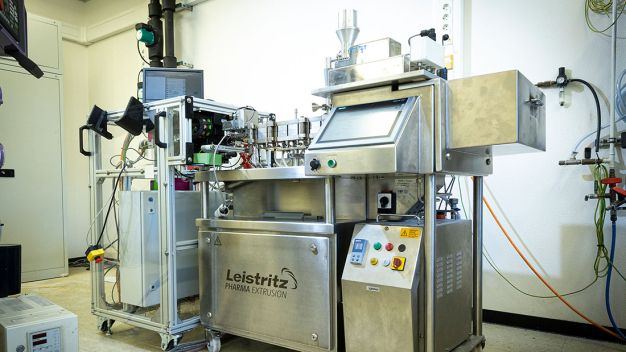
The system developed in the HME 3D project, consisting of the print bed (left) and the extruder (right). (Image: Heike Fischer / TH Cologne)
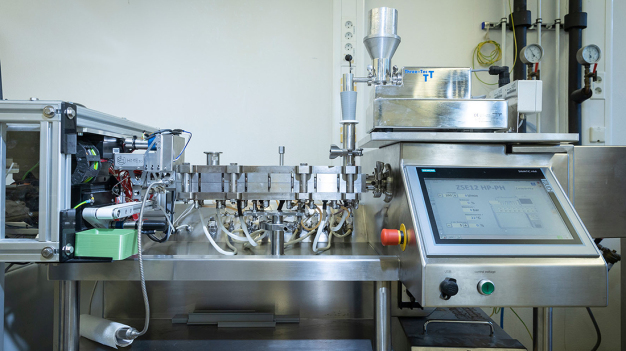
The melting extruder melts and mixes polymers and medicinal active ingredients. (Image: Heike Fischer / TH Cologne
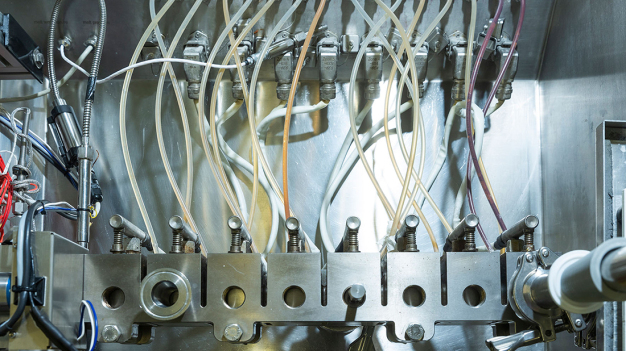
Extruder barrel with doser (right) and HME printing system (left). (Image: Heike Fischer / TH Cologne)
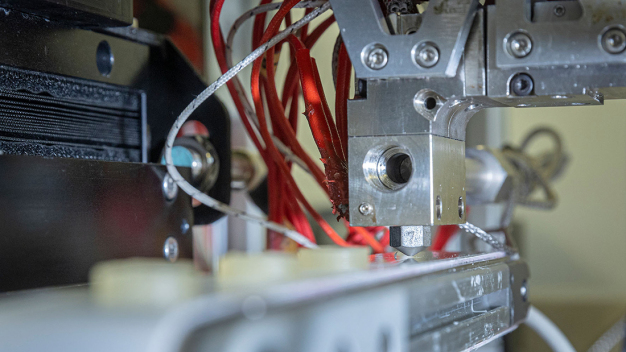
The print head can produce up to 160 tablets per hour, with the capability to print not only polymers but also lipids. (Image: Heike Fischer / TH Cologne)
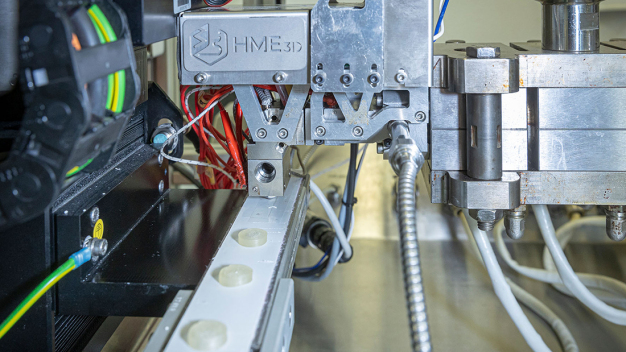
In addition to polymers, lipids can also be printed. (Image: Heike Fischer / TH Cologne)
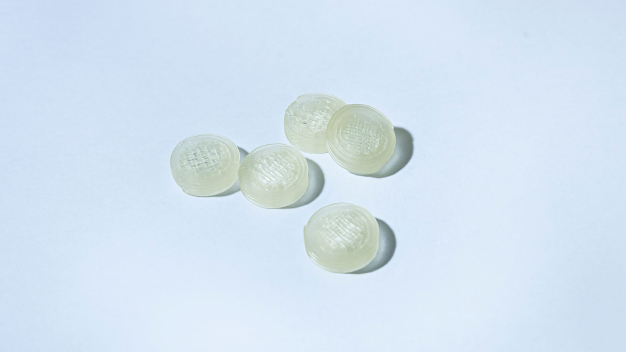
Tablets produced in the project. (Image: Heike Fischer/TH Cologne)
3D-printed medications can be tailored very precisely to the specific disease profile, improving effectiveness and reducing side effects. To make the technology more practical, TH Cologne and Heinrich Heine University Düsseldorf developed a new printing process in the HME 3D project. This allows more active ingredients and carrier materials to be printed.
The most commonly used 3D printing technology involves melting plastic and forming it into long filaments, known as filaments. The 3D printer melts these again and shapes the final product from them. "When pharmaceutical polymers are used in such a process and heated twice, it damages the active pharmaceutical ingredients contained within. Additionally, filaments made from pharmaceutical polymers are often too soft or brittle and cannot be reliably printed. Therefore, we developed a process in which the plastic is directly printed without first producing a filament," explains Ines Haase from the Institute for Product Development and Construction Technology at TH Cologne.
"Our application area is primarily pediatrics. Due to the rapid growth of infants and children, medication doses would need to be adjusted in very small steps. This is not currently reflected on the market. When the treating doctors calculate the required dose, we could print the medication exactly on prescription," adds Prof. Dr. Julian Quodbach, who led the project at the Institute for Pharmaceutical Technology and Biopharmacy at Heinrich Heine University Düsseldorf (HHU) and is now a professor at Utrecht University. The method can also be used in precision medicine, which doses drugs precisely for individual patients. Batch sizes between one and several thousand tablets are possible.
New Printing Process
A team from the Manufacturing Systems Laboratory at TH Cologne is developing a novel printing process for this purpose. The starting point is a melt extruder that melts and mixes polymers and active ingredients. This material is transported to the print head and formed into tablets. "Melt extrusion is a continuous process – the same amount of material always comes out of the machine. In contrast, 3D printing is a discontinuous process, because after each tablet, the printing must be interrupted," explains Haase. To solve this problem, the team added a buffer storage that fills with excess material during the process.
Another challenge: melt extrusion occurs horizontally, but printing is done vertically. Therefore, the molten mass must be redirected. "The pharmaceutical materials used are very sensitive. We had to ensure that the rerouting does not negatively affect the quality of the melt. Still, the technology used must be kept simple, as it must be easy to dismantle and clean after each extrusion process according to 'Good Manufacturing Practice' standards for pharmaceutical production," says Haase. Over the course of the project, a prototype was developed and tested at HHU.
New Materials
The HHU pharmacists had also been working on developing the materials to be printed. "The new technology has enabled us to consider a much broader range of carrier materials and active ingredients. Because the gentler handling of the material allows for the processing of more sensitive active substances. Additionally, it is possible to use lipids, i.e., fats, as carrier materials. This significantly expands the field of possible active ingredients, as many interesting drug candidates cannot be processed in polymers," explains Arne Schulzen, a doctoral student at the Institute for Pharmaceutical Technology and Biopharmacy at HHU.
To produce polymers and lipids with the required properties, the HHU team conducted extensive development and testing. "The requirements for these substances are very extensive: on one hand, the active pharmaceutical ingredients must be well distributed within them. On the other hand, they must function well during the printing process to ensure uniform feeding. Parameters such as the temperature in the extruder must be carefully controlled," says Quodbach. In a subsequent step, the printing of waxes can also be tested to expand manufacturing possibilities further.
The project "HME 3D – 3D Printing of Pharmaceutical Dosage Forms via Melt Extrusion" was funded through the "Industrial Collective Research" (IGF) program of the Federal Ministry for Economic Affairs and Climate Action. The program supports basic research with a focus on industrial or commercial applications, among other areas.
TH Köln
50678 Köln
Germany