


- Translated with AI
On the trail of iron-sulfur compounds
From electron transport to enzymatic reactions
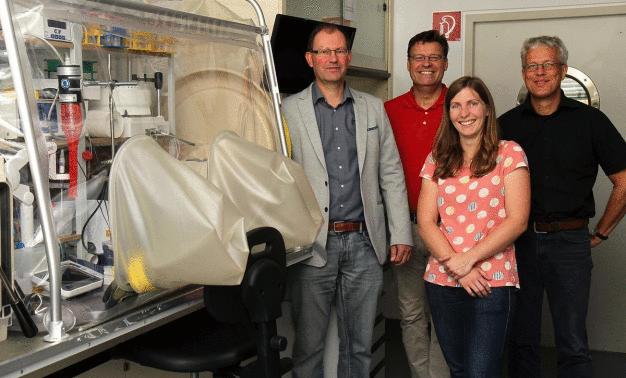
Professor Dr. Antonio Pierik (l. to r.), Professor Dr. Volker Schünemann, Doctoral Candidate Christina Müller, and Professor Dr. Michael Schroda work together in the Priority Program. (Photo: Koziel/TUK)
Red blood cells can transport oxygen thanks to their iron atoms. The metal is also used in other parts of our cells, such as in various iron-sulfur compounds. These are important in enzymes and in the transport of electrons within cells. At the Technical University of Kaiserslautern (TUK), three research teams are studying their synthesis and role in metabolism. The work is part of the Priority Program (SPP) 1927 "Iron-Sulfur for Life" of the German Research Foundation (DFG). The findings could be interesting for biotechnology, for developing new forms of energy production or for producing active substances.
Whether in respiration, photosynthesis, or other metabolic pathways – iron-sulfur centers play a central role in many essential processes. "These centers are often embedded in a large protein complex," says Professor Dr. Antonio Pierik, who researches in the Department of Biochemistry at TUK. They appeared early in evolution and are found in bacteria, fungi, plants, and animals. In enzymes, they are important for enabling catalytic processes such as the splitting of sugar molecules. They are also essential for the cell's energy production, as they facilitate electron transport, thereby storing energy in the form of molecules.
Within the framework of SPP 1927, the Kaiserslautern research groups are examining the exact structure of these centers and how they are incorporated into proteins. "There are many different iron-sulfur compounds," says Pierik. "Among other things, we want to understand how they are synthesized in the cell."
Special techniques are used in their research: The researchers utilize the magnetic properties of iron. The team led by Pierik uses the so-called Electron Spin Resonance Spectroscopy. In this method, microwave radiation is directed at the sample being studied, which is also in a magnetic field, causing the iron electrons to become excited. Similar to a fingerprint, the researchers obtain characteristic spectra for each iron-sulfur center during the measurement.
Professor Schünemann and his working group from the Department of Biophysics and Medical Physics use Mössbauer spectroscopy. "This is an analytical method that exploits the absorption of high-energy X-ray radiation by the iron nucleus," explains Schünemann. Using both techniques, the teams gain a detailed picture of the composition of the metal centers.
These results are complemented by the work of Professor Schroda and his group from the Department of Molecular Biotechnology and Systems Biology. Here, mass spectrometry is used. This method identifies and quantifies protein molecules based on their mass. Essentially, they are weighed. "Similar to a fingerprint, each molecule has a characteristic value," says Professor Schroda.
Taken together, the three research groups obtain a detailed picture of the iron-sulfur compounds and the protein complexes in which they are embedded. Not only for fundamental research but also for biotechnology, these insights are interesting, for example, for the synthesis of medicinal active substances or for new forms of energy production.
The SPP is led and coordinated by Professor Dr. Silke Leimkühler at the University of Potsdam. The goal is to understand the precise role of the metals and how they influence the activity of proteins. The program is now in its second funding period. In the first phase, Professors Pierik and Schünemann participated. They received around 478,000 euros from the DFG for this work. Now, Professor Schroda is also involved in the project. Together, the three groups receive around 781,000 euros, so that the research at TU Kaiserslautern within the framework of SPP has been funded or is being funded with a total of approximately 1.26 million euros.
Questions answered:
Prof. Dr. Antonio Pierik
Department of Biochemistry
Tel.: 0631 205-3421
Email: pierik(at)chemie.uni-kl.de
Prof. Dr. Volker Schünemann
Department of Biophysics and Medical Physics
Tel.: 0631 205-4920
Email: schuene(at)physik.uni-kl.de
Prof. Dr. Michael Schroda
Department of Molecular Biotechnology and Systems Biology
Tel.: 0631 205-2697
Email: schroda(at)bio.uni-kl.de
Technische Universität Kaiserslautern
67663 Kaiserslautern
Germany