




- Clothing & Packaging / Films
- Translated with AI
Klaus Eckardt
Of 15-ton monsters and slow employees
Marcus Weinacker embarks on a "journey through the microcosm of the cleanroom" at CWS-boco
Two employees of CWS-boco Cleanrooms putting on cleanroom clothing.
"The greatest risk of contamination still comes from humans," says Marcus Weinacker from "MZQ Managementberatung," who accompanied CWS-boco Germany in the implementation of the cleanroom laundry in Heidenheim. Therefore, a central task in this project was also to keep the entry of microorganisms into the cleanroom by employees as low as possible. The expert illustrated how many cells a person loses over their lifetime with an impressive figure: if skin flakes, hair, etc., did not fall off but remained on the body, a person would develop into a 15-ton monster over their lifetime.
On his "journey through the microcosm of the cleanroom" on the occasion of the opening of the cleanroom laundry, Weinacker pointed out that microorganisms had about 3.5 billion years to develop their survival strategies and could also survive for thousands of years without heat, oxygen, and water. These creatures must now be kept away from the cleanroom.
In Heidenheim, employees must pass through a three-chamber airlock before reaching their workstation, which complies with ISO Class 4 standards. A slight overpressure in the airlock also prevents insects from entering. Media such as air and water introduced into the cleanroom must contain hardly any germs. Regarding water, CWS-boco in Heidenheim uses reverse osmosis and pipes the water through disinfectable stainless steel pipes. A particular challenge was managing the moisture released when opening the washing machine. "But we have mastered that," assured Weinacker. The highly filtered air used for drying the laundry also meets cleanroom criteria.
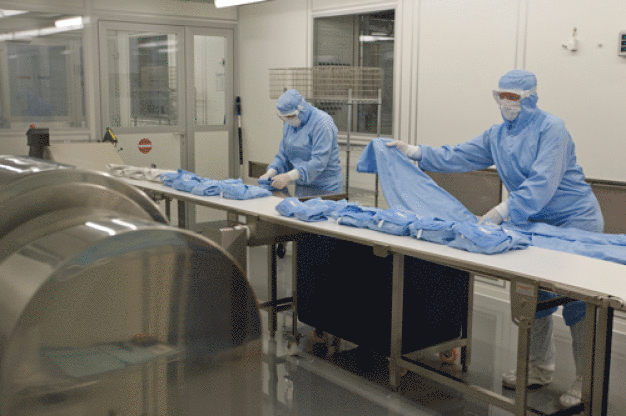
It was noticeable to some visitors at the opening celebration that the employees in the cleanroom, whose work they could observe through glass panels, worked quite slowly when removing laundry from the machine and folding it. "The staff really have to train for that," explained Weinacker. Because moving too quickly could create turbulence in the air, which might lead to the swirling of particles.

CWS Cleanrooms Deutschland GmbH & Co.KG
Dreieich Plaza 1 A
63303 Dreieich
Germany
Phone: +49 6103 3091290
Fax: +49 6103 309169
email: cleanrooms.de@cws.com
Internet: http://www.cws.com/reinraum



