




- Translated with AI
News from Earth's history: How oxygen-producing cyanobacteria enabled our life
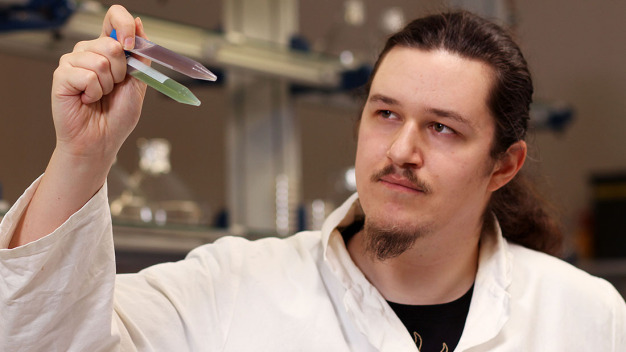
Achim Herrmann researches the spread of early cyanobacteria. (Photo: Koziel/TUK)
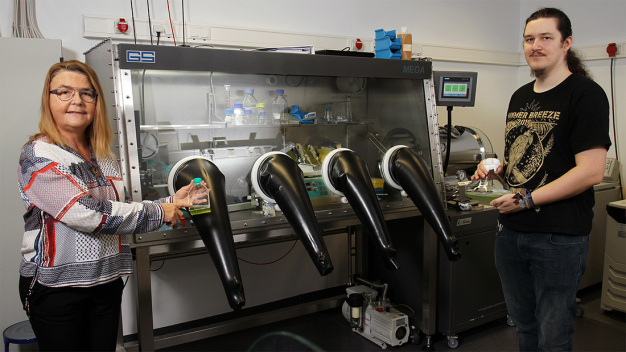
Achim Herrmann is completing his doctorate under Michelle Gehringer in the field of Geomicrobiology. (Photo: Koziel/TUK)
2.43 billion years ago, the "Great Oxygenation Event" (GOE) began: Earth's atmosphere gradually became enriched with oxygen, a byproduct of photosynthesis. The trigger was, according to science, photosynthetic cyanobacteria. But why did this crucial change happen so late? Evidence from rock samples shows that cyanobacterial life existed at least 300 million years before the GOE. Achim Herrmann, who researched the spread of early cyanobacteria in his doctoral thesis at TU Kaiserslautern, is on the trail of answers. His current research paper has now been published in the journal Nature Communications.
"There are many scientific theories that interconnect and explain why the spread of cyanobacteria necessary for the GOE or the oxygen catastrophe was delayed," explains Herrmann, who completed his doctorate under Michelle Gehringer in the Department of Geomicrobiology. "For example, that they could have originated in freshwater, which at that time, as today, only covered a fraction of Earth's surface. Only when they adapted to saltier waters and finally became native to the open ocean could they produce enough biomass to cause a global change in Earth's atmosphere." Another theory suggests that iron-rich seawater may have initially been toxic to photosynthetic bacteria. During the anoxic "Archean" era, iron had predominantly accumulated in the ocean in the form of highly soluble, reduced iron(II) ions.
Herrmann's research builds on the iron toxicity hypothesis. "We wanted to verify whether iron(II) not only inhibits modern but also more primitive marine strains, specifically Pseudanabaena sp. PCC7367 and Synechococcus sp. PCC7336, in their growth and photosynthetic capacity," explains the biologist.
It quickly became clear how crucial the experimental setup is. In the already established system – where bacteria are cultivated in closed glass bottles – they generally developed poorly: "The biological activity was very low in both strains, with Synechococcus almost completely suppressed," says the biologist. The solution: "A specially manufactured anaerobic workstation from the TUK metal workshop, in which the atmospheric composition can be fully automatically regulated in its chambers," says the biologist. "In this, we cultivated the cyanobacteria in large laboratory bottles with gas-permeable caps to enable gas exchange. The oxygen produced by them was regularly removed from the system, and carbon dioxide was maintained at a low, constant concentration. This allowed us to realize a shallow marine oxygen oasis, as implied by rock samples from the Archean."
As expected, it showed that the cyanobacteria "felt more comfortable" in the more realistic environment. But what happened with a single addition of iron at increasing concentrations? The bacteria from the Pseudanabaena strain grew well overall – but more slowly than in the parallel control system. In contrast, bacteria from the Synechococcus strain clearly showed that with increasing iron levels, the rate of cell division decreased. Another finding: The oxygen produced mainly oxidized the dissolved Fe(II) ions rather than escaping into the atmosphere. And the oxygen production capacity of the strains reached significantly higher values in the anoxic experimental environment than in a control setup with an oxygen-rich atmosphere, as we have today.
Additionally, only in this system was the formation of so-called "green rust" observed, a mixture of Fe(II) and already Fe(III) oxidized iron. The formation of green rust was accompanied by a strong decrease in biological activity, presumably caused by the "clogging" of cells with iron oxides. During the Archean, the formation of such green rust could have contributed significantly to the formation of banded iron ore, which is today the most important source of raw iron ore.
Finally, Herrmann changed the experimental scenario again and adjusted the addition of iron to a simulated tidal cycle. The addition was initially made regularly at the beginning of the night, when the oxygen concentration in the medium dropped to near zero without photosynthetic activity. Subsequently, growth slowed significantly in both strains but never completely stopped. This showed that an oxygen oasis of the Archean could also have tolerated the influx of iron-rich water during the night. Here too, green rust formed, but it could be quickly further oxidized, preventing complete growth cessation.
Overall, Herrmann's research work has filled additional gaps in the puzzle of Earth's history. He was able to demonstrate for both cyanobacterial strains how the iron cycle might have proceeded in an archaic oxygen oasis and also that, due to higher oxygen production, less surface area would have been necessary for the start of the GOE. Furthermore, he developed a concept for cultivating cyanobacteria that better reflects the conditions during the Archean.
"I hope that my research paper can contribute to a better understanding of how our oxygen-rich atmosphere could have developed," concludes the biologist.
Information about the published research paper:
Herrmann A.J., Sorwat J., Byrne J.M., Frankenberg-Dinkel, N. and Gehringer M.M.
"Diurnal Fe(II)/Fe(III) cycling and enhanced O2 production in a simulated Archean marine oxygen oasis"
https://www.nature.com/articles/s41467-021-22258-1
DOI: 10.1038/s41467-021-22258-1
Questions answered by:
Achim Herrmann
Email: a_herrma@rhrk.uni-kl.de
Phone: (0)631 205-2199
Technische Universität Kaiserslautern
67663 Kaiserslautern
Germany