


- Translated with AI
Melanie Löw
New technology makes micro 3D printers more precise
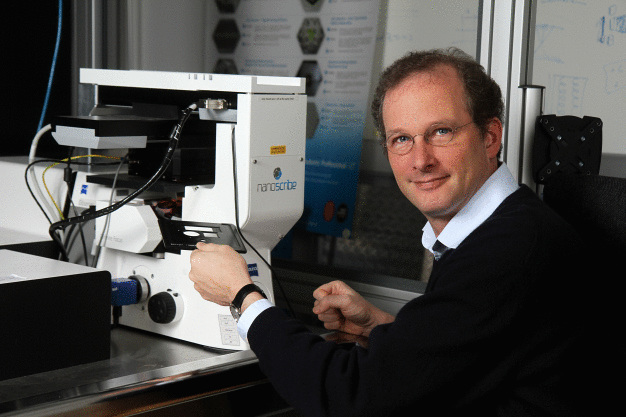
Professor Dr. Georg von Freymann (Photo: TUK/Thomas Koziel)
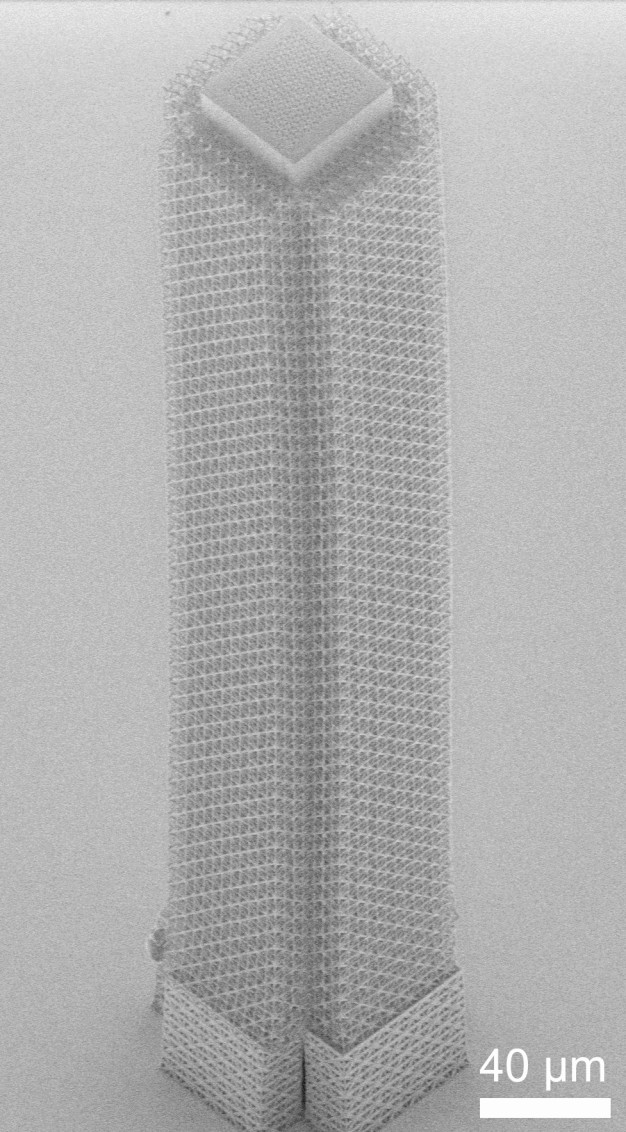
A photonic quantum simulator is visible. The actual structure is located inside the block and is not visible even under this magnification. (Photo: Freymann research group)
The market for 3D printers is growing: they allow products to be produced quickly and easily. But they are not only used in the visible world for us, but also in the nano- and microcosm. This is made possible by special micro-3D printers. Physicists at the Technical University of Kaiserslautern (TUK) are working with this technology. They have now expanded the functions of the laser system used here so that they can produce much more complex structures. The technology helps, for example, in producing new microstructures for the surfaces of components to reduce friction, but also to better explore fundamental principles in quantum physics.
The printed objects that physicists around Professor Dr. Georg von Freymann are working on at the Kaiserslautern campus are so tiny that they are not visible to the human eye, at most as grains of corn. They are smaller than the diameter of a hair, and the smallest structural details are in the range of about 100 nanometers. Only the scanning electron microscope makes them and their delicate shapes visible.
Micro-3D printers have been on the market for several years. They use lithographic processes that work similarly to exposure in traditional photographic films. "A laser beam exposes a viscous plastic liquid," explains Georg von Freymann from the Chair of Optical Technologies and Photonics. "The laser intensity is so high that a local chemical reaction occurs, causing the plastic to harden." A computer program specifies the desired 3D shape. After the exposed part hardens, the remaining liquid can be removed.
The physicists from Kaiserslautern have been working with this technology for a long time and are further developing it: they have expanded the functionality of the printers. "We can control the amplitude, phase, and polarization of the laser beam," says the professor. This allows researchers to produce much more complex structures with the printing process.
The technology is used in various fields. In the Collaborative Research Center 926 "Component surfaces: morphology on the microscale," the physicists collaborate, for example, with colleagues from the Department of Mechanical Engineering and Process Engineering. They develop innovative microstructures for the surfaces of components. "This makes it possible, for example, to reduce friction and wear," says the professor. Such methods are also of interest for controlling the accumulation of cells. "Microorganisms tend to settle in the form of biofilms in many areas," von Freymann cites as an example. This can be in hospitals, but also in industrial production facilities. "With specially structured surfaces, this can be prevented. Conversely, it is also possible to deliberately place cells," for example, in research to improve the growth of cell cultures.
The laser printing technology is also important for basic research, for example, to study phenomena in quantum physics precisely. "We can develop models with it, in which we, among other things, move the positions of individual atoms. This is not so easy in real solids," says von Freymann. "We can investigate what happens at the quantum level."
Von Freymann is also involved with the company Nanoscribe, founded in 2007, which manufactures such micro-3D printers. Recently, the company, together with the Institute of Nanotechnology at the Karlsruhe Institute of Technology, received the Technology Transfer Award from the German Physical Society.
Technische Universität Kaiserslautern
67663 Kaiserslautern
Germany