



- Universities
- Translated with AI
New study: Physicists identify energy states of individual atoms after collision
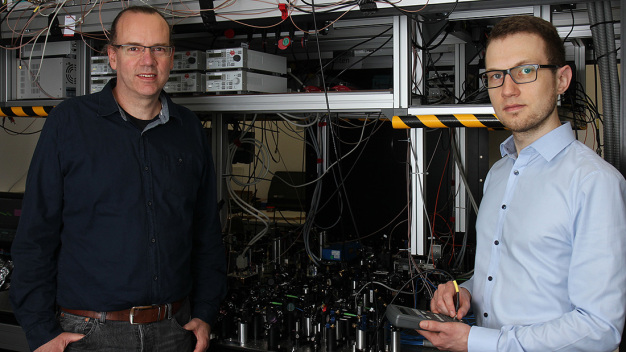
Professor Herwig Ott (left) and Philipp Geppert are researching ultracold quantum gases and quantum atom optics at TU Kaiserslautern. (Photo: Koziel/TUK)
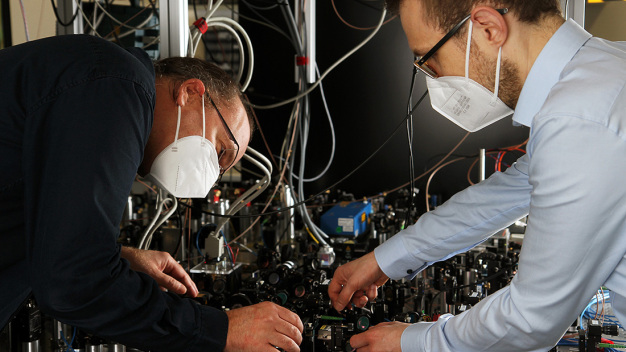
Professor Herwig Ott (left) and Philipp Geppert have developed a special microscope specifically for directly measuring the impulses of atoms. (Photo: Koziel/TUK)
Physicists at the Technical University of Kaiserslautern led by Professor Dr. Herwig Ott have succeeded for the first time in observing collisions between highly excited atoms, known as Rydberg atoms, and atoms in the ground state. The special feature: they can precisely identify the energy states of individual atoms. This was not possible before. To achieve this, the researchers developed a special microscope that directly measures the impulses of the atoms. The observed processes are important for understanding interstellar plasma and ultracold plasmas produced in the laboratory. The study has been published in the renowned journal "Nature Communications".
In their experiment, the physicists used a cloud of rubidium atoms cooled to about 100 microkelvin — that is, 0.0001 degrees above absolute zero. Some of these atoms were then excited to a so-called Rydberg state using lasers. "In this process, the outermost electron is placed on a distant orbit around the atomic core," explains Professor Herwig Ott, who researches ultracold quantum gases and quantum atom optics at TU Kaiserslautern. "The orbital radius of the electron can be more than a micrometer, making the electron cloud larger than a small bacterium." Such highly excited atoms also occur in interstellar space and are chemically extremely reactive.
When a Rydberg atom and an atom in the ground state collide, an inelastic collision occurs. "Here, the atom in the ground state penetrates deeply into the orbit of the Rydberg electron," he continues. The subsequent molecular dynamics of the two atoms are highly complex and lead to their separation, with the electron's orbit changing.
"During this state change, both the principal quantum number and the angular momentum quantum number of the electron can change," says Philipp Geppert, the first author of the study. He further explains: "From the distribution of these final states, we can now gain new insights into atomic collision processes, where both large and small internuclear distances are important."
The Rydberg electron returns in this final state to an orbit closer to the atomic nucleus, releasing energy in the process. This energy is transferred as kinetic energy to both involved atoms, which move apart in opposite directions due to conservation of momentum.
This movement can now be observed with an impulse microscope, which the scientists developed specifically for the experiment. The basic principle is quite simple: the neutral atoms are ionized with a laser pulse and guided to a position-sensitive detector using a weak electric field. The impact point depends on the initial velocity of the atoms and thus provides their momentum. The microscope can resolve even the smallest velocity differences, making it possible to precisely identify the final states of individual atoms.
The findings help to understand fundamental atomic processes in plasma. Plasma is a mixture of various particles such as electrons, ions, atoms, and molecules. In research, plasma plays an important role in studying particle interactions more precisely. Since plasma also occurs in space, laboratory results can be relevant for astrophysics, for example, to better understand the chemical and physical processes occurring in interstellar space.
The work for this study was conducted within the framework of the priority program "Giant Interactions in Rydberg Systems," funded by the German Research Foundation. It was carried out in the OPTIMAS profile area (State Research Center for Optics and Material Sciences), which has been supported since 2008 as part of the state's research initiative.
The results of the measurements and a description of the experimental setup have been published in the renowned journal "Nature Communications": "Diffusive-like redistribution in state-changing collisions between Rydberg atoms and ground state atoms"; Philipp Geppert, Max Althön, Daniel Fichtner & Herwig Ott
https://www.nature.com/articles/s41467-021-24146-0
DOI: https://doi.org/10.1038/s41467-021-24146-0
Questions answered by:
Prof. Dr. Herwig Ott
Department of Ultracold Quantum Gases and Quantum Atom Optics / TU Kaiserslautern
Tel.: 0631 205-2817
Email: ott@physik.uni-kl.de
Technische Universität Kaiserslautern
67663 Kaiserslautern
Germany