


- Translated with AI
New standards for dry cleanrooms: First energy chains certified according to ISO Class 1
New testing environment at Fraunhofer IPA enables igus’s e-skin flat ESD and e-skin soft ESD to be certified to the highest cleanliness level
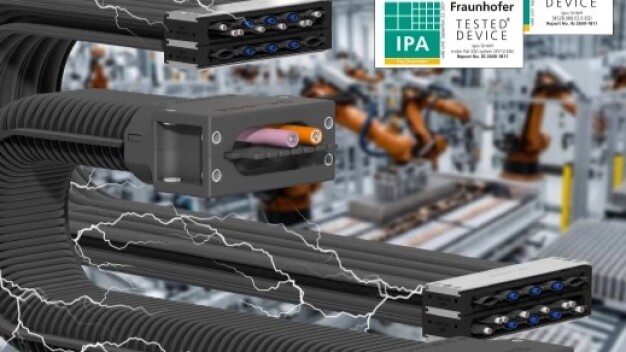
The e-skin flat ESD and e-skin soft ESD energy chains from igus are the first energy chains to be certified by the Fraunhofer IPA under dry cleanroom conditions according to ISO Class 1. (Source: igus SE & Co. KG)
From electric vehicles to solar energy storage: as battery manufacturing evolves, so do the requirements for production environments. For example, cable management systems in production equipment must release virtually no particles while in motion. Another challenge is the extremely dry atmosphere of modern dry cleanrooms. igus has developed the e-skin flat ESD and e-skin soft ESD energy chains specifically for the microelectronics industry. They have now become the first energy chains in the world to receive ISO Class 1 certification from Fraunhofer IPA. This provides planning certainty for future cleanliness requirements in battery manufacturing.
Modern battery production factories face two adversaries: moisture and contamination. Machines and equipment must therefore function in extremely dry environments with relative humidity below one percent. At the same time, they must not release particles that could damage sensitive cell materials. This also poses a challenge for energy chains, which, for example, guide cables and hoses to moving machine parts during cell assembly. In extremely dry conditions, friction behavior changes, which can increase wear and particle emissions. “We developed the e-skin flat ESD and e-skin soft ESD energy chains, among other products, specifically for this demanding scenario. They are made of tribologically optimized high-performance plastic that is particularly resistant to abrasion, meaning that virtually no particles are released even during rapid movements in an extremely dry atmosphere,” says Kira Weller, e-chain Product Manager and cleanroom expert at igus. The evidence is provided by a new certificate from the Fraunhofer Institute for Manufacturing Engineering and Automation IPA, confirming that the e-skin flat ESD and e-skin soft ESD are the first energy chains in the world to achieve the highest cleanliness classification, ISO Class 1, in a dry cleanroom. Kira Weller: “The certificate is an important milestone for us. As battery manufacturing expands worldwide, the requirements for process reliability and cleanliness are continuously increasing. We expect industry and regulators to demand even higher standards in the future. The ISO 1-certified energy chains already provide the security needed for future high-purity production facilities in battery manufacturing.”
Certification made possible by Fraunhofer IPA’s new test facility
igus has been working with Fraunhofer IPA for several years to have its energy chains independently tested and certified. Until now, however, testing technology had placed limits on testing specifically for dry cleanrooms. In the past, certifications under dry cleanroom conditions were only possible up to ISO Class 4. “With our new test facility, we can, for the first time, investigate particle emission behavior under dry cleanroom conditions down to ISO Class 1,” says Dr.-Ing. Frank Bürger, Head of Testing and Certification at Fraunhofer IPA. “The tests provide additional data on the behavior of moving components under dry cleanroom conditions. This expands the testing basis for industrial applications.” By way of illustration: in the new IPA dry cleanroom, at a relative humidity of below one percent, a maximum of ten particles measuring 0.1 micrometers or larger are permitted per cubic meter. For ISO Class 4, the limit is up to 10,000 particles—one thousand times as many. “The tests were conducted as part of the collaboration between igus and Fraunhofer IPA. They demonstrate the potential of applied research in industry when evaluating technologically demanding applications in dry cleanrooms. The results provide additional transparency for users with the highest cleanliness and process reliability requirements,” adds Dr.-Ing. Frank Bürger.
Two designs for a wide range of motion tasks
To cover as many applications as possible in the microelectronics industry, igus has developed various energy chains: the e-skin flat ESD is a flat, modular energy supply system that can be assembled from individual closed cable chambers, depending on the size of the application. The e-skin soft ESD, on the other hand, consists of a flexible, closed corrugated tube. The upper and lower shells can be joined together like a zipper to form a closed tube, preventing particles from the cables from escaping to the outside. The suffix “ESD” stands for “electrostatic discharge.” Thanks to additives in the material, the energy chains are dissipative, allowing electrostatic charges to be discharged through the connecting elements rather than jumping to sensitive components. “The two designs enable us to cover a wide range of motion tasks,” says Kira Weller. “Both systems combine two crucial properties for cleanrooms: minimal particle emissions and ESD safety, even under extremely dry conditions.”
igus SE & Co. KG
51147 Köln
Germany