


- Translated with AI
New S4 Laboratory in Berlin
Equipped with SAUTER systems for the highest security level
New S4 Laboratory in Berlin
The Robert Koch Institute is the central facility in Germany for infection control. Currently, a new laboratory building is being constructed at the Berlin-Wedding site on Seestraße, including a high-security laboratory required for work with certain pathogens such as Ebola or Lassa viruses. Therefore, the facility falls under protection level 4 (S4), which includes detailed specifications for room airtightness and room pressure regulation. For the building management of the newly constructed S4 laboratory complex of the Robert Koch Institute (RKI) in Berlin, a meticulously planned concept had to be developed. To ensure that no contaminated air escapes to the outside, the volume flow and room pressure controllers used must react especially precisely and quickly. The building management expert SAUTER was entrusted with this task. The company has already equipped all other S4 laboratories in Germany with its systems.
Worldwide, there are 34 laboratories of the highest safety level, three of which are in Germany, with a fourth currently under construction. Since August 2011, a facility with around 250 pneumatically/conventionally controlled rooms has been developed on the grounds of the Robert Koch Institute on Seestraße in Berlin. About half of these are S2 laboratories. The laboratory rooms also include airlocks, which serve as corridors according to regulations. These passages operate on the principle of a pressure cascade: this prevents contaminated air from escaping the laboratory into the environment. High safety standards are also implemented within the laboratory rooms themselves through a special pressure stage concept.
13,000 data points clearly managed
For the complex building and room automation, SAUTER's technology is used. In building automation, all HVAC technology is regulated and controlled, while at the room automation level, the systems of the laboratory rooms are managed and monitored. Controllers serve this purpose, integrating all room functions into a single device. These functions include heating and cooling systems, lighting, and blinds. The current room data for temperature, humidity, air quality, occupancy, or lighting level are transmitted via sensors. These are directly connected to the controllers, as are the necessary actuators. The integration of blinds and lighting is carried out via open fieldbus protocols.
The monitoring software visualizes all information clearly and structured. In this way, 100 automation stations record nearly 13,000 data points. The monitoring system allows events and user interventions to be traced back at any time. The open integration of the rooms into the building management system ensures fast, secure, and seamless data transmission.
The automation functions can be easily programmed and customized according to individual requirements. "The customer has a calendar function available, through which they can program different room functions by day, week, or month," explains Matthias Breternitz, project manager at SAUTER. For example, it can be set that the temperature is lowered after 10 p.m. or that all operations are shut down on Saturdays. Day and night modes can also be configured.
Pressure measurement accuracy up to 1 Pa
To prevent the release of contaminated air, supply and exhaust air are regulated via volume flow. A pneumatic controller is used for this purpose, which, in conjunction with a fast pneumatic actuator, maintains the prescribed control speed without issue. With a torque of 10 Nm, the actuator is also suitable for large volume flow boxes. A differential pressure sensor integrated into the room pressure controller achieves measurement accuracy up to 1 Pa even at very small pressure differences, which is crucial for nighttime setbacks with minimal volume flows. If there are disturbances in the exhaust air regulation, this is automatically indicated visually and acoustically. Additionally, another electronic differential pressure transmitter is used for independent monitoring of room pressure. It detects under- or overpressure within the range of up to ±150 Pa. A special software allows the desired measurement range to be individually set and visualized on a display.
Security regulations for S4 laboratories also include the ability to hermetically seal the rooms for disinfection purposes. The entire laboratory is gassed for this purpose. Therefore, it had to be ensured in advance that the system components of the room automation could withstand these cleaning processes without damage. Gas testing was conducted beforehand, which the controllers and stations successfully passed.
In addition to reliable laboratory automation, energy efficiency was also an important consideration before installing the automation system. For the RKI, an ice storage system was installed. This uses nighttime outdoor temperatures for cooling and stores the cold in water for several hours until it is needed for cooling in the laboratory.
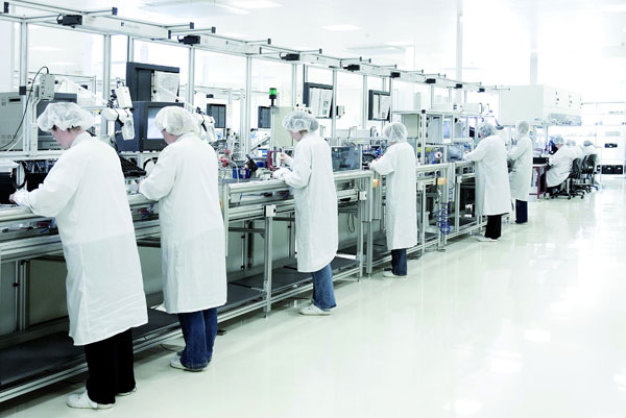
Image: For the building management of the newly constructed S4 laboratory complex of the Robert Koch Institute in Berlin, a meticulously planned concept had to be developed. To ensure that no contaminated room air escapes to the outside, the volume flow and room pressure controllers used must react especially precisely and quickly. Source: SAUTER Germany
Sauter Cumulus GmbH
79108 Freiburg
Germany