- Translated with AI
New research building at TU Chemnitz
Federal and state governments promote research at the Saxony site with 43.6 million euros – construction start planned for 2013
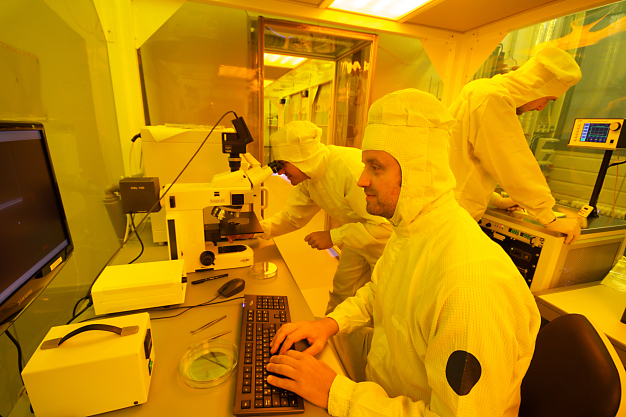
New research building at TU Chemnitz
The Joint Science Conference (GWK) of the Federal Government and the States decided on June 29, 2012, to promote nine research buildings distributed across Germany and proposed by the Science Council. Saxony's Minister of Science, Prof. Dr. Sabine von Schorlemer, is especially pleased that a research initiative from Saxony will also receive support for the funding phase beginning in 2013. With MAIN, a "Center for Materials, Architectures, and Integration of Nanomembranes" at the Technical University of Chemnitz, a promising project can now be implemented. The goal of the center is to develop a new class of nanomembrane materials with broad application potential, including high-performance and ultra-fast flexible electronics, magnetoelectronics, and ultra-compact energy storage. "The research project at TU Chemnitz has a clear objective, is of high scientific quality and relevance, and is also interdisciplinary. These factors convinced us and made approval easy," explained Sabine von Schorlemer about the GWK's decision. Construction is set to begin in 2013.
With the approval for funding and a total of around 43.6 million euros, there is nothing standing in the way of building the new facility and implementing the research plans at TU Chemnitz. The central goal pursued by the scientists with their research project is to connect applied and fundamental research in the field of materials science through a new class of so-called nanomembrane materials. "The topic pursued in MAIN offers TU Chemnitz the chance to build another bridge between basic research and technological implementation," said Sabine von Schorlemer. For Prof. Dr. Arnold van Zyl, Rector of TU Chemnitz, the funding of the new research building also signifies recognition of the long-standing research achievements of the involved scientists. "Just a few days ago, TU Chemnitz received extensive funding in the field of excellence clusters as part of the federal and state excellence initiative. Now, within the current funding period for research buildings, TU Chemnitz has the largest share in comparison to other federal states. This repeated commitment from the federal government and the states underscores the high importance of research at TU Chemnitz in Germany. This allows us to further develop our trademark 'Relevant Excellence'," said Arnold van Zyl.
The transdisciplinary research within MAIN involves the Faculty of Electrical Engineering and Information Technology, including the Center for Microtechnology, as well as the Faculty of Natural Sciences. "MAIN is creating the first interdisciplinary center in Europe for the investigation of inorganic and hybrid nanomembranes," says its spokesperson Prof. Dr. Oliver G. Schmidt, holder of the Chair of Material Systems for Nanoelectronics at TU Chemnitz. "These innovative materials will play a central role in exploring new application fields in flexible and stretchable electronics and will significantly enhance the visibility of TU Chemnitz and Saxony in Germany and beyond," assures Arnold van Zyl, adding: "The mentioned research topics bring together existing excellent activities and simultaneously define a new direction within TU Chemnitz's research focus 'Intelligent Systems and Materials'."
"The new research building will create all the necessary material conditions for the project," said Saxony's Minister of Science. The building will be located on the university campus and will offer space for about 100 scientists on 4,000 square meters. The use by other facilities of TU Chemnitz as well as the expansion of collaborations with external institutes is planned within joint projects.
Additional Information on Funding for Research Buildings at Universities
The possibility of extensive funding for research buildings and large-scale equipment at universities has existed since the introduction of Federalism Reform I in 2007. The purpose of the reform is to further support German universities so they can succeed even more in national and international competition. The funding is equally shared by the federal government and the states, which together provide around 600 million euros annually. In 2013, the full funding amount for research buildings is 426 million euros, and for large-scale equipment, 170 million euros. Buildings at universities with investment costs exceeding five million euros, whose infrastructure is primarily used for research, can be funded. The funding is open in thematic terms.
TU Chemnitz
09111 Chemnitz
Germany