




- Translated with AI
New investments in semiconductor research
New investments in semiconductor research
New investments in semiconductor research – Fraunhofer IISB and the University of Erlangen-Nuremberg expand cleanroom equipment in the laboratory.
At Fraunhofer IISB in Erlangen, a new ion implantation system is currently being commissioned. The nearly 15-tonne and approximately 3 million euro large equipment will be installed in the cleanroom operated jointly with IISB at the University of Erlangen-Nuremberg. This significantly enhances the research and teaching capabilities of both institutions in semiconductor technology for micro-, nano-, and power electronics.
Ion implantation is now the industrial standard process for doping semiconductors. In this process, ions of the desired dopant elements are accelerated in an electric field and shot onto the surface of semiconductor wafers—also called wafers.
Depending on the speed or energy and the dose with which foreign elements are introduced into the semiconductor, different penetration profiles and depths are created within the solid, e.g., in a silicon wafer. Through this and the choice of the dopant itself, the electrical properties of semiconductors can be precisely adjusted. This is an essential prerequisite for the realization of modern semiconductor devices.
Fraunhofer IISB is one of the leading research institutions for ion implantation in Europe and has decades of experience in this field. The new ion implanter replaces an older system and is one of the larger investments in the ongoing modernization of the cleanroom facilities in Erlangen, funded by the Bavarian Ministry of Economic Affairs, the federal government, and the EU. With the new system, research on semiconductor wafers up to 200 mm in diameter will be possible, instead of the previous 150 mm. Additionally, the energy range for accelerating ions will be significantly expanded.
In the future, singly charged ions can be produced with an energy range of 2 to 270 kilo-electronvolts (keV). Especially in the low-energy range, this allows for the creation of very thin implantation layers in semiconductors—important for the continuous miniaturization in device technology. Also new is the use of ions with up to triple charge, enabling implantations with maximum energies of 810 keV.
“The spectrum of materials for the implanted elements includes the standard dopants for silicon wafers, such as boron, phosphorus, and arsenic, but also elements like aluminum and nitrogen for doping silicon carbide, a semiconductor that offers many possibilities especially for high-temperature and power electronics,” explains Dr. Volker Häublein, who is responsible for ion implantation as a group leader at IISB. Additionally, so-called “exotics” for specialized applications outside traditional semiconductor technology, such as cesium, rubidium, or lanthanum, can also be implanted.
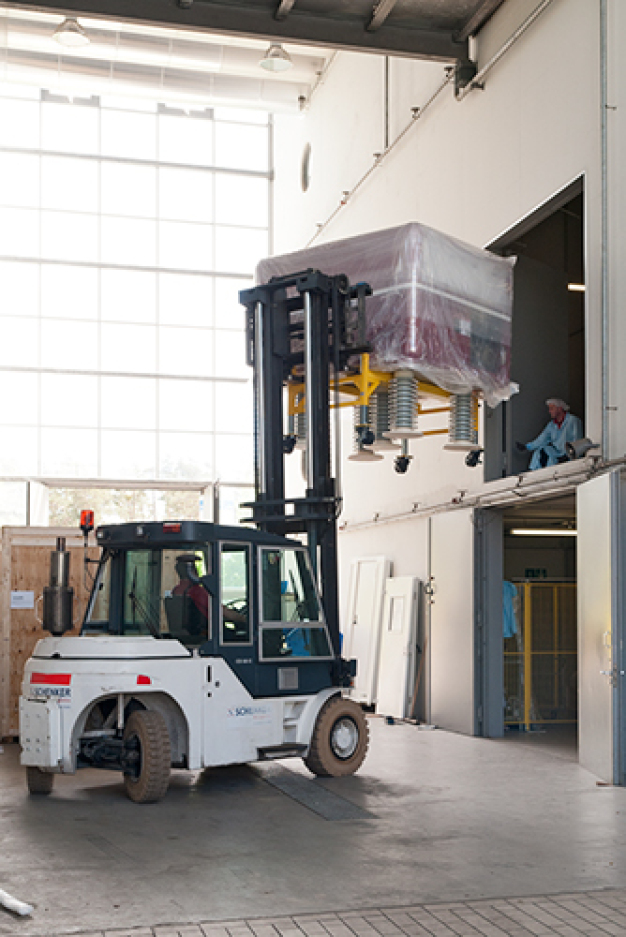
The delivery of the system and its integration into the cleanroom involve significant logistical effort. More than 24 tons of transport weight required the use of three trucks and a heavy-duty forklift. A special construction of steel beams and thick aluminum plates stabilizes the floor of the cleanroom laboratory beneath the heavy equipment. The university, as the host of the cleanroom, which is one of the largest of its kind for research and teaching in Germany and Europe, is involved in the necessary renovation of the laboratory level within the cleanroom building.
“The upgraded cleanroom facilities will further intensify the close, synergistic cooperation between Fraunhofer IISB and the University of Erlangen. Besides expanding research opportunities, the cleanroom will also serve as a highly attractive environment for students in technical disciplines, such as electrical engineering or nanotechnology,” says Prof. Dr. Lothar Frey, director of IISB and holder of the Chair of Electronic Components at the university.
The modernization of Fraunhofer IISB’s cleanroom facilities is funded by the Bavarian State Ministry for Economic Affairs, Infrastructure, Transport and Technology, the Federal Ministry of Education and Research, and the EU.
Image: Delivery of the implantation system at the large cleanroom hall of the University of Erlangen-Nuremberg on May 21, 2012. Fraunhofer IISB



