



- Translated with AI
New endowed professorship for nanophysiology: Tracking cellular order
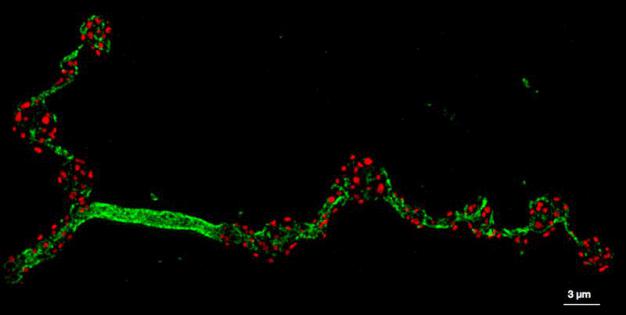
Thanks to state-of-the-art, high-resolution microscopy, it is even possible to visualize the cell skeleton (green) of a fly's nerve cell as well as the contact points (red) with other cells. (Photo: Prof. Jan Pielage)
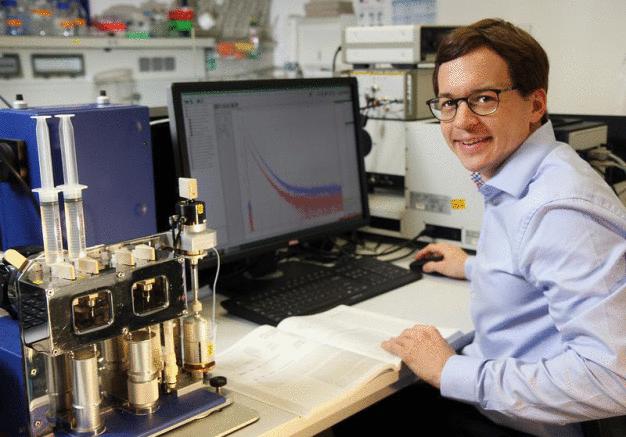
Professor Sandro Keller, Vice Dean of the Department of Biology
What happens in cells precisely at the nanoscale remains a mystery for research so far. How are structures, such as membranes and enzyme complexes, arranged within a cell? How does a cell know where front, back, bottom, and top are? How are spatially and temporally coordinated structures formed? The Foundation Professorship for Nanophysiology at the Technical University of Kaiserslautern (TUK) aims to provide answers. In the first five years, it will be funded by the Carl Zeiss Foundation with one million euros. The goal is to better understand pattern formation in cells at the molecular level, in order to also find causes of diseases, such as nerve disorders.
Whether it's the spots on the fur of leopards and giraffes or the stripes of zebras – how such patterns develop during embryonic development has now been well studied. "Genes that are only read in certain cells and only at a specific time during development play an important role," says Professor Dr. Sandro Keller, Vice Dean of the Department of Biology at TUK, where the new professorship will be based.
Similar processes also occur at the molecular level – in an area that is not directly visible to the human eye. The importance of such order here is demonstrated, for example, by the transmission of information in nerves. A spatially and temporally precisely coordinated arrangement of synapses on nerve cells is crucial for the correct processing of information between them.
The cytoskeleton, the cell's skeleton that controls movement and transport processes, is also subject to precise arrangement. Generally, cells are highly complex structures, in which mitochondria, the power plants of the cells, or protein complexes on membranes are arranged in specific patterns. "However, exactly what happens at the molecular level, how cells form this order, maintain it functional over months or years, and simultaneously adapt it to changing conditions, is not yet understood in detail," Keller continues.
The Foundation Professorship, funded by the Carl Zeiss Foundation, will focus on such questions in the future. Among other tools, highly resolution microscopes that provide insight into the nanocosmos will be used. "With conventional light microscopes, we can only see up to about a third of a micrometer inside cells," says Keller. "But this technique is not suitable for the nanoscale."
New microscopy techniques are needed here, which are currently revolutionizing biological research and will now also be used at TUK thanks to the new professorship. To process the large amount of data and images digitally, close collaboration with the departments of Mathematics and Computer Science as well as the Fraunhofer Institute for Industrial Mathematics ITWM is planned.
The results will not only help to understand fundamental cellular processes but also to find molecular causes of diseases, such as nerve disorders or developmental abnormalities. The new professorship for Nanophysiology is scheduled to be filled in 2018 and will further strengthen TUK's research focus on membrane and system biology.
Professor Dr. Arnd Poetzsch-Heffter, Vice President for Research and Technology, is pleased about the new professorship: "This allows us, on the one hand, to strengthen the research focus with an important thematic area, and on the other hand, to expand interdisciplinary collaboration between the departments of TUK and with the Fraunhofer ITWM. I congratulate everyone involved on this success."
Theresia Bauer, Chairwoman of the Foundation Board of the Carl Zeiss Foundation, explains the funding decision: "With the support of the Foundation Professorship, the Carl Zeiss Foundation enables TU Kaiserslautern to further expand its already strong research focus on membrane and system biology. This complements our ongoing funding of the Lipidomics Center and follows the Foundation's principle of aligning funding with the academic strengths of the applicants and their strategic orientation."
Technische Universität Kaiserslautern
67663 Kaiserslautern
Germany



