

- Translated with AI
New camera system monitors distillation and helps save energy
Achema 2018
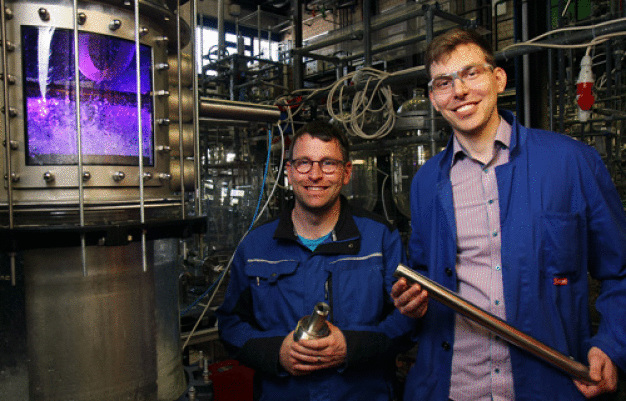
Markus Lichti (left) and Jonas Schulz are developing the camera system. (Photo: TUK/Thomas Koziel)
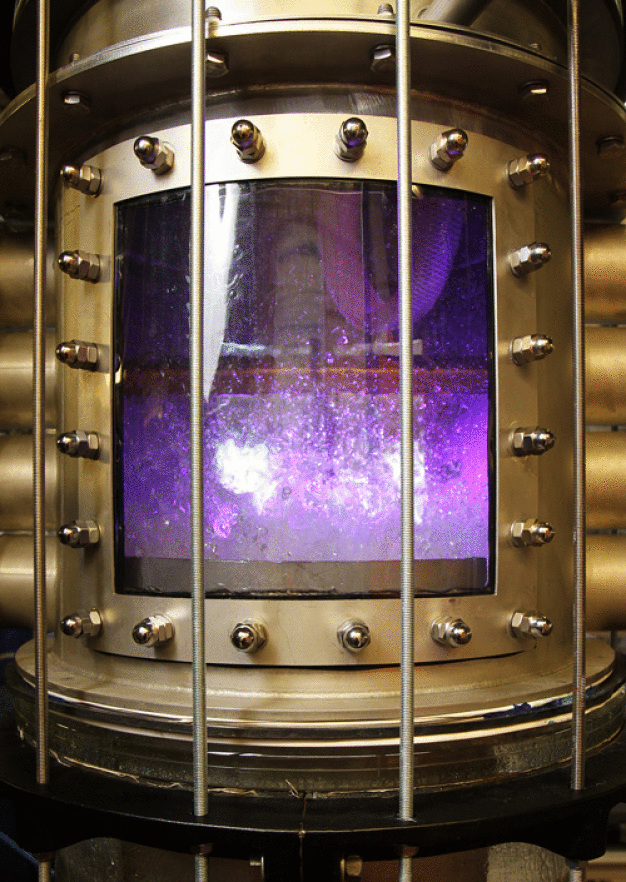
The system monitors droplet formation during distillation. (Photo: TUK/Thomas Koziel)
To separate chemical mixtures into their individual components, energy-intensive distillation is commonly used in industry, such as in crude oil refining. Researchers at the Technical University of Kaiserslautern (TUK) are developing a camera system that monitors this process. It measures whether there is excessive droplet formation, which can negatively affect the separation of components. The technology could automatically counteract these issues in the future when measurement values change, potentially saving energy. They will present this technology at the Process Engineering Fair Achema in Frankfurt from June 11 to 15 at the Rheinland-Pfalz research stand (Hall 9.2, Stand A86a).
Distillation involves separating liquids into their components through vaporization and subsequent condensation of the vapor. A well-known example is crude oil refining, where crude oil is separated into heavier and lighter fractions such as heavy fuel oil, diesel, petroleum, kerosene, or gasoline. "This common method is associated with high energy consumption," says Jonas Schulz, who is working on the process as part of his doctorate at the Chair of Thermal Process Engineering under Professor Dr. Hans-Jörg Bart. In the United States alone, distillation accounts for half of the energy costs in thermal separation processes in the chemical industry, amounting to over 100 billion US dollars annually.
The engineers at TUK are developing a technique to improve energy efficiency in the future. They rely on a camera system that observes the process. "Distillation in the chemical industry takes place in so-called separation columns," says Markus Lichti, also involved in the project. These are cylindrical devices with built-in trays or stages, which can be designed differently depending on the need, such as trays with sieve-like surfaces.
This separation process is continuous, starting with the production of vapor by initially introducing the mixture to be separated into the middle of the column. It flows downward over the trays and is heated at the bottom of the column. The vapor then rises upward. To prevent the process from stopping, a mixture is regularly fed in. "The vapor heats the liquid again, causing it to start boiling and rise as vapor," explains Schulz. "It cools again and collects as liquid on the next higher tray." Consequently, the components of the liquid with lower boiling points vaporize again and move upward in the column to the next separation stage. This process continues across multiple levels until the liquid with the lowest boiling point accumulates at the top tray.
"Distillation always involves impurities because the liquid does not separate properly into its components," Lichti continues. Various factors can cause this, such as too high vapor flow, excessive pressure, or too little liquid in the system. For example, liquid and vapor can become heavily mixed on the tray, causing many droplets of the liquid phase to be carried upward with the vapor. Experts refer to this as entrainment, derived from the English "to entrain." The droplets migrate to the next tray, where they remain — in crude oil refining, this could lead to parts of the heavy oil accumulating in the diesel, altering its chemical properties.
The camera system developed by Kaiserslautern researchers can help here: the camera is housed in a probe, a stainless steel tube that protects it from the hot vapor. The probe is inserted into the separation column via an access point, similar to a drawer where the probe is locked in place. The camera views inside the column through a glass window. To enable high-contrast images, a lighting system is installed directly opposite in another access point. "Our system is designed so that these inserts can be positioned at various points in the separation column," says Schulz. This allows the process to be examined at the edge or in the middle. "With the images, we can see how large the droplets are or how quickly they form," the engineer continues. "Our technology allows us to measure parameters that could not be examined before." The camera is controlled by software that also evaluates the images and detects entrainment. Until now, there have been no studies on how this process exactly occurs. The data obtained here provides insights for researchers, including whether the process parameters need adjustment."
In the future, industry could use the software for an automatic control system that adjusts when measurement values deviate from the norm, helping to save energy, such as reducing heating power, and lowering operating costs. Additionally, material savings could be achieved if it turns out that certain separation stages are unnecessary or oversized.
At the fair, the Kaiserslautern researchers from the Department of Mechanical and Process Engineering will present their system. The work is part of the project "Drop Formation and Reduction in Mass Transfer Devices," or TERESA, funded by the Federal Ministry for Economic Affairs and Energy (BMWi). Besides the TUK researchers, the project involves Ruhr University Bochum, Technische Universität Braunschweig, and the Helmholtz Center Dresden-Rossendorf. Industry partners include HZDR Innovation GmbH, Envimac Engineering GmbH, Falk & Thomas Engineering GmbH, Linde AG, Munters-Euroform GmbH, DencoHappel GmbH, Raschig GmbH, RVT Process Equipment GmbH, and Horst Weyer and Partner GmbH.
Technische Universität Kaiserslautern
67663 Kaiserslautern
Germany