



- Translated with AI
New building for Max Planck Solar System researcher
DLR comet hunter sends observation data to Göttingen
(Photo: Jörg Stanzick, Carpus+Partner)
(Photo: Jörg Stanzick, Carpus+Partner)
(Photo: Jörg Stanzick, Carpus+Partner)
(Photo: Jörg Stanzick, Carpus+Partner)
(Photo: Jörg Stanzick, Carpus+Partner)
(Photo: Jörg Stanzick, Carpus+Partner)
Since May 2014, Rosetta, the first comet spacecraft in space research, has been sending its observations 800 million kilometers through space to Earth. To analyze the data, the Max Planck Institute for Solar System Research moved into a new research building in January. Only thanks to optimal vibration decoupling can this high-tech building house highly sensitive laboratories for the development and manufacturing of optical systems and heavily shaken vibration test stands, where the operational conditions of space equipment are simulated. The special feature: the move-in date was already fixed at the start of planning four years ago and could not be postponed. Because this research object – traveling through space for ten years – takes no account of deadlines on Earth.
The core of the comet 67P/Churyumov-Gerasimenko measures only three by five kilometers. Yet space researchers at ESA are intensely interested in it. Because its composition is supposed to provide insights into the formation and development of our solar system. Therefore, since March 2004, the probe Rosetta – also called the comet hunter by the German Aerospace Center (DLR) – has been on its way to it and will enter the comet's orbit in May. Landings on the surface are planned for the end of the year. Preparations are underway both in space and on Earth. Nearly simultaneously with the awakening of the probe from its energy-saving deep sleep in January, researchers at the Max Planck Institute for Solar System Research (MPS) moved into a specially constructed new research building on the North Campus of the University of Göttingen.
“January 29, 2014, was fixed as the move-in date from the beginning of the project in June 2010,” recalls Ralf Walter, project manager at the responsible general planner Carpus+Partner. Even with years of experience with such large projects, such a deadline is a challenge: “It was necessary to bring all involved – planners, architects, and all trades – on board and commit to the date. We all pulled together here below. Because we cannot influence the trajectory of a comet,” says Walter.
Unusually, the client, the Max Planck Society for the Advancement of Science, and the general planner waived contractual penalties for delays, which are quite common in projects with critical schedules. Instead, they worked together and on equal footing. “A major challenge was the long winter in spring 2013. We were forced to pause the shell construction site for four weeks,” recalls Heinz-Peter Frantzen with mixed feelings; he was responsible for construction execution on-site for Carpus+Partner. “The delay could only be made up in the following weeks through multi-shift operation with an extremely tight schedule.”
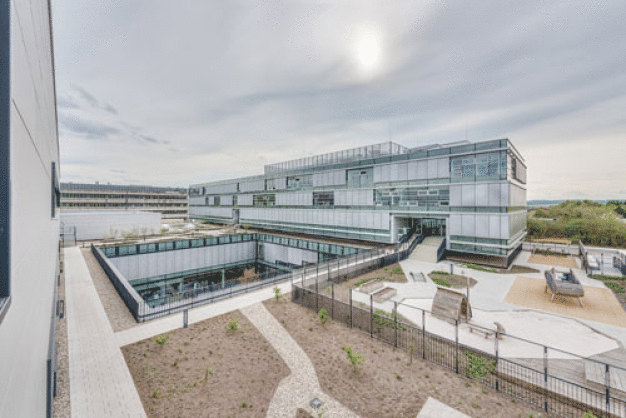
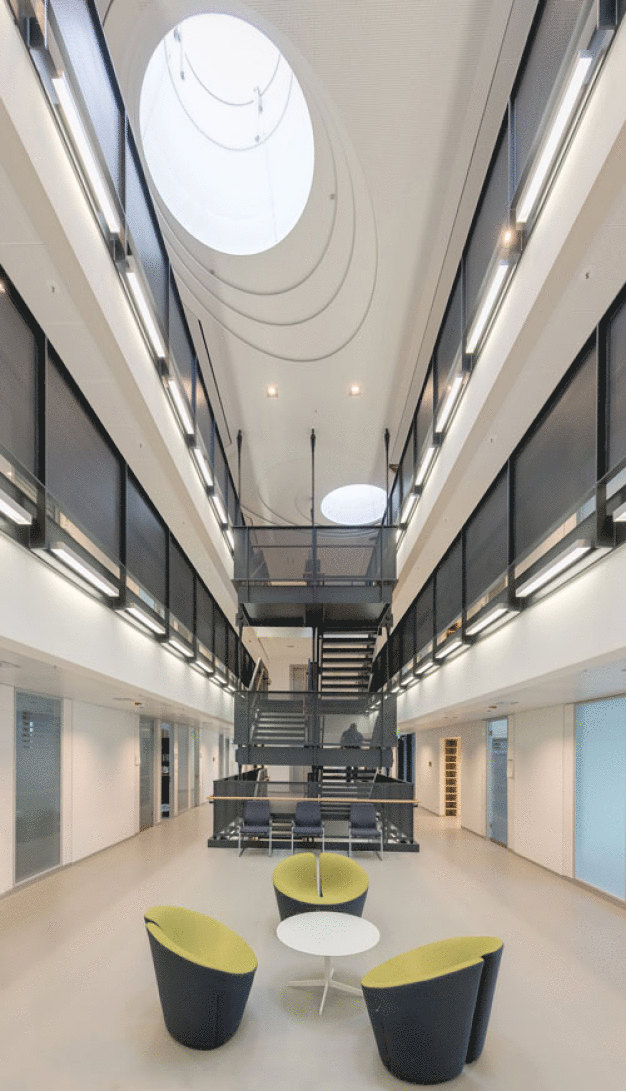
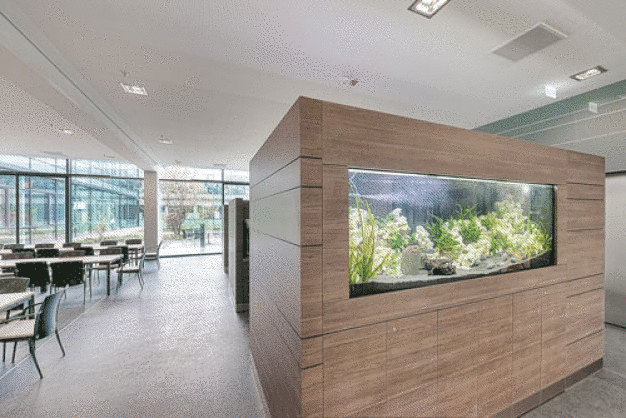
The effort has paid off, as is evident when looking behind the shining facade of the new building. The barrier-free building houses, on an area of about 20,000 square meters, in addition to research laboratories and office workplaces, a library, lounge and communication areas, a cafeteria, an expandable event foyer, a daycare center, a rooftop garden, and guest rooms for visitors of the institute.
Vibration-decoupled cleanroom laboratories with extra height
Crucial for the analysis of the Rosetta signals, as well as for the development, manufacturing, and testing of the institute’s optical devices and assemblies, are primarily sustainable vibration protection and cleanroom conditions in the respective research areas of the building. Vibrations or particle contamination would disturb the highly sensitive measuring instruments and distort the data of the comet probe.
The requirements for vibration minimization are significantly higher than in conventional projects. Calculations and simulations during the design phase showed that these could only be achieved through extensive, combined measures. Besides shielding against external sources of disturbance such as road traffic or wind turbines, internal areas emitting vibrations had to be structurally separated from vibration-sensitive areas. To prevent transmissions, test stands, the in-house workshop area, and the technical building equipment are mounted floating on ground plates with Sylomer pads and decoupled by expansion joints from the laboratories where the optical devices and assemblies are located. These laboratories, in turn, have self-supporting floor slabs on foundations made of compacted gravel packs and, in some cases, individual and strip foundations with Sylomer pads. The vibration test stand, which simulates loads for sensors and optical devices, e.g., during rocket launches, is additionally decoupled by spring damping elements. This protects the other laboratories from its influence.
The largest part of the total 2,500 square meters of cleanroom laboratories is intended for physical, chemical, and electrical experiments. A highlight for solar system researchers is the so-called hall area with ceiling heights of up to nine meters. Two of the four halls, each with 180 to 240 square meters, are designed as cleanrooms of ISO classes 6 and 8. Albert Borucki, architect at Carpus+Partner: “Because components up to seven meters high are assembled here, for example, for observatories that are then lifted into the stratosphere by helium balloons for solar observation, the halls had to be connected with correspondingly large roller doors. A continuous crane system for transport is also not a given in a cleanroom.” The third, the so-called balloon hall, is not a cleanroom but a controlled area with particle monitoring. From here, components can also be transported outdoors for testing under weather conditions. The fourth hall serves as a storage room.
The cleanroom halls are arranged so that they border the other cleanrooms and the central cleanroom corridor (ISO class 8), allowing movement throughout the entire cleanroom area without leaving it. Access is via a central personnel lock. To remain flexible in the long term, the room geometry in the laboratory area is variable, i.e., the walls can be easily moved – even without changing the ceiling height. Special importance is given to areas where components for extraterrestrial life detection are produced. Any contamination with, for example, hydrocarbons or bio-molecular substances must be avoided here to ensure the research results are usable. Accordingly, these rooms are built to GMP standards up to the highest class A.
Open communication architecture in the office areas
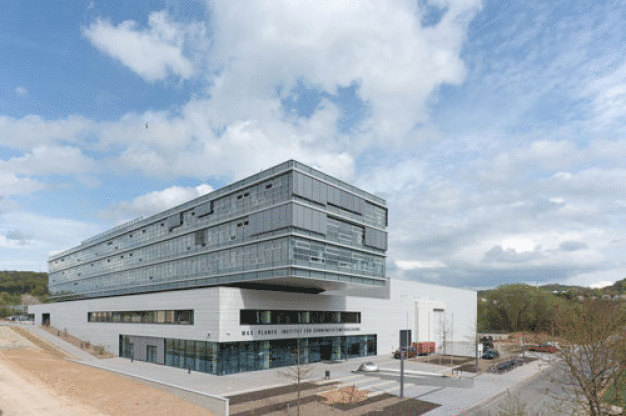
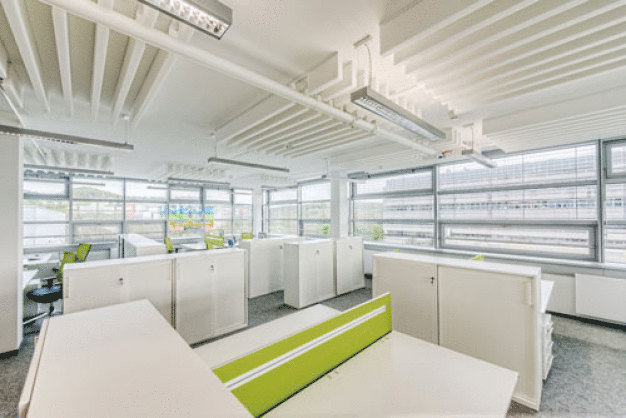
On the side opposite the laboratories rises above the base building the most conspicuous part of the building. The three-story office block with glass facade extends far beyond the building on the south side and seems to hover above it. While the lower part of the building contains the scientific research and general areas, such as the cafeteria, various – with variable walls flexible – seminar and conference rooms, the foyer with an exhibition, or the library, the office spaces for research and administration are located in the glass cube.
Here, the diverse requirements beyond technical equipment become apparent, which the researchers had for their new building: The work areas are characterized by open, communication-promoting structures. Short paths and opportunities for encounters are intended to – complemented by retreat options – promote interdisciplinary exchange and networking. Thanks to a daycare center with its own outdoor area, apartments for guest researchers, and the 2,000-square-meter rooftop garden, the building also meets the demands of changing structures in today’s knowledge society. Thus, the Max Planck scientists have received a new building with a high-quality architectural concept that creates optimal working environments for the next generation of researchers.
Carpus+Partner AG
52074 Aachen
Germany