- Translated with AI
Multicomponent localization in quantum systems questioned
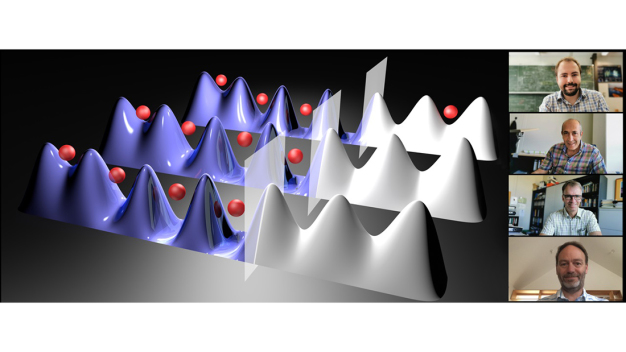
In a so-called multi-particle localized state, particles initially concentrated in one part of the system should remain there forever. A new theoretical study now suggests that this is not the case, and that particles thermalize over very long timescales. The project team (from top to bottom): Maximilian Kiefer-Emmanouilidis, Dr. Razmik Unanyan, and Prof. Dr. Michael Fleischhauer – all TU Kaiserslautern – as well as Prof. Dr. Jeskao Sirker, University of Manitoba. (Photo: TU Kaiserslautern)
A team of theoretical physicists from TU Kaiserslautern and the University of Manitoba in Canada has demonstrated through complex numerical simulations on the high-performance computer "Elwetritsch": Quantum particles in an exotic non-equilibrium phase, known as many-body localization, are not stable over long time scales – contrary to initial theories – and do thermalize. The results of this research collaboration were recently published in the journal Physical Review Letters and described in a synopsis article in the journal Physics.
The world of quantum particles, which exists at the subatomic level, follows its own laws. Therefore, states in which particles are present there are difficult to understand using classical physics alone. A central question, which remains open and widely discussed to this day, is: Does the ubiquitous phenomenon of thermalization in the classical world also apply unconditionally in the quantum world? Specifically, thermalization refers to the process by which a small subsystem of a closed system reaches a state describable by only a few parameters through energy and particle exchange with the rest of the system, satisfying the universal laws of thermodynamics.
In the late 1950s, Nobel laureate Philip Anderson, for example, showed that non-interacting electrons in a disordered material remain localized, meaning they stay confined to a small region in space for all time, instead of diffusing throughout the system. "Initially, it was believed that this effect, known as Anderson localization, would be destroyed by interactions, until an exotic state of matter called many-body localization (MBL) was discovered. Analogous to Anderson localization, no particle diffusion is expected in an MBL phase," explains Prof. Dr. Michael Fleischhauer, who researches at TU Kaiserslautern (TUK) in the Department of Physics.
The theoretical description of the long-term dynamics of such interacting quantum systems still presents major challenges – to this day, there is no complete understanding of MBL. Now, a team of theoretical physicists from TUK and the University of Winnipeg, consisting of Maximilian Kiefer-Emmanouilidis, Dr. Razmik Unanyan, Prof. Jesko Sirker, and Prof. Fleischhauer, has challenged the previous understanding of MBL. The numerical simulations conducted by the researchers suggest that particles in a quantum system with MBL do not localize but instead diffuse endlessly throughout the system.
"To demonstrate this, we numerically calculated the so-called particle number entropy, which is the contribution to entropy or, simplified, the uncertainty of the subsystem caused by fluctuations in the number of particles moving back and forth," explains Prof. Fleischhauer. "If the system were strictly localized, the particle number fluctuations and thus the associated particle number entropy should quickly reach a constant, small value. Instead, the simulations showed that the particle number entropy increases indefinitely, albeit very slowly, proportional to ln(ln(t))." These results indicate that either an as-yet-unknown mechanism causes systems to only localize over much longer timescales, or that MBL, in the strict sense, does not exist.
Further information on the published works:
M. Kiefer-Emmanouilidis, R. Unanyan, M. Fleischhauer, J. Sirker
Evidence for unbounded growth of the number entropy in many-body localized phases
Phys. Rev. Lett. 124 243601 (2020)
https://doi.org/10.1103/PhysRevLett.124.243601
Erika K. Carlson
Many-Body Localized States Inch Toward Equilibrium
Physics 13, s80 (2020)
https://physics.aps.org/articles/v13/s80
Questions answered by:
Prof. Dr. Michael Fleischhauer
Tel.: 0631 205-3206
E-Mail: mfleisch@physik.uni-kl.de
Technische Universität Kaiserslautern
67663 Kaiserslautern
Germany