


- R+D & Community of Interest
- Translated with AI
More space for applied research
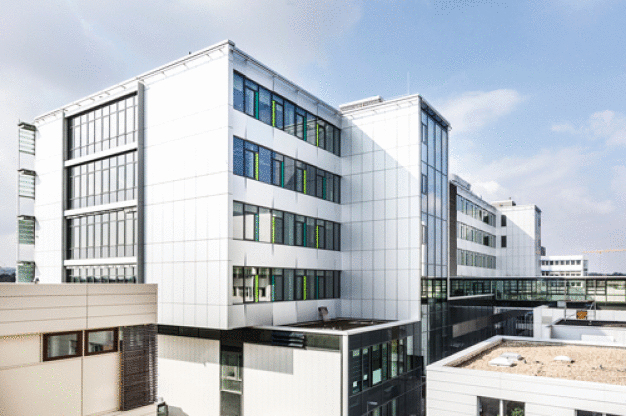
New technical college building exterior facade. (Source: Fraunhofer IPA, Photo: Rainer Bez)
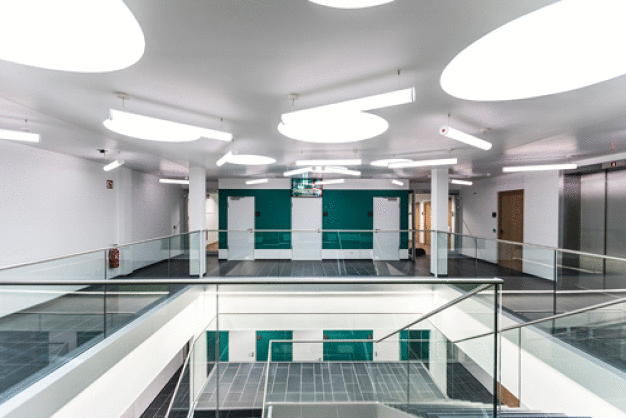
New technical college building interior view. (Source: Fraunhofer IPA, Photo: Rainer Bez)
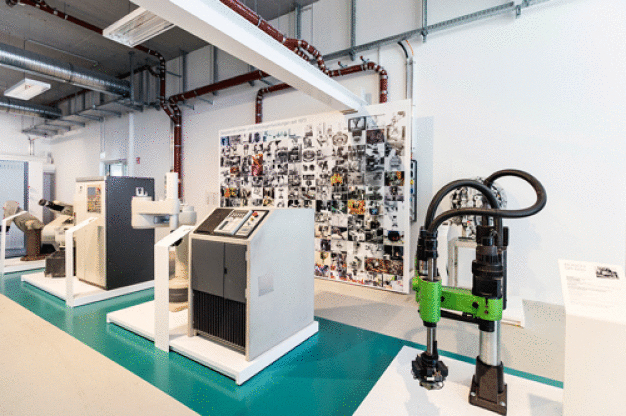
A look at the exhibition "Milestones of Robotics". (Source: Fraunhofer IPA, Photo: Rainer Bez)
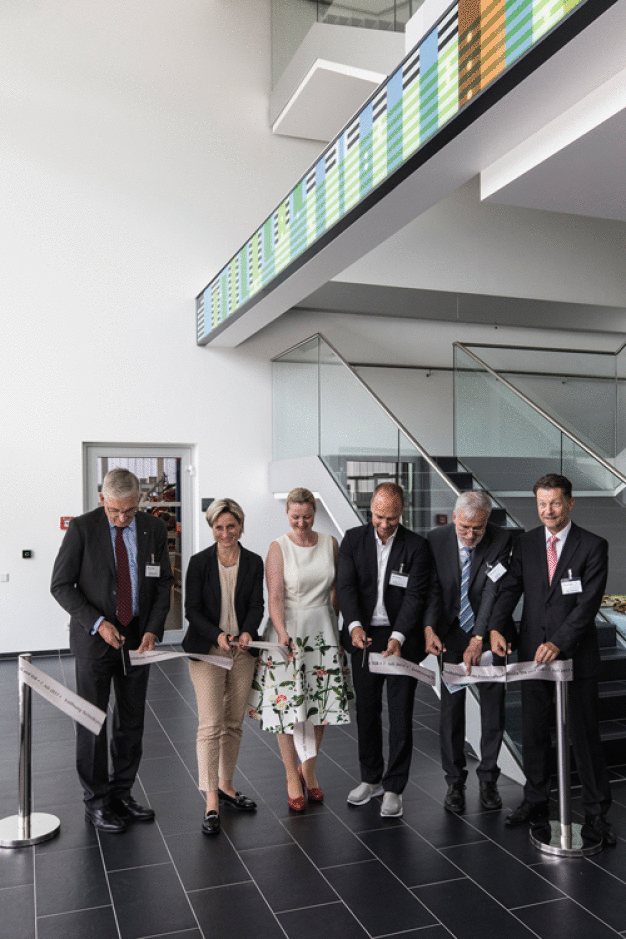
Ceremonial opening with Minister Dr. Nicole Hoffmeister-Kraut (2nd from left). (Source: Fraunhofer IPA, Photo: Rainer Bez)
At the beginning of the year, a new technical building was put into operation in Stuttgart-Vaihingen for the Fraunhofer Institutes IGB and IPA. The new construction houses labs, test fields, and technical facilities in the fields of robotics, resource efficiency, and laboratory automation, food and medical technology, as well as water treatment. This provides the site with further important infrastructure to drive innovations for the region, the state of Baden-Württemberg, Germany, and Europe in the future. The new technical building was officially inaugurated on July 7, 2017.
The Fraunhofer Institute Center Stuttgart is one of the largest locations for applied research and development in Baden-Württemberg. Currently, about 1,700 employees work across five independent institutes on various research areas such as production engineering and technology management, biotechnology and environmental technology, organizational and automation tasks, urban planning and spatial development, as well as innovation and IP management. With a usable area of 8,300 square meters – including 1,500 square meters of ground-floor technical space – the new building D offers more room for contract and preliminary research.
»Baden-Württemberg should remain the number one innovation location in Europe. With the new technical building for the Fraunhofer Institutes IPA and IGB, we strengthen the necessary excellent research infrastructure and thus overall applied research," said Dr. Nicole Hoffmeister-Kraut, Minister for Economic Affairs, Labor, and Housing of Baden-Württemberg. "For the Fraunhofer Campus in Stuttgart – one of the largest Fraunhofer sites nationwide – this new building represents an outstanding development and secures further potential for future growth of the institutes here at the site."
Prof. Dr. Alfred Gossner, Board Member for Finance, Controlling, and IT of the Fraunhofer Society, adds: "The infrastructure expansion at the Fraunhofer Institute Center Stuttgart is the result of an attractive research portfolio and successful research work of the institutes. It also lays the foundation for future innovations 'made in Stuttgart' in fields such as Industry 4.0, robotics, personalized and regenerative medicine. At the same time, the spatial proximity of both Fraunhofer institutes creates synergy opportunities and enables mutual knowledge transfer for the benefit of both."
From laboratory automation to robotics to water treatment
»Our Fraunhofer institutes are growing very rapidly, and the new building is a first step to meet the dynamically increasing space requirements. In the large-scale campus concept we plan to implement over the next few years, many more laboratories, workshops, and office spaces will be created. I am truly pleased that today – after some delays during the construction phase – we can celebrate the opening," said Prof. Dr. Thomas Bauernhansl, Director of the Fraunhofer IPA.
»Scaling processes is a central concern for the Fraunhofer IGB as a process engineering-oriented institute. With the new facilities, we can demonstrate developed processes at an industry-relevant scale. The immediate proximity to Fraunhofer IPA allows us to automate processes for biotechnology and regenerative medicine, enabling the economical production of products," reports Prof. Dr. Katja Schenke-Layland, Institute Director of Fraunhofer IGB. The developed processes are implemented in pilot plants in various technical facilities.
Colloquium 'Innovations at the Boundaries' presents new solutions
The researchers at Fraunhofer IGB now have entirely new possibilities with the technical building. The institute presents this potential to interested clients and partners at the specialist colloquium "Innovations at the Boundaries." For current challenges in the fields of health, chemistry and process industry, as well as environment and energy, the scientists present new solutions and demonstrate how their research benefits from the capabilities of the modern technical building.
Afterwards, guests have the opportunity to get a firsthand impression of the various systems and laboratories of the institute during a tour. The range of research activities displayed includes technologies for the food industry, wastewater treatment, surface coating, industrial biotechnology, as well as health topics such as tissue engineering, molecular cell technology, and next-generation diagnostics.
Exhibition 'Milestones of Robotics' Looks Back Half a Century
With the opening of the new building, visitors can experience another highlight: Fraunhofer IPA presents its exhibition "Milestones of Robotics." Its goal is to depict the development of robotics at Fraunhofer IPA through original exhibits and to highlight events or individuals that have shaped the past 50 years. The exhibition was made possible by the Association for the Promotion of Production Technology Research (FpF), which has been accompanying developments at the Fraunhofer Institutes IPA and IAO for years and also runs alumni activities. Its managing director and long-time IPA institute director, Prof. Dr. Rolf Dieter Schraft, was particularly committed to the exhibition and contributed his own exhibits from his robot model collection.
The robot models are arranged in chronological order. They include industrial and service robots, including robots for applications outside of production. From the beginning, Fraunhofer IPA focused not only on developing robot technologies but also on the use of industrial robots in modern manufacturing. The extensive range of implemented robot applications is demonstrated by an installation of former industrial robots and a photographic documentation of over 150 grippers and tools. For service robotics, examples include mobile systems, climbing robots, and the relatively new field of soft robotics. Additionally, there are exhibits providing insights into work and research at the institute, as well as key technologies of robotics such as navigation, image processing, and human-robot collaboration.
About the Fraunhofer Institutes IGB and IPA
The Fraunhofer Institute for Interfacial Engineering and Biotechnology IGB develops and optimizes processes, products, and technologies for the fields of health, chemistry and process industry, as well as environment and energy. The institute combines the highest scientific quality with professional know-how in its areas of expertise – always with an eye on economic efficiency and sustainability. Complete solutions from laboratory to pilot scale are among the institute's strengths. The constructive interplay of various disciplines at Fraunhofer IGB opens new approaches in areas such as medical technology, nanotechnology, industrial biotechnology, or environmental technology.
The Fraunhofer Institute for Production Technology and Automation IPA is one of the largest institutes of the Fraunhofer Society. Methods, components, and devices up to complete production systems and factories are developed, tested, and implemented. Fourteen specialized departments work interdisciplinary, coordinated through six business units, mainly with industries such as automotive, machinery and equipment manufacturing, electronics and microsystems technology, energy, medical and biotechnologies, and process industry. Fraunhofer IPA aligns its research with the sustainable and personalized production of economically viable products.

Fraunhofer-Institut für Produktionstechnik und Automatisierung IPA
Nobelstraße 12
70569 Stuttgart
Germany
Phone: +49 711 970 1667
email: joerg-dieter.walz@ipa.fraunhofer.de
Internet: http://www.ipa.fraunhofer.de