
- Translated with AI
More efficient to optimally cleaned surfaces
CO₂ snow jet cleaning in medical technology
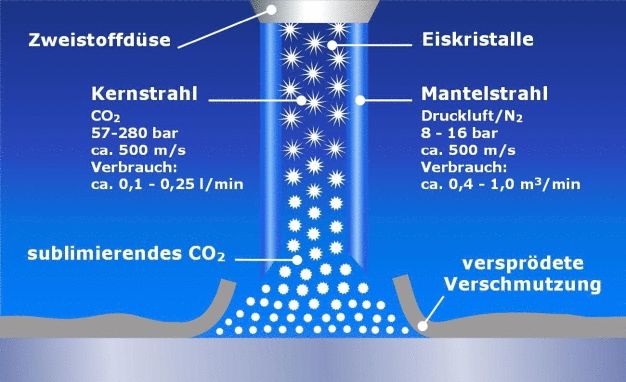
Principle of snow beam cleaning (Image source: acp)
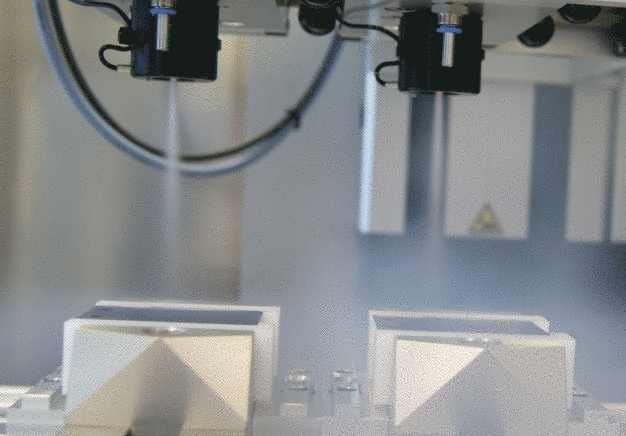
One of the core elements of the quattroClean cleaning system is an ultrasonic two-component nozzle. The liquid carbon dioxide is directed through the nozzle and relaxes upon exit into a snow/gas mixture. (Image source: acp)
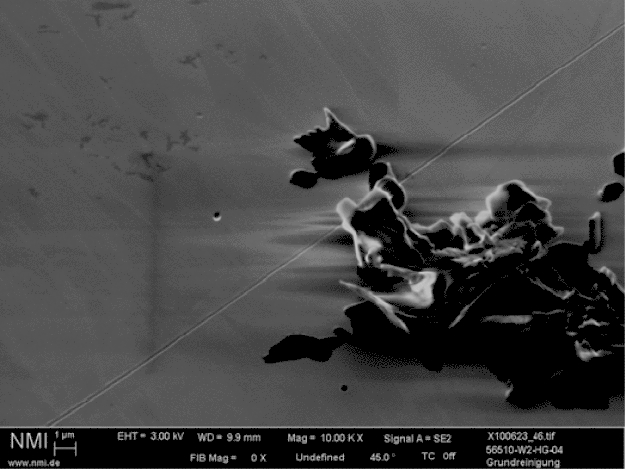
Stainless steel probe 1.4441 after basic cleaning (Image source: NMI)
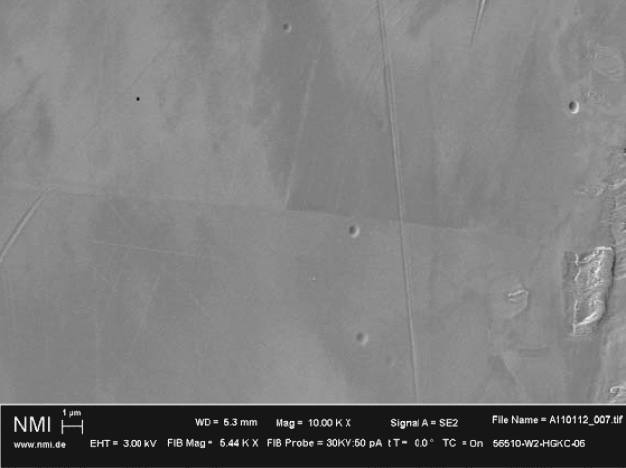
The sample after cleaning with the acp snow jet cleaning system. (Image source: NMI)
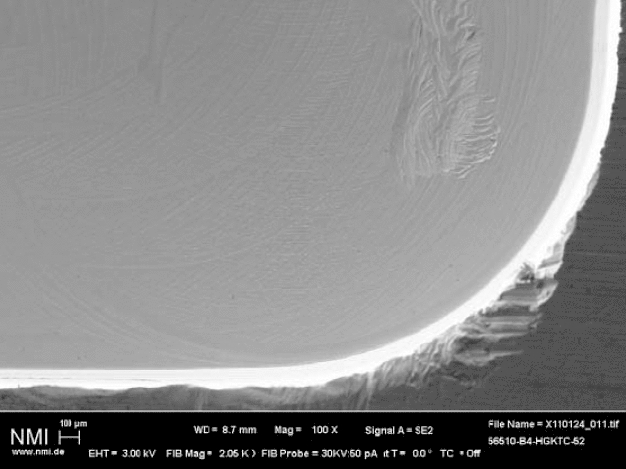
The combination of wet chemical and CO₂ snow blasting provides the best results. (Image source: NMI)
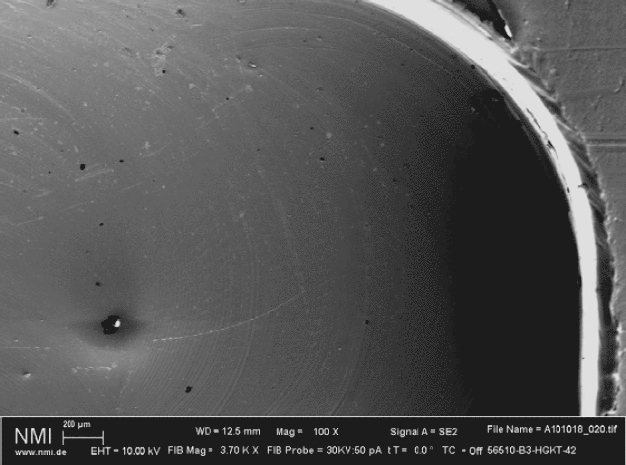
Test after the wet chemical cleaning (Image source: NMI)
The selection of the optimal cleaning technology makes an important contribution to the quality and cost-effectiveness of medical device manufacturing. With the quattroClean snow jet cleaning, a high level of cleanliness can be achieved even with products with very complex geometries. This has been demonstrated by a study conducted at the Natural Science and Medical Institute (NMI) at the University of Tübingen on the use of innovative cleaning methods.
Residuals from manufacturing pose a risk when using numerous medical devices, such as instruments, implants, and surgical sets for minimally invasive and traditional surgical procedures. Manufacturing-related contaminants such as processing media, release agents, particles, and burrs must be reliably removed. During final cleaning, a high level of particulate and film cleanliness as well as biological compatibility must be achieved. At the same time, the cleaning process must not impair the surfaces or the properties of the products. Especially with parts with complex geometries and difficult contours, such as blind hole drilling and undercuts, traditional aqueous chemical final cleaning often reaches its limits. This is usually due to insufficient rinsing of the material surfaces in these areas. This can lead to inadequate cleaning of the surfaces or hindered removal of the cleaned contamination. Another aspect is that additional process steps, such as coating, may follow after cleaning. This creates a need for innovative cleaning methods that, like the quattroClean snow jet cleaning from acp – advanced clean production GmbH, enable an improvement in cleaning quality.
Study on Validation of the Cleaning Process
The Natural Science and Medical Institute (NMI) at the University of Tübingen conducted studies as part of a collaborative project on the applicability, performance, and suitability of innovative cleaning methods such as plasma and CO2 snow jet cleaning. Furthermore, a validated aqueous chemical process suitable for integration into existing cleaning processes for medical technology was presented, considering the possible integration of these cleaning technologies. The project participants came from the fields of medical devices and cleaning processes, including acp.
The cleaning efficiency was determined by comparing the purity state of defined contaminated samples before and after cleaning. Various assemblies with difficult-to-clean geometries (blind hole drilling, undercuts, channel drilling with a high length-to-diameter ratio, blind hole drilling with undercuts, and blind hole drilling with undercuts and threads) made of stainless steel and titanium with different surface structures, as well as PEEK, were examined. After manufacturing the samples, a material characterization, a basic cleaning, and another material characterization were performed. X-ray photoelectron spectroscopy (XPS), light microscopy (LM), and scanning electron microscopy (SEM) were used for this purpose. Subsequently, the samples were contaminated in a defined manner with particles and films, chemically cleaned, and characterized material-wise. Then, cleaning was performed with plasma or CO2 snow technology. Additionally, some samples were cleaned only with plasma and carbon dioxide. The final assessment regarding cleanliness, particle reduction, cytotoxicity via BCA test, and functionality (surface structures) showed that the combination of aqueous chemical cleaning followed by CO2 snow jet cleaning with the quattroClean system achieved the best cleanliness values for all metallic samples.
Therefore, the process is suitable for targeted cleaning of difficult contours or specific functional areas in a one-piece flow process after aqueous chemical cleaning. This allows increasing the throughput of the cleaning system and thus its economic efficiency.
Dry, Residue-Free, and Gentle Cleaning
The medium used in snow jet technology is liquid carbon dioxide. It is produced as a byproduct in processes such as chemical manufacturing and biogas production and is prepared for cleaning from bottles or tanks. The excellent cleaning performance of the process results from the special mode of action of the patented quattroClean cleaning system. One of its core elements is a ultrasonic twin-nozzle. Liquid carbon dioxide is directed through the nozzle and relaxes upon exit into a snow/gas mixture. This core jet is surrounded by compressed air as a mantle jet, which accelerates the harmless and non-flammable CO2 snow crystals to supersonic speeds. The low hardness of the fine carbon dioxide snow also ensures that sensitive components and delicate structures are cleaned gently without substrate damage.
When the well-focused snow jet hits the surface to be cleaned, four effects occur:
Thermal Effect
The approximately -78.5°C cold jet material shock-cools the top layer of the surface, causing dirt to loosen. Different coefficients of thermal expansion of the material and contamination favor this mechanism. Due to the low process temperature, CO2 snow jet cleaning also has a bacteriostatic effect and supports microbial reduction on surfaces.
Mechanical Effect
The mechanical effect causes dirt particles to detach from the substrate. The kinetic energy of the carbon dioxide and the compressed air jet helps to blow away the loosened dirt particles.
Solvent Effect
During the transition from solid to gaseous phase, carbon dioxide acts as a solvent and removes organic contaminants.
Sublimation Effect
This supports the aforementioned effects through a pressure wave caused by the volume expansion during the transition from solid to gaseous state.
Since carbon dioxide sublimates completely at ambient pressure, no cleaning agent residues or secondary waste remain, and the cleaned item is immediately dry.
Flexible Process with a Wide Range of Applications
Because the quattroClean snow jet cleaning can reliably and reproducibly remove both particulate and film contaminants (including silicones) from almost all materials, it offers a broad range of applications in medical technology. Not only for cleaning instruments and implants but also for mechatronic components. For example, the process allows for the selective cleaning of contact and bonding surfaces, adhesive areas, or weld zones before and after welding. Since cleaning is performed dry, it can also be used for electrically conductive components and assemblies as well as plastic parts. Process parameters such as jet intensity and duration can be precisely adjusted to the specific application, material properties, and contamination to be removed, and stored as recipes in the control system.
At the same time, the ease of automation ensures trouble-free integration into production lines. This is supported by the small footprint – a quattroClean snow jet unit from acp, including a dust extraction system for the removed dirt, can be accommodated in an area of approximately 20 x 20 cm. Systems designed for cleanroom environments can be implemented with a local cleanroom system (MENV) and a specially adapted extraction system according to the task requirements.