


- Lasertechnology
- Translated with AI
More contrast, less risk: "Black Marking" for medical technology
Shiny metals, extremely small marking areas, and strict UDI requirements pose challenges for direct marking of medical devices. The technical article shows how ultrashort pulse lasers solve these through the marking effect "Black Marking."
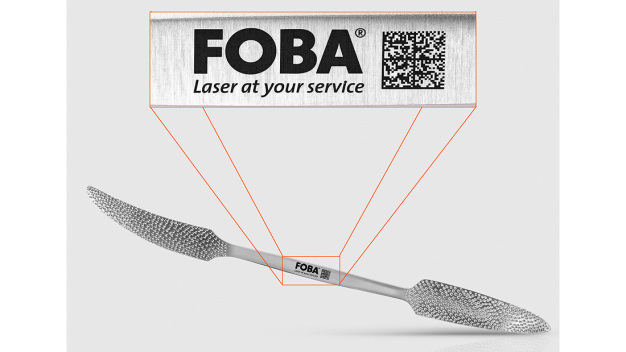
Stainless steel instrument with "Black Marking". The marking was done using the ultra-short pulse laser FOBA F.0100-ir. (Copyright: FOBA Laser Marking + Engraving)
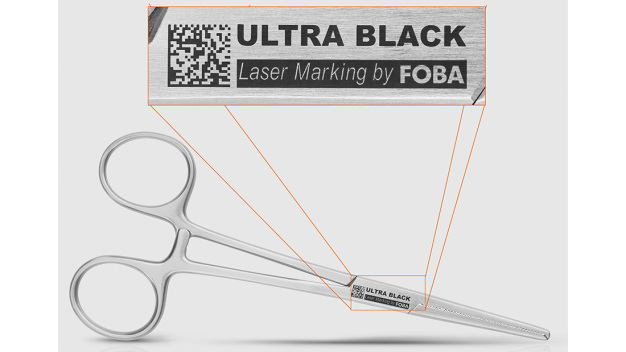
Permanent clearly readable black marking ("Black Marking"), labeled with the FOBA F.0100-ir ultrashort pulse laser. (Copyright: FOBA)
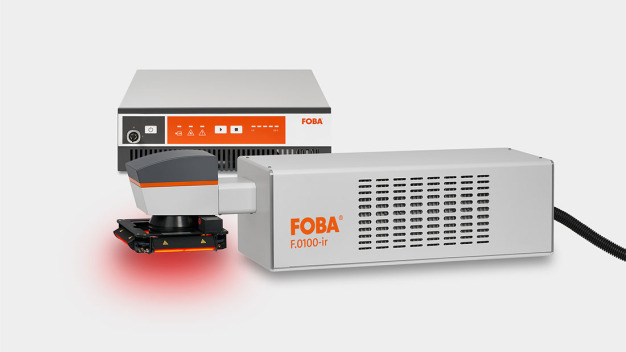
Ultrashort pulse laser from FOBA with continuously adjustable pulse width and laser-integrated camera system. (Copyright: FOBA)
With UDI requirements according to FDA and MDR, direct marking is mandatory for many medical devices, including surgical instruments and implants. In practice, these requirements apply to highly reflective metals, extremely limited marking areas, and demanding conditions throughout the entire lifecycle. Markings must be permanently contrast-rich and reliably legible without impairing function or material properties. Black marking with ultrashort pulse lasers, also called “Black Marking,” has established itself as a reliable solution for these challenges. It is especially preferred on medical stainless steel, but it is also suitable for other metals.
Four hurdles in direct marking of medical stainless steel
Stainless steel is indispensable in medical technology due to its corrosion resistance, mechanical stability, and biocompatibility. Direct marking of medical stainless steel is technically demanding. Four points should be particularly considered:
1. Reflections on polished surfaces
High-gloss surfaces complicate direct marking, optical inspection, and code verification. Reflections reduce readability.
2. Very small marking fields and complex geometries
On micro-instruments or functional surfaces, often only minimal space is available. Codes must be extremely fine, precise, and simultaneously reliably legible.
3. Thermal influences and risk of corrosion
Thermally induced marking processes can affect passive layers and surface properties. The balance between contrast, corrosion resistance, and material integrity must be considered.
4. Stress from processing
Cleaning, disinfection, sterilization, and possibly passivation repeatedly affect the surface. Markings must remain durable and corrosion-free during these processes.
The combination of reflection, miniaturization, material sensitivity, and processing stress means that classical laser marking methods (e.g., material removal or annealing marking) reach their limits for certain marking requirements. Precisely at this point, “Black Marking” demonstrates its strengths, as it can address all four challenges simultaneously.
Working principle of “Black Marking”: Nanostructure instead of heat input
“Black Marking” refers to a laser marking effect that produces deep black, matte, and non-reflective markings. It is characterized by angle- and light-independent readability: The inscription appears uniformly black regardless of viewing angle and lighting. This is especially relevant for camera-based inspection processes and the reliable machine readability of DataMatrix codes, which are common in UDI marking.
“The black marking is created not by material removal or thermally generated oxide layers, but by a nanostructure on the surface. These so-called ‘light traps’ reduce reflection, resulting in a strong contrast,” explains Damian Zawadzki, Product & Application Manager at FOBA Laser Marking + Engraving.
Ultrashort pulse lasers are used for the “Black Marking” process. The ultrashort pulses in the femto- and picosecond range with high pulse energy create the nanostructures necessary for the “Black” effect practically without heat input. Because the pulse duration is so short, little energy is transferred to the surrounding material, often described as “cold laser marking.”
Long-term tests by medical technology service provider add’n solutions and FOBA Laser Marking + Engraving demonstrate that durability can also be proven under realistic conditions: Stainless steel instruments marked with the “Black Marking” process were repeatedly processed (cleaned/passivated in fully automated systems, autoclaved, and subjected to additional highly alkaline cleaning intervals). The test results: After 1,000 cycles, the markings produced with the ultrashort pulse laser FOBA F.0100′ remained reliably legible. “The marking is still highly readable. It endures the lifespan of an instrument. The material of the test instruments failed before the marking did,” reports Dominik Pfeiffer from add’n solutions.
Regarding the four challenges mentioned above, the summary is: “Black Marking” with ultrashort pulse lasers combines reflection-free contrast creation, high precision for miniaturized codes, extremely minimized heat input to protect the material, and high durability against cleaning, disinfection, and sterilization processes.
“Black Marking” in practice: Application examples
1. Permanently readable UDI codes on highly polished stainless steel instruments
Initial situation: A manufacturer of surgical instruments needed a permanently durable, corrosion-free UDI marking on a highly polished stainless steel surface. Classic marking methods with fiber lasers provided insufficient contrast or caused surface changes. Additionally, reflections hindered machine readability. Standard ultrashort pulse lasers also did not meet the customer’s expectations.
Solution: The decisive factor for a secure marking was the infinitely adjustable pulse width of the FOBA F.0100′ ultrashort pulse laser: This allows highly precise and optimal adjustment of the energy input to the material and surface condition. As a result, a deep black, reflection-free contrast is created without affecting the material or function.
Added value: Permanently stable, process-safe, and corrosion-free marking of reliably readable UDI codes — even after countless cleaning and sterilization cycles.
2. Reliable readability of miniaturized codes on dental implants
Initial situation: A manufacturer of dental implants faced the challenge of reliably marking very small fields with high information density. The shiny surfaces complicated machine readability, and the marking had to be precisely positioned on the small area.
Solution: The high precision of the FOBA F.0100′ ultrashort pulse laser and the laser-integrated vision system IMP (Intelligent Marking Positioning), combined with the MarkUS software, were crucial for solving this challenge. By optimally adjusting all parameters, the laser enables delicate “Black” marking structures on the smallest surface. The non-reflective, deep black marking is reliably machine-readable. The FOBA workflow, based on software and vision, ensures exact, automated positioning and code verification.
Added value: Reliable readability even of the smallest codes, minimized scrap rate through high-precision positioning, and a stable marking process.
Practical tips for process design and quality assurance in “Black Marking”
In regulated environments, not only the quality of the marking is crucial. Equally important for the safe labeling of medical devices is that the entire marking process is stable and qualified. The following points have proven effective in practice for successful “Black Marking”:
1. Consider material and surface early
Alloy, surface finish, and cleanliness significantly influence the parameter range in which a stable contrast is achieved. Even minor changes in the material or surface preparation can shift the process window. Laser expert Damian Zawadzki recommends: “When conducting marking tests, always consider the actual serial condition of the components.”
2. Adjust parameters specifically to material and application
A reliable “Black” marking process requires precise adjustment of laser parameters such as pulse energy, pulse duration, repetition rate, and focus position. Testing on original parts is the safest way to achieve reliable results. “Our application laboratories conduct multiple tests with different settings. This way, we determine the optimal parameters that meet customer requirements,” reports Zawadzki.
3. Include downstream processes
The product lifecycle (e.g., cleaning, sterilization, or passivation) should be part of process qualification and considered from the beginning to ensure marking security.
4. Consider inline inspection and documentation
Especially for UDI applications, direct verification of code quality after marking using an integrated vision system is recommended. Camera-based inline inspections reduce early risks, while software-recorded process data support auditability and traceability.
5. Mark, verify, and document as an integrated system
Maximum safety and stability are achieved when the entire marking process is viewed holistically. This means considering all steps—from component positioning to documentation. A closed marking process, such as FOBA’s workflow, reduces interfaces, simplifies validation, and maximizes stability. FOBA combines laser technology, software control, automated marking alignment, vision inspection, and documentation into a coordinated overall system.
“Black Marking”: Technology and process at a glance
“Black Marking” with ultrashort pulse lasers offers a technically convincing solution for the demanding direct marking of metallic medical devices. The deep black, reflection-free contrast, high durability against cleaning and processing, and the nearly heat-free marking process address central challenges in medical device labeling. However, the key to sustainable success is not only the marking effect but also a well-thought-out overall solution: only a stable, qualified workflow ensures that markings meet long-term regulatory, functional, and safety requirements.
FOBA Laser Marking + Engraving
23923 Selmsdorf
Germany