



- Translated with AI
Monitoring of room overflows
Monitoring of room overflows
Introduction
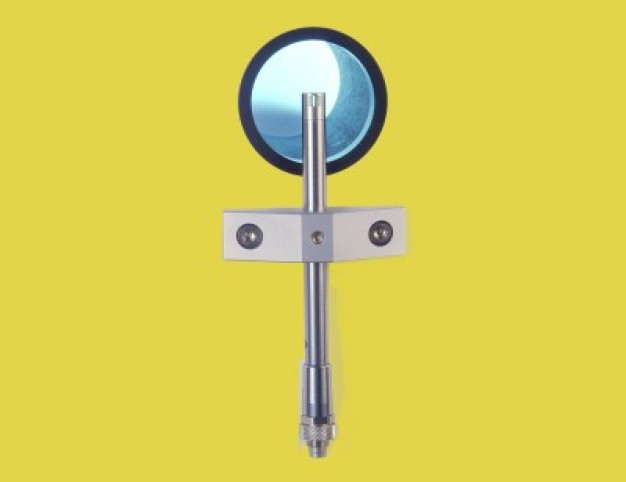
A new flow sensor from SCHMIDT Technology offers entirely new features. Hidden inside a very slim metal housing is a thermal flow probe that can detect the flow direction as well as measure the flow velocity in two directions. This probe aims to significantly improve flow monitoring in cleanroom technology. One of the application cases is the monitoring of room over-ventilation. This report aims to explain what is meant by room over-ventilation, how it has been detected so far, and how it can be improved with the help of this new sensor.
What is room over-ventilation?
When products are processed openly in cleanrooms, it is often necessary to ensure that contaminated air from adjacent rooms does not enter and damage the open products. This can be ensured either by sealing the rooms homogeneously (isolation technology) or by forcing an over-ventilation of air from the protected room into the adjacent room. For this purpose, a positive pressure is created in the protected room, causing air to flow out through any existing openings, thus preventing contaminated air from entering. To maintain this stable situation, it is usually sufficient to supply continuous fresh air to the over-pressurized room and regulate the room to a constant overpressure using a differential pressure sensor. Overpressure greater than 15 Pascals and nearly airtight rooms are easy to manage.
However, if a room has frequently opened doors or large openings in the wall, e.g., for product conveyors, it is often impossible to maintain such a large pressure difference. In these rooms, very low overpressure is used, and product safety is ensured by monitoring the airflow between rooms instead of the differential pressure. If a suitable wall opening already exists, a measuring device can be installed in this opening. Otherwise, a special over-ventilation opening is installed in the wall.
To assess how the room differential pressure affects the velocity of over-ventilation, the "Torricelli" efflux law can be used as an approximation, assuming a thin wall and a sufficiently large hole.
w = √(2 × Δp / ρ)
where:
w = flow velocity m/s
Δp = differential pressure [Pa]
ρ = density of the medium [kg/m^3]
Under the conditions of room air at 20°C and standard air pressure of 1013.25 hPa, the calculation yields the following relationship:
Differential pressure [Pa] | Velocity w [m/s]
0.01 | 0.13
0.1 | 0.41
1 | 1.29
5 | 2.89
10 | 4.08
15 | 5.00
20 | 5.77
30 | 7.07
From this calculation, it can be seen that a flow sensor installed in the over-ventilation opening can detect over-ventilation even when only very small differential pressures are present.
Existing solutions
The safest way to prevent backflow between rooms is, as already mentioned, to establish as high a differential pressure as possible. In pharmaceutical cleanrooms, differential pressures between 15 and 30 Pascals are common. The set differential pressure that generates the required over-ventilation is verified during acceptance tests by visualizing the airflow with smoke particles. For continuous monitoring of over-ventilation, differential pressure sensors are often used to verify that the required differential pressure is maintained constantly. The weakness of this solution is that the sensor signals become unstable at very small differential pressures, requiring a relatively high pressure to be maintained. Alternatively, wind vanes are used in specially installed wall openings to read the airflow direction. Unfortunately, this method is also relatively insensitive and cannot be integrated into electronic monitoring systems due to the lack of an electrical interface. Some solutions also use standard flow sensors placed in the over-ventilation opening, but these cannot detect the direction of airflow.
Working principle of the new sensor
The flow sensor SS 20.400 is the first from SCHMIDT whose sensing element can detect the direction of flowing air. It operates on the principle of the thermal anemometer (also called hot-wire principle). Thermal anemometers differ from other airflow measurement devices by the following advantages:
- Minimum measurable flow velocities (from 0.05 m/s)
- No moving parts and thus no wear
- Very low flow resistance, i.e., low pressure drop at the measurement point
The new sensor of type SS 20.400 also has several other advantages, which will be explained below.
Element and electronics in miniature format
To protect against mechanical stress, SCHMIDT has integrated the sensing element into a chamber, called the "chamber head." Through careful aerodynamic design of this chamber head, it has been ensured that even an imperfect installation of the sensor (slight twisting along the flow axis or tilting against the sensor axis) has minimal impact on the measurement result. Directly behind the sensing element in the sensor tube is the ultra-small evaluation electronics, so there is no need for an external signal converter. The core of the electronics is a microprocessor connected to the outside via the following interfaces: analog output 4–20 mA / 0–10 V, direction output, threshold output (both as open collector), and RS 232 interface. The analog output provides a linear signal for both forward and reverse airflow. Using the serial interface, the user can precisely set the sensor to their needs. SCHMIDT Technology offers a programming kit that is easy to operate via a PC.
Advantages of the new sensor
· Clear direction detection
· Measurement in two directions
· Very fast response time in the ms range
· Built-in switching outputs, making it suitable as a watchdog for direct alarms
· Very compact dimensions
· Configurable via PC
· Built-in contamination detection
· GMP-compatible materials
Technical data
Design: Immersion probe (Ø 9 x 150 mm incl. connector),
Signal converter integrated into the sensor tube.
Application area: Free-flowing air and guided air in pipes from 15 to 1000 mm
Measurement ranges: 1 / 2.5 / 10 / 20 m/s (in both directions)
Start of measurement range: 0.05 m/s
Pressure: Atmospheric, 700 .. 1300 hPa
Mounting: Wall mount, flange, or through-hole screw connection
Power supply: 12 – 24 VDC / less than 10 mA
Outputs: 0 / 4 ... 20 mA, 0–10 V, 0–5 V,
2 open collector outputs for direction and threshold
RS 232 for parameter setting
Application of the new sensor
The SCHMIDT flow sensor SS 20.400 has all the features needed to reliably monitor the previously mentioned over-ventilation. For mounting the sensor in front of the over-ventilation opening, there is a suitable wall mounting flange. The thin probe is screwed into this and adjusted so that the sensing element is centered in the opening and the sensor slit aligns with the axis of the opening. Using the analog output, the airflow velocity through the over-ventilation opening can now be monitored. Since the sensor can measure from 0.05 m/s, over-ventilation can still be detected even when the differential pressure is no longer clearly measurable. If the sensor can no longer detect forward airflow or if backflow occurs, it reports this condition via its switch output OC1.
With the help of the programming kit, the user can dampen the sensor's analog signal and set the switching thresholds of the switching outputs themselves. This allows the sensor to be ideally configured for each application.
The new sensor is offered in various variants, opening up further application possibilities in cleanroom technology:
Laminar flow monitoring
Volume flow measurement in supply and exhaust ducts
Cooling air monitoring
Flow control in protective gas atmospheres
Conclusion
The flow sensor SS 20.400 opens up new possibilities for flow monitoring in cleanrooms. Especially for monitoring room over-ventilation, this sensor offers the following advantages:
· Stable measurement signal even at very small differential pressures
· Avoidance of false alarms
· Easy installation
· Easy to clean in the installed state
· Quick installation and removal (e.g., for calibration)
· Calibration possible in any good wind tunnel
References:
Stöcker, Taschenbuch der Physik, 2nd edition 1994

SCHMIDT Technology GmbH
Feldbergstraße 1
78112 St. Georgen / Schwarzwald
Germany
Phone: +49 7724 899198
Fax: +49 7724 899101
email: o.joos@schmidttechnology.de
Internet: http://www.schmidttechnology.de