




- Service
- Translated with AI
Steven Kochevar (Senior Applications Engineer), Dr. Raymond Jansen (General Manager PMS Germany)
Monitoring of compressed gases
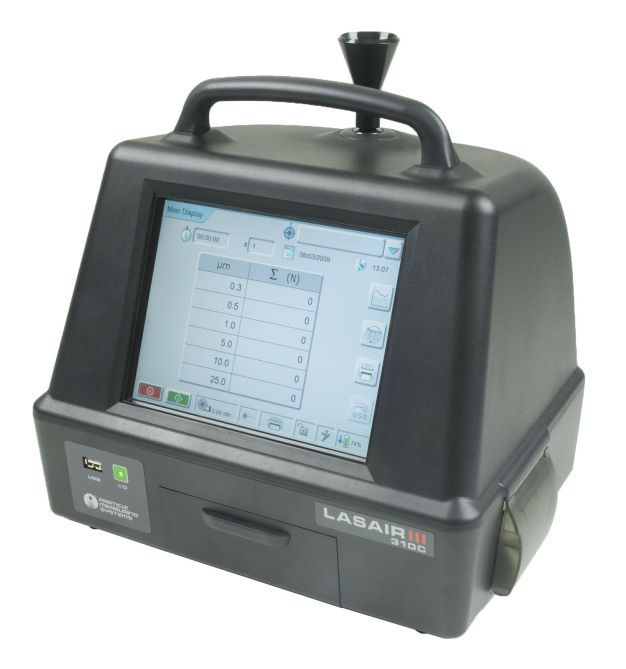
Figure 1: Lasair III Particle Counter
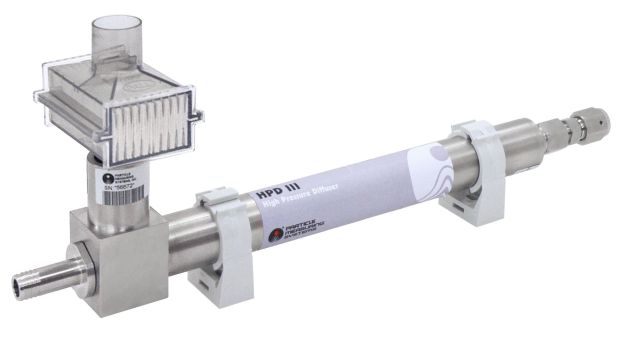
Figure 2: High-Pressure Diffuser (HPD)
This article deals with the fundamental relationships between air or gas volume, pressure, and flow rate, and how these parameters influence particle counting. It also discusses a simple installation as an alternative method for occasional measurement of inert pressurized gases.
Volume, Pressure, and Flow Rate
When a certain amount of a medium (air or gas) moves from an area of higher pressure to an area of lower pressure, this movement causes changes in pressure and flow rate. A precisely functioning particle counter must account for these changes because they can occur very suddenly. Mass flow meters or pressure sensors inside the particle counter ensure a constant flow when pressure or volume change.
Volume, pressure, and flow rate have different units of measurement, meaning they are distinct and pose challenges for the particle counter. Volume is the amount of space occupied by a three-dimensional object and is expressed in cubic units (e.g., cubic meters or cubic feet). Pressure is the amount of force per unit area and is measured in kilograms per square meter with the unit Pascal (Pa). The typical units are bar (1 bar = 105 Pa) or more precisely mbar (1 mbar = 100 Pa = 1 hPa). In the Anglo-American region, the unit PSI (Pound per Square Inch; 1 PSI = 0.068948 bar) is often used. Flow rate is the amount of medium moved per specific time unit and is usually given in liters per minute (LPM) or cubic feet per minute (CFM).
Pressure has the most significant influence on the flow velocity and the sample volume for analysis by the particle counter. The design of a particle counter requires an understanding of Boyle's gas law (see below), which states: as pressure increases, volume decreases.
P1V1 = P2V2
(where P = pressure and V = volume)
Applying the above equation, one can understand that one cubic meter of air at sea level is not the same as one cubic meter of air at about 1,500 meters altitude. The higher altitude and the correspondingly lower atmospheric pressure allow the air to expand.
Compared to the pressure at sea level, the atmospheric pressure decreases by about 20% at approximately 1,500 meters altitude. For example: if a volume of air contains 10 particles at sea level, the same volume at 1,500 meters will contain about 8 particles. This result occurs because the existing particles now distribute into the expanded volume, which has increased to about 120%. Without considering pressure differences, flow rate measurement, and control, a particle counter set for a flow of 1 CFM at sea level will produce significantly less accurate particle count data at higher altitudes. In our example, this particle counter would then "see" only 6 particles, resulting in about a 25% lower count.
Flow Rate Control
Volumetric corrections for ambient pressure are necessary. Particle counters typically have flow rate measurement and control so that the pump speed can be adjusted or excess air can bypass the measurement chamber.
These controls are adjustable, either via software, mechanically, or automatically regulated based on ambient pressure. Each method monitors the ambient pressure, which is the same on both sides of the pump, and adjusts the pump's flow rate accordingly.
If a particle counter is calibrated for sea level pressure (1,013 hPa) and then moved to an altitude of about 1,500 meters (830 hPa), the particle counter needs a way to adapt to the altitude. For example, Lasair® III particle counters from Particle Measuring Systems (Figure 1) automatically detect overpressure conditions and reject the data as invalid.
Monitoring gases at pressures higher than normal pressure presents a greater challenge. Connecting pressurized gas lines to a particle counter can overwhelm its flow control system. To solve this problem, high-pressure diffusers (HPD) have been developed. HPDs (Figure 2) reduce high pressure to normal pressure at sea level. They work by venting excess gas into the environment or diffusing it, allowing the particle counter's flow control system to function as intended.
Although an HPD is a good solution for periodic particle counting in high-pressure gases, some users employ a simple overpressure valve. These pressure-reducing T-valves can be easily connected to most high-pressure lines and offer a solution for users who only occasionally test their gases. However, this option is more costly in terms of gas consumption because these valves vent more gas than necessary for monitoring. As the number of measurements increases, the costs for a high-pressure diffuser balance out.
Conclusion
Altitude above sea level, or more precisely, air pressure, has a significant impact on particle counters and must be considered when monitoring particle contamination. The particle counter should offer the ability to compensate for different altitudes. If the investigation involves high-pressure gases, the user has several options: a specialized gas particle counter (e.g., HPGP 101c), an HPD, or a pressure-reducing T-valve.
Dedicated gas counters are not discussed in this article because they go beyond its scope. The decision is simply a matter of the particle sizes to be monitored, the sampling frequency, and the gas consumption costs.

Particle Measuring Systems Germany GmbH
Im Tiefen See 45
64293 Darmstadt
Germany
Phone: +49 351 88963850
email: pmsgermany@pmeasuring.com
Internet: http://www.pmeasuring.de



