

- Corona
- Translated with AI
Mobile labor for the localization of Corona hotspots
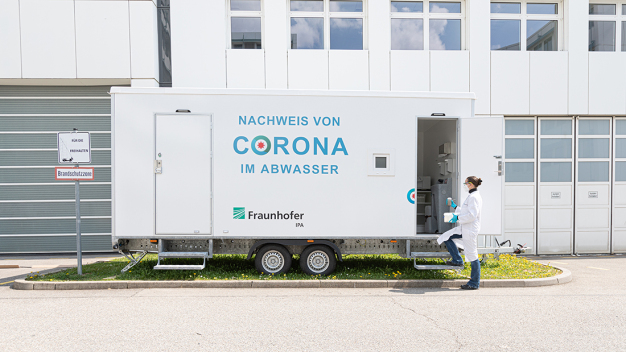
The mobile laboratory is divided into different rooms to separate the preparation of wastewater samples, the purification of virus fragments, and sensitive virus analysis. © Fraunhofer IPA/Photo: Rainer Bez
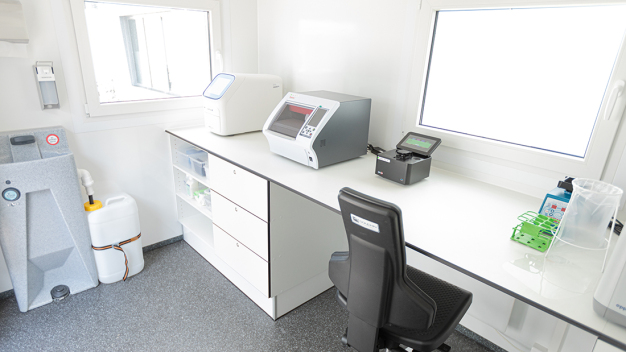
Laboratory devices for the detection of SARS-CoV-2 fragments from concentrated wastewater samples. © Fraunhofer IPA/Photo: Rainer Bez
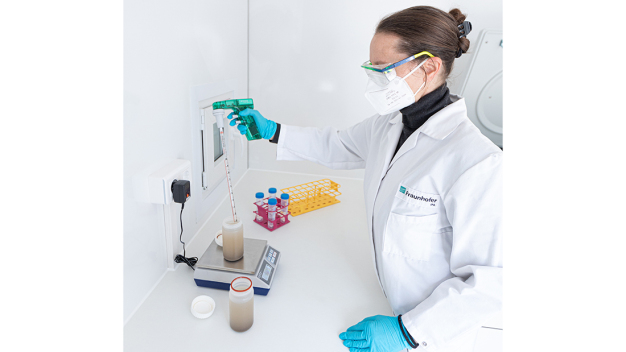
Preparation of wastewater sample for isolation of SARS-CoV-2 fragments. © Fraunhofer IPA, Photo: Rainer Bez
With a mobile test laboratory, researchers from the Fraunhofer IPA can now quickly and reliably detect fragments of coronaviruses in wastewater. These are an indication of increased infection rates and thus an indicator of pandemic hotspots. It is scheduled to start in September.
The countdown is on. The trailer with the inscription "Detection of Corona in Wastewater" is still parked behind the IPA building. Biologist Sibylle Thude is responsible for the conception and design of the mobile laboratory, including the electrical safety of the laboratory equipment, the hazard assessment, biological safety, and the implementation of the analytical process in the mobile lab: "It's not so easy to coordinate the experimental procedures logistically and to fit all the devices we need into a small space, positioning them in a way that allows for meaningful and safe analytical work. Additionally, everything must be securely fixed so that highly sensitive and expensive analytical instruments are not damaged during transport."
In a few weeks, Sibylle Thude will go on tour with the mobile laboratory. During the maiden voyage, samples will be taken from various treatment plants in the Stuttgart metropolitan area and examined on-site. "Our goal is to detect COVID-19 hotspots faster and more accurately with the mobile lab than was previously possible," explains Guido Kreck, project manager for purity technology at IPA. "Each sewage treatment plant processes wastewater from about 10,000 residents. If infected individuals are among them, we can detect fragments of coronaviruses in the wastewater—ahead of about a week and a half before those affected show symptoms and can be tested." The idea of detecting COVID-19 outbreaks through wastewater analysis is not new. Analyses of wastewater samples from Milan and Turin, for example, suggest that the virus was already present in Italy in December 2019—two months before the first known outbreak. However, wastewater analyses have been time-consuming so far: samples had to be packaged and sent to specialized laboratories, where they were handled and analyzed without cross-contamination. It could take several days to get results.
Faster is better
If you want to detect COVID-19 cases to combat the pandemic, you need to be faster: Results are needed immediately to prevent further spread with appropriate measures. The mobile laboratory trailer allows samples to be analyzed on-site without delay. Everything needed is onboard: centrifuge, freezer, drying oven, and pipetting aids. Also, a purification system that, with the help of magnetic beads, isolates virus fragments from wastewater. And last but not least, a PCR cycler that amplifies and analyzes the viral genetic material. Results are available within a few hours.
Algorithms for prognosis
"If everything works, we can examine all treatment plants in a federal state within just one to two weeks using the new method. Since all analyses are conducted in the same laboratory, the results are highly comparable—potential hotspots can thus be localized very precisely," predicts Kreck. From the concentration of virus fragments in a sample, algorithms can infer the number of infected individuals.
The data basis for such calculations is now to be provided by the investigations in the Stuttgart metropolitan area: "Our laboratory is still a prototype. We need to test the devices, optimize workflows, collect data, and further develop the prediction tools," says Kreck. Thanks to AI, the system constantly learns: the more measurements are available that can be compared with known infection figures of a region, the better the predictions become.
And what if the COVID-19 pandemic is over one day? The IPA researcher Thude is convinced that the mobile laboratory will still be needed after the crisis: "In the event of a renewed pandemic, we can quickly adapt the analysis and look for other viruses. The great thing about the new mobile lab trailer is that we are completely flexible: we can go where we are needed— for example, to search for health-threatening substances like insecticides or antibiotics in groundwater or wastewater, with appropriately adapted equipment and analysis."

Fraunhofer-Institut für Produktionstechnik und Automatisierung IPA
Nobelstraße 12
70569 Stuttgart
Germany
Phone: +49 711 970 1667
email: joerg-dieter.walz@ipa.fraunhofer.de
Internet: http://www.ipa.fraunhofer.de