

- R+D & Community of Interest
- Translated with AI
Minister of Economic Affairs Hoffmeister-Kraut at the Center for Digitalized Battery Cell Production
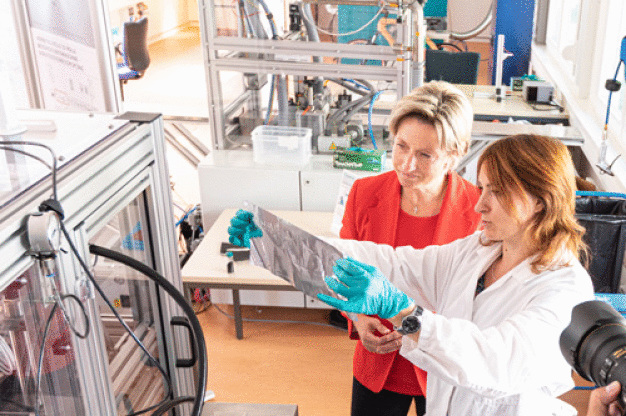
Minister Hoffmeister-Kraut at the networked roll-to-roll coating machine. (Source: Fraunhofer IPA, Photo: Rainer Bez)
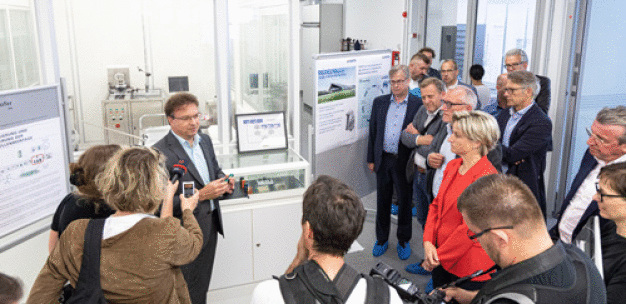
IPA expert Dirk Schlenker explains the automation and digitalization of battery cell assembly. (Source: Fraunhofer IPA, Photo: Rainer Bez)
The automotive industry is facing a crisis: the electric motor is replacing the internal combustion engine, computers are increasingly taking over control, and car-sharing is becoming trendy. Additionally, Industry 4.0 introduces a completely new strategy into factories. Significant efforts are needed to manage the transformation. The Minister of Economics for Baden-Württemberg, Nicole Hoffmeister-Kraut, has therefore taken a look at the state of technology in the region. She visited various research institutions and companies with members of the press. The trip first led her to the Fraunhofer Institute for Production Technology and Automation IPA, where the focus is on the digitalized manufacturing of battery cells.
"For the future of electromobility, battery technology will play a crucial role," said Minister of Economics Dr. Nicole Hoffmeister-Kraut about the core component of electromobility – the battery. Its importance is comparable to that of the engine in a conventional car. "Approximately 38 percent of the cost of an electric vehicle is attributable to the battery," said IPA Director Prof. Thomas Bauernhansl. However, the market for this component is currently largely dominated by Asian manufacturers. Bauernhansl therefore warned against dependency. Although Europeans have set a goal to produce about one-third of their demand domestically by 2030, they must reduce manufacturing costs to compete effectively against Asian rivals.
"In digitalization, we see a major lever to increase competitiveness," said Reiko Stutz, General Manager of Strategic Projects at VARTA. The company has been working with the IPA for years, which possesses extensive experience in this field. Even more optimistic about the situation is Joachim Montnacher, the head of the IPA's Energy division: "Through the consistent digitalization of manufacturing processes and resource-efficient production, Baden-Württemberg has the potential to become a global leader in the ecological and economic production of battery cells." Specifically, according to Institute Director Bauernhansl, digitalization could save 10 to 15 percent of manufacturing costs. Currently, there are deficits mainly in quality. Since battery cells are only tested at the end of production, an entire batch is lost if an error occurs somewhere in the process. The rejection rate is therefore quite high, between 5 and 10 percent. The IPA is working on monitoring individual steps with sensors and managing the collected data centrally. This aims to improve quality and simultaneously reduce waste.
Minister Hoffmeister-Kraut was able to see firsthand how this works at the Center for Digitalized Battery Cell Production. For example, there is a machine for coating electrodes that continuously collects data and monitors the quality of its work. Another system is exploring new approaches to coating. Instead of applying a paste onto a substrate, such as aluminum foil, it uses powder. The advantage of this innovative dry coating process using electrostatics: no solvents are needed, which are harmful to health and require extensive drying. This makes the entire system significantly more compact. And "about 50 percent energy savings," says Inga Landwehr, the responsible expert at IPA.
Finally, the minister had to put on overshoes to avoid bringing dirt into the cleanroom. Here, she saw, among other things, an intelligent workpiece carrier that transports semi-finished battery cells from one machine to the next. The clever part: the carrier not only monitors the quality of individual cells with its sensors but also collects data on environmental conditions and sends it to the cloud. This allows precise tracking of where each cell is, in what condition, and under what environmental conditions. Even this carrier alone can help significantly reduce the rejection rate. "In addition to research and development, it is crucial for the Baden-Württemberg site that the transfer of research results into industry succeeds," emphasizes Hoffmeister-Kraut.

Fraunhofer-Institut für Produktionstechnik und Automatisierung IPA
Nobelstraße 12
70569 Stuttgart
Germany
Phone: +49 711 970 1667
email: joerg-dieter.walz@ipa.fraunhofer.de
Internet: http://www.ipa.fraunhofer.de