

- New building
- Translated with AI
Milestone for Mainz Leading Research: Center for Fundamental Physics (CFP) inaugurated
Expansion of the research-strong physics quarter at the Mainz Gutenberg Campus
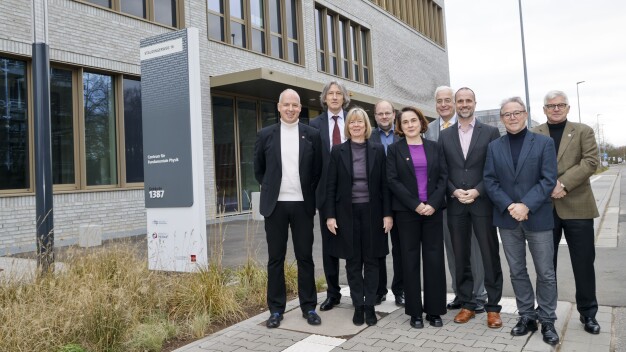
Opening of the Center for Fundamental Physics (CFP): (from left) JGU President Prof. Dr. Georg Krausch, Prof. Dr. Hartmut Wittig, Cluster Coordinator and Director of PRISMA+, Finance Minister Doris Ahnen, Prof. Dr. Volker Büscher, Construction Manager of CFP II, JGU Chancellor Dr. Kerstin Burck, Prof. Dr. Kurt Aulenbacher, Construction Manager of CFP I, Minister of Science Clemens Hoch, Prof. Dr. Matthias Neubert, Cluster Coordinator and Director of PRISMA+, and LBB Managing Director Holger Basten (Photo: Stefan F. Sämmer)
With the Center for Fundamental Physics (CFP), the cutting-edge research of the PRISMA+ Excellence Cluster at Johannes Gutenberg University Mainz (JGU) receives excellent infrastructure: The four-story laboratory and office building (CFP II) forms, together with several research laboratories, a two-story assembly hall, and a conference area, the above-ground counterpart to the renovation and expansion of the underground experimental halls (CFP I), where the new electron accelerator MESA will be operated in the future.
"The construction of the Center for Fundamental Physics (CFP) demonstrates: University construction has a high priority for the state government. For the overall CFP project, state and federal funds are investing around 105.7 million euros in construction costs and 18.3 million euros for large equipment and initial setup. Included are research construction funding from the federal government amounting to approximately 30.66 million euros. The construction of a new research building, such as the CFP, is always associated with a demanding planning and construction process. The highest building standards must be met to create tailored conditions for the demanding research purposes, the use of highly complex large equipment, and the very different technical units of the research groups at the Mainz site," explains Finance and Building Minister Doris Ahnen.
"Johannes Gutenberg University Mainz has long been recognized as an outstanding location nationally and internationally in core, particle, and hadron physics, as well as in detector construction and related research fields. The new research building creates excellent conditions to continue the university's highly successful development in this area. In the current DFG Funding Atlas 2024, it ranks first nationwide in funding in the field of physics, which speaks to the remarkable track record of Mainz University and the scientists conducting research in this area," says Science Minister Clemens Hoch. The state government contributes by creating good framework conditions and structures for top-level research, for example through the research initiative. This helps ensure that the university is well-equipped for international competition for top personnel, young scientists, and funding," the minister continues.
In 2012, as part of the then Excellence Initiative, the PRISMA ("Precision Physics, Fundamental Interactions and Structure of Matter") Excellence Cluster was approved, establishing a new research network in particle and hadron physics. In the next round of the Excellence Strategy, the success story continued, and in 2019, PRISMA+ succeeded as the successor cluster. Nearly 300 scientists are currently engaged in PRISMA+ research, including the investigation of dark matter, about which only indirect conclusions can be drawn so far, and have achieved outstanding scientific successes in this field over the past ten years. "Our excellence cluster has an impressive development to show," says Prof. Dr. Georg Krausch, President of Johannes Gutenberg University Mainz. "The combination of unprecedented precision measurements, leading participation in international large-scale experiments, and innovative calculations in theoretical physics has continuously strengthened JGU's status as one of the world's leading centers for particle, astroparticle, and hadron physics. In this way, PRISMA+ has been sharpening JGU's research profile for over ten years and enhancing the university's national and international visibility and competitiveness in the race for funding, top researchers, and young scientists. We thank the state of Rhineland-Palatinate for its investment and commitment to this technically very demanding construction project, which provides our scientists with state-of-the-art research conditions."
"CFP II also houses specialized laboratories for detector development, including cleanrooms and a 400-square-meter assembly hall for constructing large detector components," explains Prof. Dr. Volker Büscher, Professor at the Institute of Physics and construction manager of CFP II. The hall features an installed crane system and a truck entrance to transport research equipment to international large research facilities such as CERN or to the underground MESA experiment hall of CFP I. "In both buildings, we now find ideal research and development conditions," adds Prof. Dr. Kurt Aulenbacher, Professor at the Institute of Nuclear Physics, construction manager of CFP I, and head of the project team for building the innovative accelerator.
Technical and structural features of the various buildings in CFP
The challenge in constructing the underground experimental halls (CFP I) was to seamlessly connect to the existing experimental halls from the 1960s at depths of up to 11 meters and implement the structural requirements for accelerator operation. About 36 foundation piles with a diameter of 1.20 meters were driven approximately 34 meters into the ground, and a 2.5-meter-thick reinforced concrete ceiling was poured in one day for radiation protection.
On the 600-square-meter hall, an above-ground two-story technical building with approximately 590 square meters of space was finally erected. Currently, the new innovative particle accelerator MESA (Mainz Energy-Recovering Superconducting Accelerator) is being built and commissioned underground. Additionally, a new workshop with office and lounge areas covering 290 square meters and a storage hall of 240 square meters have been made available to the institute for use.
The laboratory and office building CFP II complements the expansion of the existing underground experimental halls. Planning had to ensure that CFP II integrated into the very limited space between the existing nuclear physics buildings and the Helmholtz Institute Mainz. The new building, measuring 56 meters in length, 31 meters in width, and 23 meters in height, makes optimal use of the previous open space on Staudingerweg opposite the Institute of Physics. The groups involved in the PRISMA+ Excellence Cluster are housed in the physics quarter, which has been completed, in close proximity to each other.
CFP II houses offices and specialized laboratories for six new research groups focusing on neutrino physics, astroparticle physics, dark matter, precision physics at low energies, accelerator physics, as well as the PRISMA detector laboratory and guest scientists. Additionally, there is a multifunctional conference area for the Mainz Institute for Theoretical Physics (MITP) and office space for the administration of the Excellence Cluster.
The technical and structural characteristics of the various buildings in the Center for Fundamental Physics pose special challenges for the specialized engineers at the Landesbetrieb LBB and the general planning office DGI Bauwerk (Berlin), which acted as the general planner. The executing general contractors were Leonhard Weiss (Langen) and Lindner (Arnstorf).
"Many projects of the Landesbetrieb LBB are not 'off-the-shelf' buildings but highly demanding specialized constructions like CFP," says Holger Basten, Managing Director of the Landesbetrieb Liegenschafts- und Baubetreuung (LBB). "The combination of expanding the radiation-shielded research bunkers with above-ground technical construction and a laboratory and administrative building on a limited site was a major challenge. Initially, researchers from JGU and LBB had to precisely define the needs. During the planning and implementation phases, we collaborated with specialized partners from the planning and construction industry, of which only a few possess the relevant expertise on the market. My thanks for their enormous and cooperative effort go to all involved, including JGU, the project team of the LBB Mainz branch, the general planner, and all executing companies."
Mainz Top-Level Research – the PRISMA+ Excellence Cluster
The PRISMA+ Excellence Cluster focuses on the fundamental building blocks of matter and the forces acting between them. All of this describes the Standard Model of particle physics with impressive precision – yet fundamental questions remain unanswered: Why did matter and antimatter not completely annihilate each other after the Big Bang? What is the composition of the invisible dark matter that makes up more than 80 percent of the universe's mass? What role do mysterious neutrinos play in the early universe? The search for this "new physics" beyond the Standard Model is the guiding theme of PRISMA+.
Scientific successes of the past ten years include participation in the discovery of the Higgs boson and the measurement of the W boson mass at the ATLAS detector at CERN, the detection of a neutrino from a galaxy three billion light-years away with the IceCube experiment at the South Pole, the highly precise measurement of muon magnetism, which has provided hints of new physics, at Fermilab in the USA, and the ongoing expansion of the XENON experiment, the world's most sensitive detector for dark matter searches, located in the Italian Gran Sasso mountain range.
Johannes Gutenberg-Universität Mainz - Institut für Kernphysik
55122 Mainz
Germany