




- R+D & Community of Interest
- Translated with AI
Microplastics – Opportunity for Profiling
Production and analytics can stand out
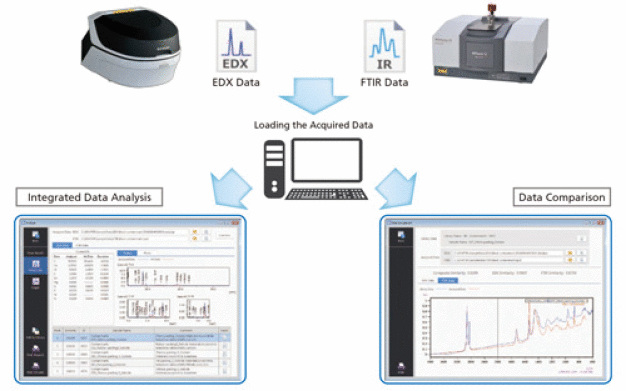
Figure 1: For a differentiated assessment, the following should also be considered: Microplastics are often not just plastics but may also contain traces of unintentionally introduced and potentially hazardous substances. This includes, for example, antimony from antimony trioxide catalysts, mercury, lead, cadmium, and many more. These trace contaminants can be traced using a combined analysis of contamination data and data comparisons, such as with a combination of EDX (Energy Dispersive X-ray Fluorescence Spectroscopy) and FTIR (Fourier-Transform Infrared Spectroscopy), along with an "EDXIR software" for simultaneous processing of data from both methods. (Image: Shimadzu)
Microplastics have arrived in society in a double sense. Chemically-analytically, they have already been detected in the gastrointestinal tract, blood, lymph, and liver of animals1, and even in human stool2. Microplastics have also become a political issue for the general public – an incentive for researchers to shed light and bring clarity to this complex field and to identify potential action needs for the involved companies.
"Anyone working as a researcher on environmental problems cannot ignore microplastics today," says Prof. Dr. Bernd Nowack from the Environmental Risk Assessment and Management Group at Empa in St. Gallen. "But it is important to define what we are talking about here. A key distinction is between primary and secondary microplastics."
Targeted use of plastics
In general, plastic particles smaller than 5 millimeters are referred to as microplastics. Primary microplastics are intentionally added to certain products to achieve specific properties, for example, so-called microbeads in cosmetics. They are intended to serve as exfoliants for the skin to give a fresh appearance, act as fillers or film formers, and control viscosity – apparently true multi-talents.
Microplastics also play a role in technical processes. A study by the University of Basel, for example, uncovered ion-exchange beads made from ion-exchange resins (e.g., based on polystyrene) in the Rhine3.
Manufacturers can do something about primary microplastics. Many seize the opportunity and replace synthetic polymers with natural ones (e.g., walnut shells). In contrast, secondary microplastics, i.e., plastic waste, pose a disposal problem. They are generated, for example, wherever microfibers from polyester textiles are released during washing4.
Both consumers and chemical-pharmaceutical processes need to become more aware: Could microplastics detach during material handling and enter surface waters? Could microplastics be released into the environment from the process itself (e.g., the beads from ion-exchange resins mentioned)?
These questions are becoming even more urgent as a modeling study by the Material Research Institute Empa at the St. Gallen site, in collaboration with the Federal Office for the Environment, sheds new light on the topic. Although the study has not yet been published, it can already be stated5: Secondary microplastics play a much larger role in the overall environmental balance than primary microplastics. The analysis focused on the material flow of seven commonly used plastics: LDPE (low-density polyethylene), HDPE (high-density polyethylene), PP (polypropylene), PS (polystyrene), EPS (expanded polystyrene/foam polystyrene), PVC (polyvinyl chloride), and PET (polyethylene terephthalate). Consequently, it would be more precise to speak of micro-LDPE, micro-HDPE, etc., rather than microplastics in general. The material flow analysis essentially addresses the question: How much of a specific plastic is produced? How are waste materials collected and disposed of? How do residual amounts, for example, reach water bodies?
Plastic analysis is in demand
The researchers initially found that sampling was sometimes done with plankton nets in rivers, and the catch was analyzed under a microscope. Plastics and especially microplastics can be identified in this way. "Overall, we found inconsistent methods both in sampling and analysis, often only qualitative results, and a lack of comparability between the methods used," summarizes Prof. Nowack his experiences.
Analysis of soil is of greater importance and higher complexity compared to microplastics in waters, because most of it ends up there. It involves quantifying polymer carbon within a carbon-rich matrix, often only achievable with very harsh digestion methods. There is a significant need for analytical research, validation, and harmonization of methods in this area.
Tire wear as a prominent challenge
An analytical specialty with increasing importance is tire wear. Over recent years, larger quantities of microplastics have accumulated here and settled in soils. At the same time, analytical chemists have rarely searched for them, as rubber from tires is difficult to identify in environmental samples – even more so than polyethylene.
A certain reassurance comes from a risk assessment aligned with the EU Chemicals Regulation Reach, which yielded very low values5.
"Sometimes, microplastics are measured in grams per liter to trigger a reaction from the 'biosensors' – the Daphnia," notes Prof. Nowack. "Plastic is very inert. So, the 'microplastic problem' might be less severe than generally assumed. However, there are definitely certain rivers in Asia with a somewhat higher risk factor."
In Europe, the ecotoxicological risk posed by microplastics is low but cannot be ruled out. Researchers here also point to signs that microplastics could damage the gastrointestinal tract through the promotion of inflammatory reactions or by the uptake of various accompanying substances2.
Therefore, there is still a significant need for studies on microplastics. Minimizing their presence in chemical, pharmaceutical, and biotechnological processes is advisable based on current scientific knowledge, as is the optimization of analytical procedures for detecting microplastics. This also means that companies and laboratories working according to the state of the art and leading in specialized fields have an ideal opportunity to distinguish themselves in the competitive landscape.
Literature
1. http://www.chemie.de/news/1158036/erstmals-mikroplastik-im-menschen-nachgewiesen.html?WT.mc_id=ca0259 (Accessed 21.2.2019).
2. Assessment of microplastic concentrations in human stool – Preliminary results of a prospective study; Philipp Schwabl, Bettina Liebmann, Sebastian Köppel, Philipp Königshofer, Theresa Bucsics, Michael Trauner, Thomas Reiberger; presented at UEG Week 2018 in Vienna on October 24, 2018 [as cited in reference 1].
3. Mani T, Blarer P, Storck FR, Pittroff M, Wernicke T, Burkhardt-Holm P: Repeated detection of polystyrene microbeads in the Lower Rhine River. Environ Pollut 2019 Feb;245:634-641.
4. Hernandez E, Nowack B, Mitrano DM: Polyester Textiles as a Source of Microplastics from Households: A Mechanistic Study to Understand Microfiber Release During Washing. Environ Sci Technol 2017, 51, 7036-7046.
5. Adam V, Yang T, Nowack B: Toward an Ecotoxicological Risk Assessment of Microplastics: Comparison of Available Hazard and Exposure Data in Freshwaters. Environmental Toxicology and Chemistry 2019;38(2):436-447.

ILMAC
MCH Messe Schweiz (Basel) AG
Messe Basel
4005 Basel
Switzerland
Phone: +41 58 206 3106
email: anne.klipfel@ilmac.ch
Internet: http://www.ilmac.ch