


- Translated with AI
Metal-free research environment
Tracking the deep currents of the oceans
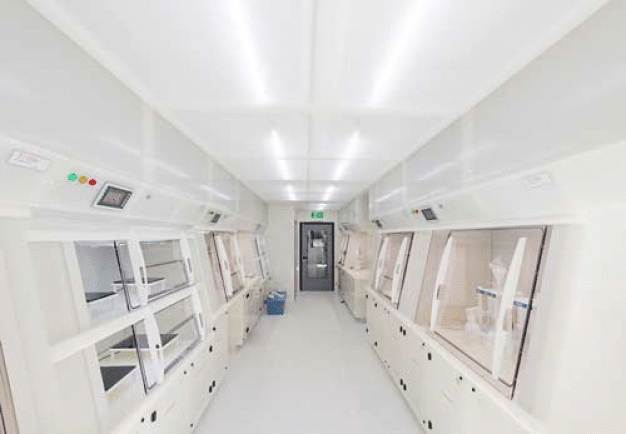
The new specialized laboratory of the ICBM at the University of Oldenburg enables trace element analyses of seawater and sediment samples.
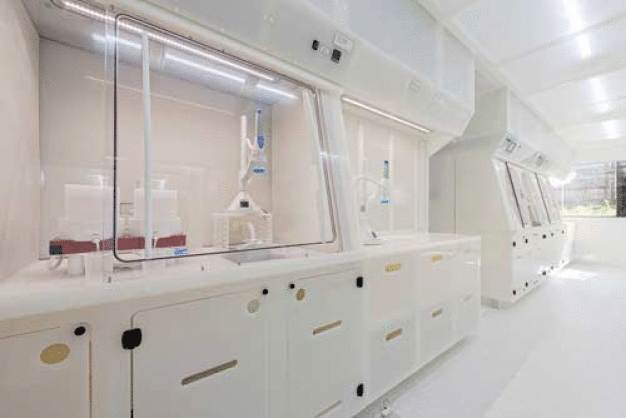
The five workstations are completely metal-free and offer particulate-free conditions at the level of classes 4 and 5 according to DIN EN ISO 14644.
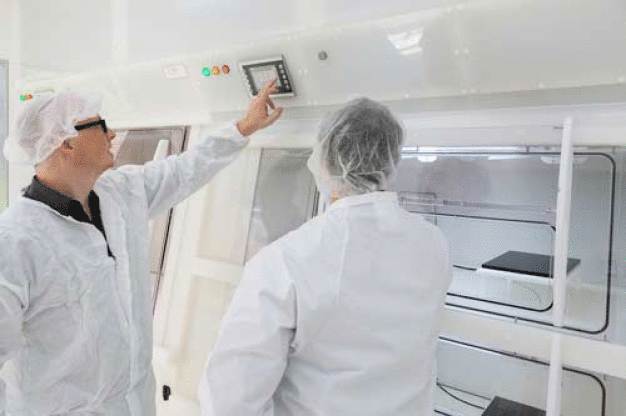
Integrated touch displays allow for individual control of ventilation and supply technology at the workstations.
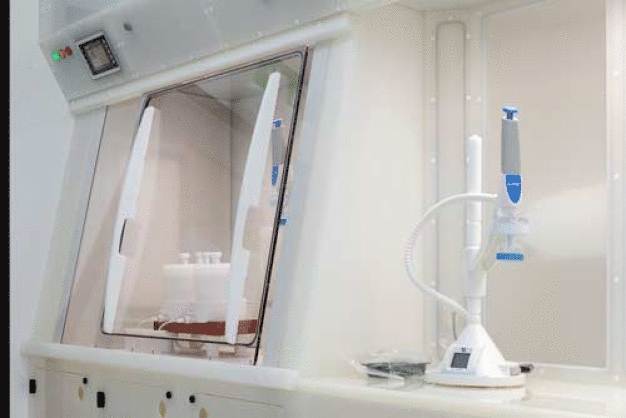
Largely no coloring of plastics was used; the oxides contained in the colors could contaminate the indoor air.
Since 2015, the scientists at the University of Oldenburg have had a completely metal-free specialized room with cleanroom conditions for sample preparation for trace element analysis of seawater and sediment samples. There, highly sensitive samples can now be prepared for the analysis of trace element concentrations and isotopes, which allow tracking deep ocean currents and their historical development.
The flow patterns in the world's oceans play a crucial role in Earth's climate system; however, the physical and chemical processes of the marine environment and their integration into climate dynamics are still largely unknown. The scientists of the Max Planck Research Group Marine Isotope Geochemistry at the University of Oldenburg are therefore tracing the path of seawater. They investigate radioactive isotopes of strontium and neodymium in water and in fossil marine sediments. The sediments include everything that sinks to the ocean floor and deposits there—from organic particles to mineral dust carried by wind from the continents.
Since the composition of these isotopes varies greatly across different regions of the oceans, the research group can use them to trace and decipher the origins of water masses and dust. Samples are taken from aboard German and international research ships at depths of up to 6,000 meters. While the trace elements in seawater provide insights into processes and water mass distributions in the present ocean, the sediments offer a glimpse into the geological development of ocean circulation and its connection to global climate fluctuations.
Cleanroom conditions protect samples
The challenge: The concentration of isotopes in the samples is extremely low—comparable to mixing a drop of dye into several Olympic-sized swimming pools. Even the smallest contamination from microscopic dust particles of rock or corroding metals would fundamentally distort the research results, as these contain the analyzed trace elements at concentrations many times higher. Since 2015, the Institute for Chemistry and Biology of the Sea (ICBM) at the University of Oldenburg has therefore had a specialized laboratory with workstations where particle-free conditions up to cleanroom class 4 according to DIN EN ISO 14644 are maintained, and which is also completely free of any metals.
This specialized room differs significantly from conventional laboratories and cleanrooms, where many surfaces are made of stainless steel. "Even the fumes from highly concentrated acids we use to prepare sediment rock samples for analysis would attack any metal," explains Dr. Katharina Pahnke-May, head of the Marine Isotope Geochemistry research group. "Microscopic metal particles could enter the room air and make our samples unusable."
This requires much more comprehensive planning compared to other cleanrooms designed for maximum particle or germ-free conditions. "In addition to the high standards that trace element analysis demands regarding particle concentration in the room, maintaining compliance with relevant laboratory guidelines and safety regulations was also a challenge," says Dipl.-Ing. Thomas Lischke, responsible for planning and overseeing the project's implementation at the consulting and planning firm Carpus+Partner. "Some requirements call for certain relevant elements to be made of metal. Reconciling this contradiction was part of the challenge."
Laboratory system made of plastic
From the beginning, close collaboration was maintained with MK Versuchsanlagen, one of the few manufacturers of plastic laboratory systems for cleanroom conditions. Based on task- and process-oriented laboratory planning, the room and the customized equipment for five workstations—including ventilation systems, lighting integration, and supply of special media such as fully deionized ultrapure water—were designed and built.
Only acid-resistant plastics such as polypropylene, Teflon, PMMA, or PE were used for work surfaces, substructures, intermediate ceilings, interior walls, or piping. Deliberately, no coloring was used to prevent contamination of the room air by oxides released during coloring. The panels of the enclosed workstations are made of high-strength, transparent polyethylene. All hinges and other door and furniture elements are also made of plastic.
Carpus+Partner integrated the laboratory as a room-in-room system, along with the entrance airlock and technical area, into a former seminar room on the ground floor of the university building. The total area is 55 square meters. The air quality inside the room meets class 6 according to DIN EN ISO 14644, while at the workstations, particle-free conditions are maintained at levels of classes 4 or 5. Sensors continuously monitor all measurement and control systems. Horizontal laminar flows prevent contamination of sensitive areas through displacement principles. Inflow and exhaust are each supplied through side panels made of mesh, which generate a directed airflow. "Of course, all supply lines, including filter elements and other components for air treatment, are also fully made of plastic as custom parts," emphasizes Lischke on the special features.
Custom developments enable research
Another custom development are the so-called Flaps; air-guiding elements at the workstations with two stacked levels that ensure horizontal laminar flow. They were necessary because heating plates are used there to concentrate seawater samples at 80 to 200 °C, often over many hours. The heat from the heating plates causes unsteady, turbulent airflows that unintentionally disturb the laminar airflow and increase the risk of cross-contamination of samples. The Flaps direct the airflow to prevent this.
The heating plates themselves are an in-house development by the Hessian company, manufactured and continuously improved there for 20 years; their aluminum core ensures absolutely homogeneous heat distribution across the entire surface. Their complete encasing in temperature-resistant PTFE prevents metal particles from being released into the surrounding air.
The new room represents a significant improvement in working conditions for the research group led by Dr. Pahnke-May. Previously, analyses were conducted in other university laboratories where only one workstation with a mobile fume hood was available. Particle-free conditions could not be maintained permanently there. Now, scientists can conduct research at five task-specific workstations under optimal conditions. This also makes it possible to analyze trace elements that are particularly susceptible to contamination. "The content of iron or lead, for example, is extremely low in seawater. In metal oxides or rocks, however, it is very high; thus, they are always present as dust in normal ambient air," explains Pahnke-May. "Before the new room was built, analyzing such isotopes was impossible."
Carpus+Partner AG
52074 Aachen
Germany