




- Trade fair
- Translated with AI
Medica 2021: Development of medications – Software considers movement of atoms
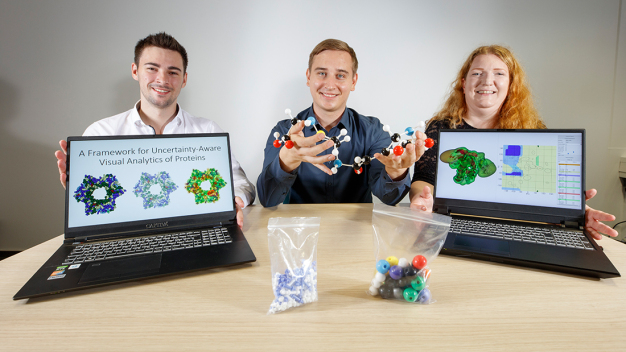
The team is working on the new software (from left to right): Kurt Schardt, Robin Maack, and Christina Gillmann. (Photo: View/Reiner Voss)
Medications often help with various diseases. To be effective, researchers need precise information about the surface molecules of viruses or bacteria. Often, the movement of the atoms of these molecules is neglected during drug development. However, this can affect the efficacy. A team of researchers is working on software that takes such movements into account. It is particularly useful for drug development. The team will present their work at the Medica medical technology fair from November 15 to 18 in Düsseldorf at the Rhineland-Palatinate research stand (Hall 3, Stand E80).
Many years of development work are required before a drug reaches the market. The active ingredient must be at the right concentration and in the right place to exert its effect. It should also cause as few side effects as possible. The chemical structure plays an important role in such substances. Often, they consist of long-chain protein molecules. "There is a repeating basic structure, called the backbone, which consists of carbon and nitrogen atoms," explains computer scientist Robin Maack, a doctoral student in the "Computer Graphics and Human Computer Interaction" working group led by Professor Dr. Hans Hagen at the Technical University of Kaiserslautern (TUK). "You can imagine that the atoms are not fixed but move. This can lead to significant shape changes of the molecule, especially in the backbone."
For the development of molecules, certain configurations can have consequences. Many conventional programs that represent and visualize proteins ignore the movement processes of the underlying atoms. "They are often considered as fixed spheres in space, although they have a certain range of motion," Maack explains. "Movements can lead to interactions between atoms."
Maack is currently working with his colleague Dr. Christina Gillmann from the University of Leipzig on software that calculates this range of motion and visualizes it together with the original visualization without obscuring existing information. "Users can combine different visualization methods and color schemes with the software," Maack continues. "It is designed to be clear and also allows the representation of positional uncertainties of atoms."
The computer scientists feed their algorithm with data from simulated and real molecules. The focus is on observing the movement of atoms. "The program now shows more precisely which parts of a molecule are stable and which are not," says Maack.
This method is particularly interesting for the development of drugs and other active substances. The technology allows quick assessment of whether it makes sense and is even possible to develop and produce the molecule.
The team will present their work at Medica.
Technische Universität Kaiserslautern
67663 Kaiserslautern
Germany