


- Cleaning as a Service
- Translated with AI
Market specialized cleaning services
How cleanroom service providers reach the right decision-makers
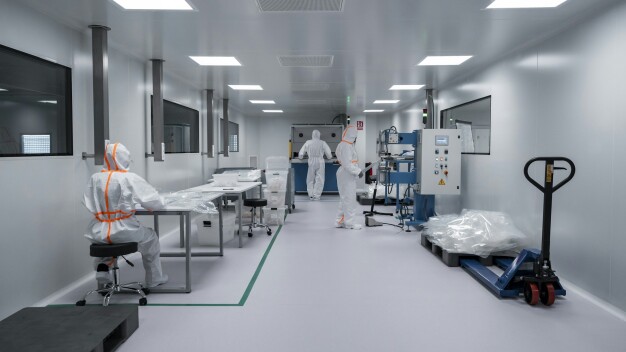
Production cleanroom with employees in protective suits (Photo: TECNIC Bioprocess Solutions / Unsplash)
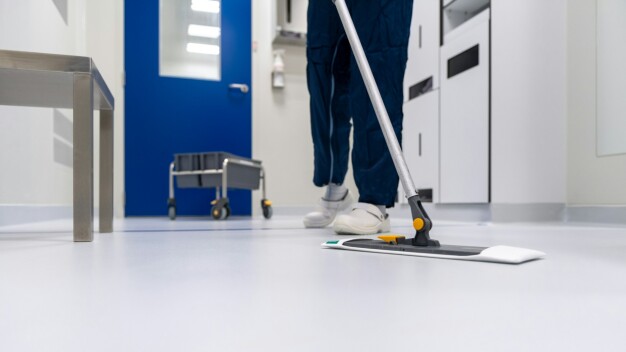
Cleaning the floor in the cleanroom corridor (Photo: Toon Lambrechts / Unsplash)
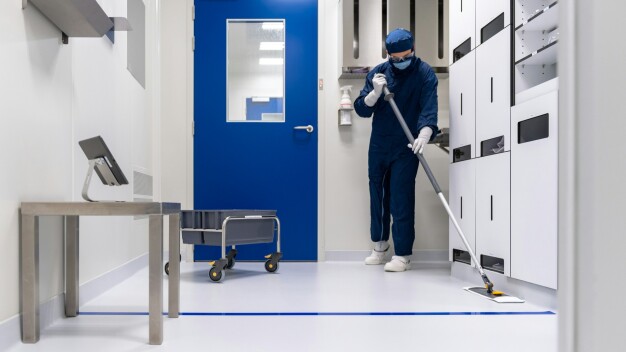
Cleaner in cleanroom clothing while mopping (Photo: Toon Lambrechts / Unsplash)
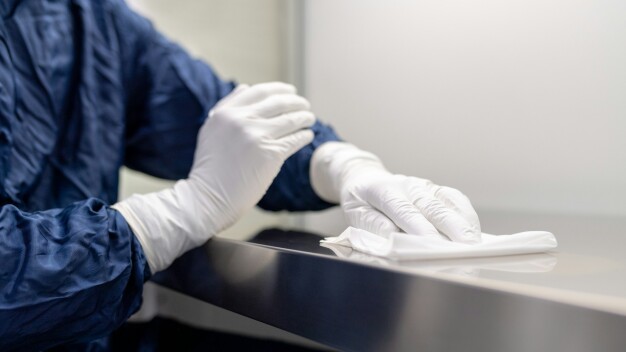
Wiping a stainless steel surface while wearing gloves (Photo: Toon Lambrechts / Unsplash)
Those who clean cleanrooms are not selling square meters, but safety. A cleaning error can cost a batch, halt production or jeopardize an audit. Accordingly, customers are very cautious when choosing their service provider. For providers, this means that the methods through which traditional contract cleaning wins new orders hardly work here. This article shows how specialized cleaning service providers can find and approach their small, highly specific target group and stay in contact throughout long decision-making processes.
1. Why specialized service providers have to sell differently
In office contract cleaning, the price per square meter is often the deciding factor. Offers can be compared, and switching providers is quick and easy. Cleanroom cleaning is different:
– The number of potential customers is small. In a region, there are often only a few dozen companies with cleanrooms, spread across pharmaceuticals, medical technology, electronics, optics, food and research.
– Switching is time-consuming for the customer. New employees have to be trained, processes validated and documentation adapted. No quality manager changes providers without a good reason.
– Price is rarely the trigger. Companies switch when the existing service provider makes mistakes, staff turnover is constant, an audit reveals deficiencies or a new facility is built.
The conclusion is clear: Advertising with discounts or broad mailings to “all companies in the region” achieves little in this market. Success comes to those who know the few suitable companies, approach the right people there and are present precisely when a reason to change arises.
2. Who is involved in decisions in pharmaceuticals, electronics and medical technology
The decision about cleanroom cleaning is almost never made by one person alone. Typically, three to five people are involved, and each role focuses on something different:
– Quality assurance (QA, quality management): How is documentation handled? Is there a trained permanent staff? How are deviations dealt with?
– Production or cleanroom management: Does the cleaning fit into the shifts? Does it disrupt operations? Who can be reached in the event of problems?
– Hygiene or environmental monitoring (in pharmaceuticals and medical technology): Are the products, change intervals and procedures compatible with the measurement results?
– Purchasing: Compares offers and contract terms, but usually only becomes involved at a later stage.
– Technical management or facility management: Responsible for the rooms and equipment, and often also for the tendering process.
In terms of approaching prospects, this means that purchasing is rarely the best first contact. It is more sensible to start with quality assurance or cleanroom management—in other words, where cleaning problems are noticed first.
3. How to find these contacts
The target group is small, so careful preparation is worthwhile. A simple approach has proven effective:
Step 1: Build a list of companies. Good sources include association directories, exhibitor lists from trade fairs, industry portals, location lists for industrial parks and job advertisements. Companies looking for cleanroom personnel or hygiene specialists usually operate cleanrooms as well.
Step 2: Identify triggers. New buildings, expansions, new production lines, relocations or certifications are often announced in press releases, local newspapers and on careers pages. A company that is currently building a new cleanroom will soon need someone to clean it.
Step 3: Identify the responsible people. Websites rarely list names from quality assurance. The most direct approach is a brief call to the switchboard with an open question: “Who is responsible for cleaning the cleanrooms at your company?” Make a note of the name, even if the actual conversation takes place later.
Step 4: Record everything. With only a few dozen target companies, every piece of information counts: contact person, current service provider, contract term and planned projects. A simple spreadsheet or a small CRM is entirely sufficient.
4. How to get to the first conversation
The initial contact should not be a sales pitch, but a conversation about the customer’s situation. Three basic principles help:
Be specific rather than general. “We also clean cleanrooms” sounds like an all-rounder. A clear reference is better: “We clean ISO 7 and ISO 8 cleanrooms in the medical technology sector, with a permanent core team and complete documentation.”
Ask questions instead of presenting. Good opening questions include: How satisfied are you with your current service provider’s documentation? How often does their staff change? Do you have an audit or expansion coming up soon? The answers will show whether there is a reason to act at all.
Take a small next step. The goal of the first conversation is not to submit an offer, but to arrange an on-site appointment: an inspection of the rooms, a discussion with quality assurance or an invitation to be included in the next tender. Anyone who arranges this step properly—with a date, time and the right participants—has achieved a great deal.
It is important to remain honest: If a company is satisfied with its service provider and sees no reason to change, a conversation about the subject is not wasted. It is the beginning of a long-term relationship (see point 6).
5. What matters in the initial meeting: evidence, processes and reliability
When an on-site appointment takes place, the participants primarily want to know one thing: Can I rely on this service provider? What is convincing here is less likely to be brochures than verifiable documentation:
– Staff training records: Who was trained, when and in what, and how are new employees onboarded?
– Sample documentation: An anonymized example of cleaning records, checklists and the handling of deviations.
– Process description: Sequence, products and change intervals, material flow, and the entry of personnel and materials.
– Stand-in arrangements: What happens in the event of illness or vacation? Who steps in, and has this person also been trained?
– Contact person: A dedicated site manager with a telephone number who can be reached in an emergency.
It is helpful to prepare these documents in a small folder that remains at the company after the meeting. It will be passed on internally, including to people who were not present at the appointment.
6. Long decision-making processes: how to stay in contact for months
In cleanroom cleaning, many months, and sometimes years, often pass between the first conversation and an order. Existing contracts expire, budgets are planned in the fall, and new facilities only become operational after a long construction period. Anyone who disappears during this time will be forgotten when the decisive opportunity arises.
Scheduled follow-ups rather than spontaneous calls have proven effective:
– After the initial meeting: a brief email summarizing the points discussed and the documentation folder.
– Every three to four months: a brief call with a genuine reason, such as asking about the status of a planned project or pointing out an innovation in your own company.
– Well before the current service provider’s contract expires: a conversation about a possible inquiry. This is why it is worth asking about the contract term during the first conversation.
– When the customer’s staff changes: New people responsible for quality assurance often take a closer look at existing service providers. A brief introductory call is worthwhile at this point.
The key is that every contact should provide value to the customer. Anyone who only asks whether there is “anything new yet” will quickly become a nuisance. Those who listen, remember previous conversations and provide relevant information, on the other hand, remain in the customer’s mind as a reliable contact.
Conclusion
Specialized cleaning is based on trust, and trust is created through conversations, not advertising. Cleanroom service providers who know their target companies, approach the right people in quality assurance and production, convince them in the initial meeting with evidence rather than promises and patiently remain in contact for months will be there when a customer wants to switch. This takes time, but it can be planned. And in a market with few customers, every single one counts.
Checklist to take away
1. Create a list of all companies with cleanrooms in your service area
2. Monitor triggers: new construction, expansion, audit, staff changes
3. Identify the people responsible in quality assurance and cleanroom management
4. Conduct the initial contact as a conversation, with the goal of arranging an on-site appointment
5. Prepare a documentation folder: training, sample records, processes and stand-in arrangements
6. Ask about contract terms and schedule follow-ups at fixed intervals
About the author
Martin Werning is managing director of Akquise Werning UG (limited liability) from Beselich in Hesse. The agency supports B2B companies, particularly in the commercial cleaning sector, with telephone-based new customer acquisition and arranges site inspection appointments with commercial decision-makers. www.akquise-werning.de
Akquise Werning UG (haftungsbeschränkt)
65614 Beselich
Germany