



- Translated with AI
Magnonic nanofibers pave the way for a new type of computers
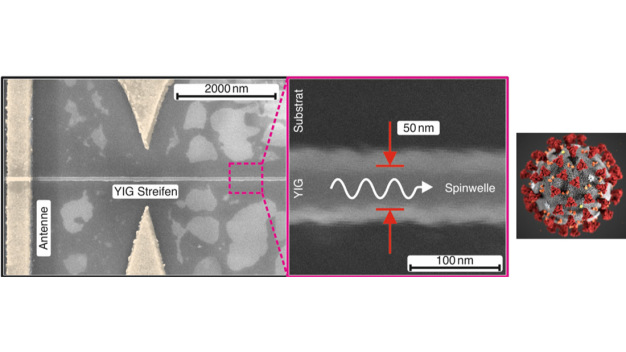
The left panel shows an image of a 50 nm wide YIG waveguide generated by scanning electron microscopy. The antenna enables the excitation of spin waves, which then propagate along the strip. The right panel shows an enlarged section of the waveguide compared to the size of the coronavirus. (Source: TUK / Nano Structuring Center)
Magnetism offers new possibilities to develop more powerful and energy-efficient computers, but realizing magnetic computing on the nanoscale is a challenging task. A research team from Kaiserslautern, Jena, and Vienna reports a significant breakthrough in the field of ultralow-power computations using magnetic waves in the journal Nano Letters.
A local disturbance in the magnetic order of a magnet can propagate as a wave through a material. These waves are called spin waves, and the associated quasi-particles are called magnons. Scientists from the Technical University of Kaiserslautern, Innovent e.V. from Jena, and the University of Vienna are known for their expertise in the research field of "Magnonics." Here, magnons are used to develop novel types of computers that could complement today's electronic-based processors.
"A new generation of computers with magnons could be more powerful and, above all, consume less energy. An important prerequisite is that we are able to produce so-called monomode waveguides, which allow us to utilize advanced wave-based signal processing schemes," says Junior Professor Philipp Pirro, one of the leading scientists of the project. "To do this, we need to shift the dimensions of our structures into the nanometer range. Developing such data lines opens up, for example, access to the development of neuromorphic computer systems that mimic the function of the human brain."
However, scaling magnonic technology down to the nanoscale is a challenge: "A very promising material for magnetic applications is yttrium iron garnet (YIG). YIG is a kind of 'noble magnetic material' because magnons in it last about a hundred times longer than in other materials," says the project leader, Professor Andrii Chumak from the University of Vienna. "But everything has its price: YIG is very complex and difficult to handle when trying to produce tiny structures from it. For decades, YIG structures were millimeter-sized, and only now have we managed to reduce this to 50 nanometers, which is about 100,000 times smaller."
For this purpose, a special new technology was developed at the Nano Structuring Center of the Technical University of Kaiserslautern, using YIG layers cultivated by Dr. Carsten Dubs from Innovent e.V. in Jena. A thin metal layer, called a mask, is applied to this YIG layer, covering most of it. The sample is then bombarded with a strong argon ion beam, which removes the unprotected parts of the YIG layer, while the material under the mask remains intact. Afterwards, the metal mask is removed, revealing a 50 nm thin strip of the finished YIG layer.
"Crucial for the success of the entire process was finding the right materials for the mask, determining how thick it must be, and adjusting dozens of different parameters to achieve the desired properties of a YIG layer," says Björn Heinz, the lead author of the paper. "After years of research, we finally found the suitable method—a combination of chromium and titanium layers. The width of the YIG structure is about a thousand times smaller than the thickness of a human hair. Following the successful structuring, the scientists continued to investigate the propagation of magnons to verify whether the nanostructured YIG maintains its superior material properties."
"We were able to show that the structuring process had only a minimal impact on the fantastic properties of this material," says Heinz. "Furthermore, we experimentally demonstrated that magnons can efficiently transport information over large distances in the lines, as previously claimed in theory. These results are a significant step forward in the development of magnonic circuits and demonstrate the general feasibility of magnon-based data processing."
The research was conducted within the framework of the ERC Starting Grant MagnonCircuits (A. Chumak), the Collaborative Research Center SFB 173 Spin+X (P. Pirro), and the DFG project DU 1427/2-1 (C. Dubs), and was supported by the Landesforschungszentrum OPTIMAS.
The results were published in the journal Nano Letters: DOI: 10.1021/acs.nanolett.0c00657
Technische Universität Kaiserslautern
67663 Kaiserslautern
Germany