

- Translated with AI
Laser safety curtains in the cleanroom
(Image: PROTECT - Laser Safety GmbH)
(Image: PROTECT - Laser Safety GmbH)
(Image: PROTECT - Laser Safety GmbH)
Lasers are indispensable in manufacturing in highly sensitive areas such as optics and semiconductor fabrication. Many of these areas are associated with cleanroom manufacturing. When using lasers, the safety regulations specified by standards must be strictly and uncompromisingly observed. Lasers are also used in various sectors of automotive and pharmaceuticals under cleanroom conditions, where all laser safety regulations also apply.
In the development of today's commercially available laser safety products, mainly in the field of large-area shields, the requirements of cleanroom technology have often not been taken into account, making it necessary to work with alternatives.
The requirements for cleanrooms are defined in the standard EN ISO 14644. In addition to the construction and operation of cleanrooms, it also specifies the cleanroom classes. These determine the maximum number of particles of a defined size, increasing in 100 nm steps per cubic meter of air. The cleanroom classes are ordered from 1-9b, with the highest class 1 representing the highest purity with a maximum of 10 permissible particles below 100 nm per cubic meter of air. This class is used in silicon crystal manufacturing. However, most applications occur in the lower classes. In principle, entering a cleanroom from ISO class 4 onwards is only conditionally possible due to contamination risks.
In particle measurement, lasers are an important tool for maintaining cleanroom operation, with diode and He-Ne lasers being notable examples. Occasionally, Nd:YAG lasers are also used in cleanrooms for metal processing. When manufacturing microcomponents that require laser welding processes at the micrometer level, it is necessary to move this to higher-class cleanrooms.
As soon as lasers are used, strict safety regulations apply, governed by DIN EN 60825, DIN EN 207, EN 208, and EN 12254. The safety regulations prescribed here for handling lasers primarily aim to protect the user. Once the laser class 1 described in norm DIN EN 60825-4 and its limits are exceeded, regulations for protecting the physical integrity of the user and bystanders come into effect. This is often the case during maintenance work, where enclosures must be opened. The standards also specify regulations for enclosures and large-area shields. These must be applied uncompromisingly to any laser classified as class 3B or 4, regardless of the environment, technical or economic circumstances, or implementation effort.
Laser safety curtains are a common means of protecting users from scattered radiation and direct hits with laser beams. When these are used in a cleanroom, both laser safety officers and cleanroom managers face a significant challenge. There are two fundamentally different requirements: one from the cleanroom and the other from laser safety, which are both essential and must be implemented without compromise. Typically, cleanroom products are not developed with laser safety considerations in mind, and vice versa, laser safety products are generally not developed considering cleanroom requirements.
A common approach has been to cover laser safety curtains with cleanroom-tested films. This achieves the desired effect of preventing particle emission through the curtain. However, this approach involves significant additional costs, a high loss of flexibility of the curtain, and a noticeable increase in weight due to the covering.
To address this issue, the laser safety specialists from PROTECT-Laserschutz GmbH in Nuremberg have incorporated two products, isoProtect-CR-ESD and isoProtect-CR, into their product portfolio. The key advantage of these two laser safety curtains for cleanrooms is that they are made from single-layer material. The isoProtect-CR-ESD, for example, has a material thickness of only 0.6 mm and a surface weight of less than 700 g/m². Suitable for ISO classes 3-9b, the curtain can be used in nearly all cleanroom environments and also features antistatic and explosion-proof properties. Unique in this segment is the existing FDA and GMP certification, which provides additional safety. Despite the relatively thin material, the curtain offers a DAB 4 protection level in the spectral range of 315 – 1050 nm and a DAB 3 protection level in the spectrum >1050 – 1400 nm according to EN 12254. This allows a wide range of laser applications to be shielded with this lightweight and flexible barrier solution for demanding cleanroom environments.
The laser safety curtain isoProtect-CR for cleanrooms of ISO classes 7, 8, and 9b can, despite its minimal material thickness of one millimeter and its low surface weight of 1.3 kg/m², provide a DAB 5 protection level in the spectral range of 315-1050 nm and, for the further infrared range of >1050 to 1400 nm, a DAB 4 protection level according to EN 12254.
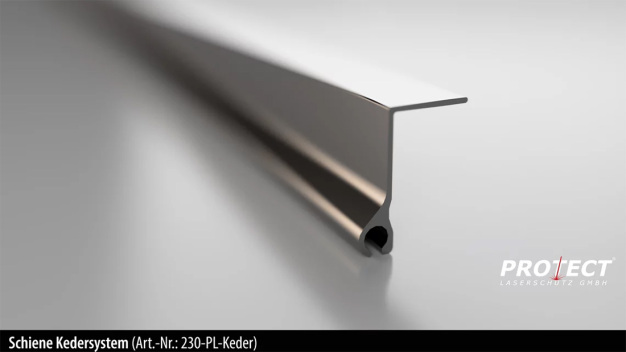
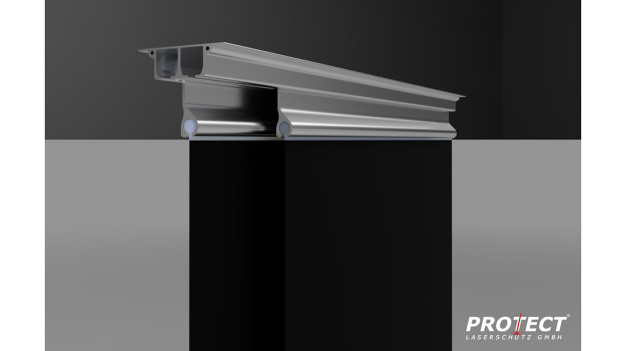
All shielding solutions are also available as mobile frame solutions. These can be designed and used for cleanrooms, enabling both stationary and mobile laser safety solutions for cleanroom applications. The PROTECT-Laserschutz GmbH product portfolio also includes all mounting systems needed for installing laser safety curtains in cleanrooms.
Thanks to the company's focus on this often neglected area of cleanroom laser safety, there is an opportunity to move away from conventional covering methods and to redesign laser safety in cleanrooms. In the near future, further laser safety products for cleanroom applications from the Nuremberg laser safety company are also expected.
PROTECT - Laserschutz GmbH
90453 Nürnberg
Germany