




- Translated with AI
Kubes for research
Specialized technical planning for the Nano Metrology Center LENA
perspective_LENA_pr
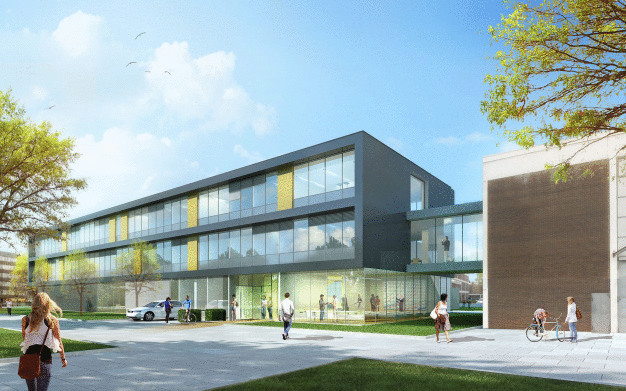
The LENA Laboratory for Emerging Nanometrology at the Technical University of Braunschweig researches nanometrology techniques. A team of interdisciplinary scientists is particularly focused on measuring three-dimensional objects in the nanoworld, which are essential, among other things, for the further development of high-performance batteries for electric vehicles. In the future, the nanometrology center will be housed in a listed, two-story hall building with an attached three-story new building. The design is credited to Meyer Architects and RKW Rhode Kellermann Wawrowsky. pbr AG is responsible for planning the technical equipment.
While the hall building – a former hall for combustion engines – is being converted into physical laboratories and measurement rooms, the three-story new building will accommodate office and seminar spaces. A single-story connecting corridor links the new building and the existing structure on the first floor. Overall, the laboratory building offers over 1,400 m² of space for laboratories and large equipment. Laboratories with particularly high requirements, e.g., for vibration-sensitive applications such as high-resolution transmission electron microscopy, cleanrooms, and measurement rooms with high temperature stability, are housed in a two-story cube within the hall building. Users access the cleanroom area through a shared airlock with multiple segregations and increasing levels of cleanliness, including a temperature-controlled airlock. Through this functional bundling of specialized rooms, the technical installations in this area are consolidated and optimized.
The building services are located on the first floor of the northern wing. Technical systems that could cause disturbances in research operations due to vibrations are housed in the new office building. These include, among others, systems for helium recovery as well as cooling and compressed air generation.
Indoor Air and Climate Control
In three cleanrooms with a cleanliness class ISO 6 according to DIN EN ISO 14644-1, very high standards are set for air purity. A continuously regulated pressure cascade from the cleanrooms through the airlocks and corridors to the main corridors ensures compliance with the specifications. All three rooms are accessed via an airlock with an integrated air shower.
For the laboratory air conditioning, a room-autonomous control system is used that accounts for the different operating conditions of exhaust systems, laboratory cabinets, and local extraction. A sliding air volume change and a demand-oriented room air balance are ensured between maximum and minimum operation. Due to the low permissible room air velocities of < 5 m/min in the setup area for the high-resolution transmission electron microscope (HR-TEM), the supply air is introduced here via textile air hoses. Contaminated exhaust air from laboratories is extracted separately.
Six full air conditioning systems for three cleanrooms and two measurement rooms meet special requirements for temperature stability and lower humidity levels. For example, room 241a requires a humidity of 50% +5/-10% in summer and 40% +5/-10% in winter at a room temperature of 20 °C +/- 1 K (drift < 0.2 K/h). Central cooling is used to supply cooling to devices in the laboratory area. A separate pipe network with different operating conditions than the building’s climate cooling is used for this purpose.
The cooling machine has two separate condensers to dissipate excess heat from the cooling load and the electrical drive power of the compressors. One condenser is used for heat recovery from cooling generation. Through this condenser, a capacity of approximately 100 kW at 50 °C can be provided. The heat recovery is carried out via an adiabatic heat exchanger on the roof, where, at high outdoor temperatures, the heat exchanger for heat transfer to the outside air is wetted with water. The resulting evaporation on the pipe register increases the efficiency of the heat exchanger.
A separate hydraulically isolated cooling system has been set up for the wall cooling of the HR-TEM room. A dry system with capillary tube mats mounted on gypsum board panels was installed inside on a wall construction with a 10 mm thick aluminum plate shielding.
Electrical Engineering and Media Supply
The buildings are connected from the 20 kV campus ring via the medium-voltage level. An energy center with a medium-voltage switchgear, transformers, and low-voltage main distribution is being newly established for this purpose.
The laboratories are supplied centrally and decentrally with the necessary media, e.g., gases such as helium, argon, nitrogen, oxygen, hydrogen chloride, xenon, and neon. For laboratory use, fully demineralized water with a conductivity of 5 µS/cm, a TOC content of 200 ppb, and a microbial count of 100 CFU/10 ml is provided.
A helium recovery system is available for reclaiming used liquid helium within the building. The gaseous helium is initially collected in a roughly 10 m³ storage balloon. When the volume is sufficient, the contents of the collection balloon are compressed back to a maximum of 200 bar using a level-controlled high-pressure piston compressor.
pbr Planungsbüro Rohling AG
49076 Osnabrück
Germany



