

- Cleaning | procedures, devices, agents, media (Wipers, Swaps,...)
- Translated with AI
Key Technologies for Cleaning Robots in Healthcare
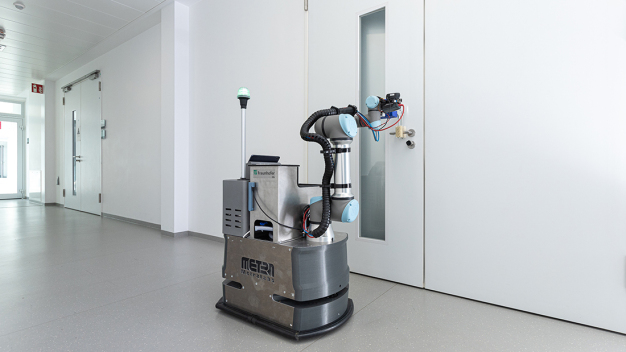
The work of Fraunhofer IPA on cleaning and disinfecting surfaces is based on the robot "DeKonBot 2" and further develops its capabilities. © Fraunhofer IPA/Photo: Rainer Bez
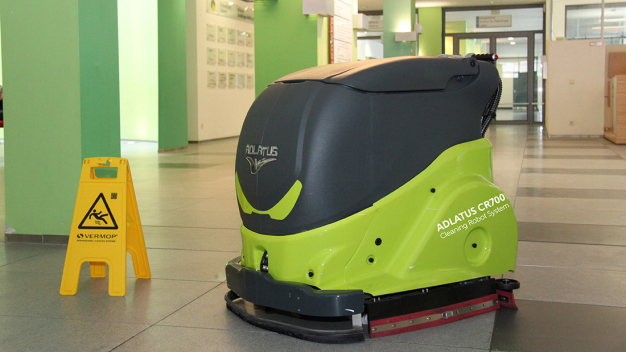
Existing floor cleaning robots can already be used for automated cleaning of large-area environments. © Klinikverbund Südwest
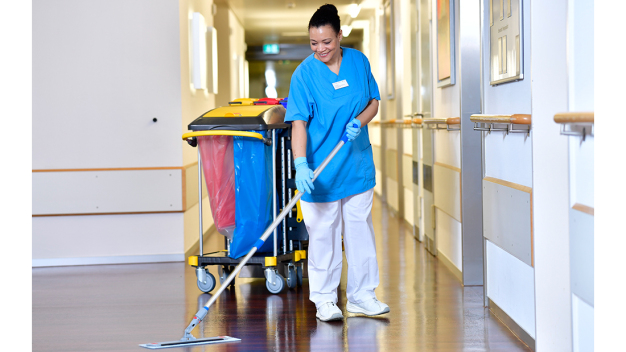
Cleaning and disinfection play an important role in clinics. Source: Klinikverbund Südwest. © Fraunhofer IPA
Regular cleaning and disinfection in healthcare facilities is demanding and labor-intensive. To ease the workload of cleaning staff, the research project "RoReBo" is developing a compact floor cleaning robot, for example for hospitals or nursing homes, as well as technologies for surface cleaning and robot-assisted door opening.
Hygiene has been very important in healthcare facilities not only during the pandemic to prevent infections. For this environment, the newly introduced hygiene standard DIN 130643 "Hospital Cleaning" defines the tasks to be performed. While the standard ensures quality, it also increases the effort required from cleaning personnel. More tasks in less time raise the risk that "hygiene compliance" may suffer. The shortage of skilled workers and demographic changes worsen the problem. Currently, there are no suitable cleaning robots on the market that meet the specific challenges of healthcare both technologically and economically.
This challenge is addressed by the research project "Robot-based cleaning and disinfection of floors and surfaces in healthcare facilities" (RoReBo). Project partners include Adlatus Robotics, InMach Intelligent Machines, bwcon research, and the Fraunhofer IPA. An application partner is, among others, the Southwest Hospital Network. Together, the partners are developing new key technologies and business models for the use of cleaning robots, for example in hospitals and nursing homes. The robots are intended to support and relieve cleaning professionals in their work. Close networking with clinics and nursing homes ensures needs-based development and allows project results to be validated under real conditions. The project receives funding from the Ministry of Economic Affairs, Labour and Tourism Baden-Württemberg as part of the Invest BW Innovation funding program.
Great Potential
In recent years, the market for commercial cleaning robots has grown significantly. According to the "International Federation of Robotics," units sold in 2020 increased by 92 percent compared to the previous year. Devices specifically for commercial floor cleaning sold 20,600 units, making them two and a half times more than before.
Many robot manufacturers have recognized this potential, including the Baden-Württemberg-based company Adlatus Robotics, whose floor cleaning robot already cleans halls in logistics, industry, hospitals, or airports and is easy to operate without special prior knowledge. These are good prerequisites for a broader use of autonomous cleaning robots in hospitals and nursing homes. With new capabilities developed in RoReBo, the company aims to better address the needs of these facilities.
Automated Cleaning in Wards and Patient Rooms
"There is usually not much space on wards and in patient rooms, and they often contain various medical devices or personal items. Nevertheless, the facilities expect thorough cleaning of edges and corners," explains Matthias Strobel, Managing Director of Adlatus Robotics, describing the conditions for robot deployment. This task is best handled by a small, compact robot that can maneuver agilely through the environment. Therefore, Adlatus is developing a new floor cleaning platform in RoReBo, particularly suitable for use in these tight spaces. In addition to conventional floor cleaning modules, the platform will also feature actuation that triggers additional functions to clean hard-to-reach corner areas.
After scientists at Fraunhofer IPA developed functions for robot-assisted disinfection of frequently touched objects in office environments, such as door handles and light switches, in the "MobDi – Mobile Disinfection" project, RoReBo now targets hospitals, specifically corridors, patient, and treatment rooms as deployment environments. For this purpose, the cleaning robot "DeKonBot 2," also developed in MobDi, will be enhanced with new functions in the project. For example, it will receive new adaptive cleaning tools tailored to the specific requirements of hospitals and the surfaces to be cleaned. "An especially important new function is opening doors. This allows the robot to expand its autonomous deployment and access environments such as patient rooms, which were previously inaccessible," explains Simon Baumgarten, project manager at Fraunhofer IPA. "We plan to make the door-opening robot arm so simple that it can be easily used by other robots. This could significantly expand the general deployment possibilities of service robots in public areas," adds Baumgarten.
On the software side, the project partner InMach is further developing procedures for autonomous navigation so that the robot can follow complex navigation patterns and reliably clean edge and corner areas. Fraunhofer IPA experts are expanding their image processing technologies to recognize new surfaces to be cleaned in hallways and rooms, as well as doors and their properties, such as the direction in which they open. The researchers are also adapting their methods so that the robot can clean objects based on the processed image data. Especially challenging is the control for door opening, as the movements of the mobile platform must be synchronized with those of the robot arm.
Addressing Practical Needs
The planned developments are based on needs and requirements analyses from hospital practice. In hospital visits and observations in clinics and nursing facilities, the project partners analyze current manual cleaning processes and conditions for optimal execution. Workshops with practitioners are used to identify needs and requirements for the robot functions to be developed and to validate implementation concepts. Results from previous practical tests with mobile cleaning robots can also be referenced.
After successful implementation, the developed technologies and robots will first be tested in laboratories, then in clinics and nursing homes, and optimized based on experiences. For practical transfer, bwcon is developing suitable business models for healthcare facilities.

Fraunhofer-Institut für Produktionstechnik und Automatisierung IPA
Nobelstraße 12
70569 Stuttgart
Germany
Phone: +49 711 970 1667
email: joerg-dieter.walz@ipa.fraunhofer.de
Internet: http://www.ipa.fraunhofer.de