




- Translated with AI
Kaiserslautern physicists alter atomic interactions in ultracold matter
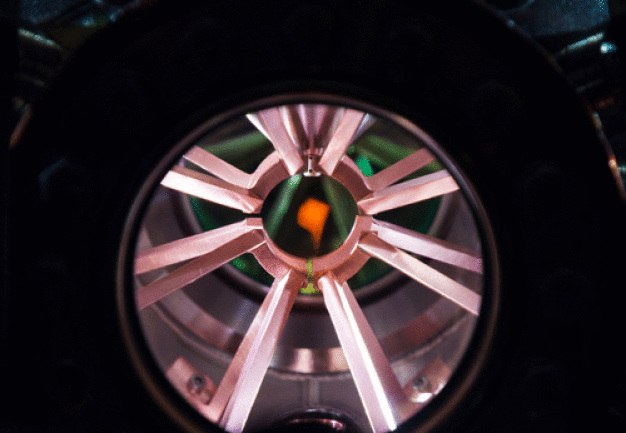
The image shows an ultracold cloud of rubidium atoms (red) in the experiment at TUK. (Photo: TUK/AG Ott)
Physicists from the Technical University of Kaiserslautern (TUK) led by Professor Dr. Herwig Ott have succeeded for the first time in altering the interaction between two atoms in ultracold matter using so-called Rydberg molecules. These recently discovered large molecules consist of only two atoms, whose bonding mechanism cannot be described by conventional chemical models. They possess extraordinary properties such as a large bond length. The study has now been published in the renowned journal "Nature Communications".
Interactions are the fundamental builders of our world. Not only in social life but also in the matter that surrounds us. As early as the beginning of the 20th century, physicist Ernest Rutherford observed that even gold is composed of over 99 percent nothing. Only the interaction of individual particles makes matter what it is. It ensures that our world holds together at its core.
This applies not only to our everyday world but also to the realm of quantum physics. To explore quantum phenomena, physicists often rely on ultracold atomic gases. "Here, temperatures are around absolute zero, approximately -273 degrees Celsius," says Professor Dr. Herwig Ott, who researches ultracold quantum gases and quantum atom optics at TUK. "The behavior of atomic gases is determined by the interaction between the atoms." Experts also refer to this as a quantum mechanical scattering process. "For science, such gases are of great importance in the exploration of quantum mechanical effects because these interactions can be altered in the laboratory," the professor continues.
In the matter that surrounds us in everyday life, this is usually not the case. "The water molecules in a glass of water, for example, always have the same interaction, and the question of what the properties of water would be if the water molecules attracted each other twice as strongly cannot be answered experimentally," explains the physicist.
Now, the scientists led by Professor Ott have succeeded for the first time in changing the interaction between ultracold atoms using so-called Rydberg molecules. The idea for the experiment: two atoms that collide are temporarily excited by a laser beam into a state that corresponds to a molecule. "This causes them to spend more time together," explains the professor. "This alters the quantum mechanical scattering process between the two atoms and thus also the interaction between them."
In the experiment, the Kaiserslautern researchers were able to observe this: they "built" a Rydberg molecule from two rubidium atoms. This form of molecules was only discovered a few years ago. These are molecules that can be as large as viruses but consist of only two atoms. Usually, molecules consisting of two atoms are much smaller. Unlike previously known bonds, where, for example, two atoms share an electron, a different mechanism is at work here: an electron has only a very weak bond to the atomic nucleus and is in an outer electron shell, in a so-called Rydberg state. The second atom then experiences a quantum mechanical interaction with the electron, resulting in a weak bond between the two atoms.
"These molecules are characterized by a number of extraordinary properties," says the professor, "such as their extremely large bond length of several hundred nanometers and their very large electric dipole moments." In scientific terms, this means that molecules can possess spatially separated positive and negative charges.
The results of the Kaiserslautern scientists enable, on the one hand, the alteration of interactions in nearly any ultracold gas. On the other hand, they open up new application possibilities such as the direct control of multi-particle interactions. "But interactions with longer ranges than previously possible can also be induced in the future," the physicist adds as another example. "This could allow the realization of novel states of matter in ultracold gases in the future."
The study was published in the renowned journal "Nature Communications": "Experimental realization of a Rydberg optical Feshbach resonance in a quantum many-body system"; O. Thomas, C. Lippe, T. Eichert & H. Ott
DOI: https://doi.org/10.1038/s41467-018-04684-w
The work was funded by the State Research Center for Optics and Materials Science, known as OPTIMAS, the graduate school "Materials Science IN Mainz" (MAINZ), and the two collaborative research centers "Condensed Matter Systems with Variable Many-Body Interactions" and "OSCAR - Open System Control of Atomic and Photonic Matter".
Technische Universität Kaiserslautern
67663 Kaiserslautern
Germany