

- Packaging
- Translated with AI
Into the bottle
Triple capacity for Portugal’s popular mineral water: Água de Luso invests in a highly efficient returnable glass line from KHS
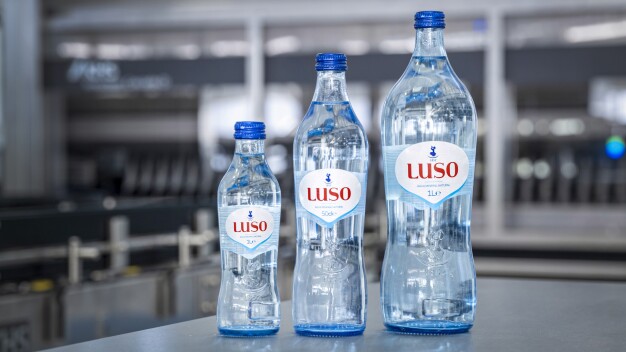
Still mineral water from Água de Luso is available in three different bottle sizes hold-ing 250 and 500 milliliters and one liter. (Copyright: Frank Reinhold)
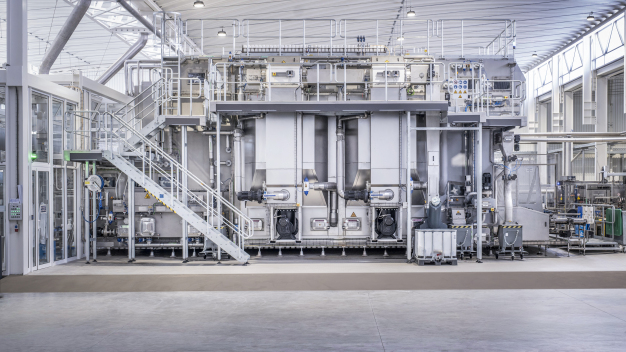
Thanks to the KHS Innoclean Cascade-D cleaning machine, the entire line requires 50 percent less thermal energy per bottle than before. (Copyright: Frank Reinhold)
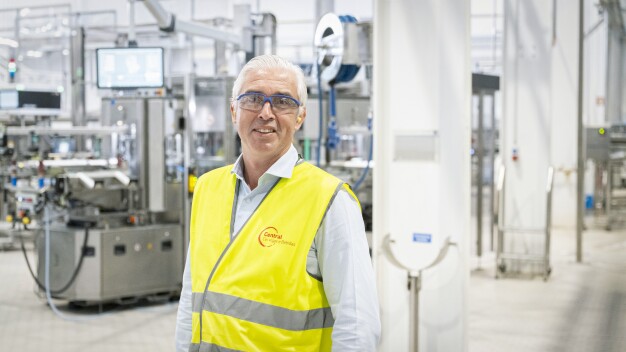
“Our operators and KHS’ engineers helped each other out. They forged a real bond”, says Pedro Sousa, Support functions manager, Sociedade Central de Cervejas e Bebidas (SCC). (Copyright: Frank Reinhold)
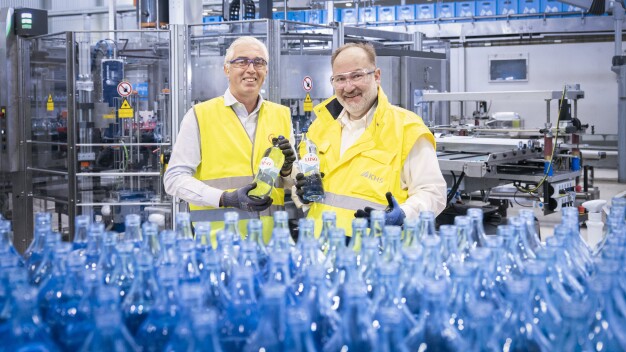
Pedro Sousa and KHS Global Key Account Manager Frank Schneidermann (right) have known each other for 14 years. (Copyright: Frank Reinhold)
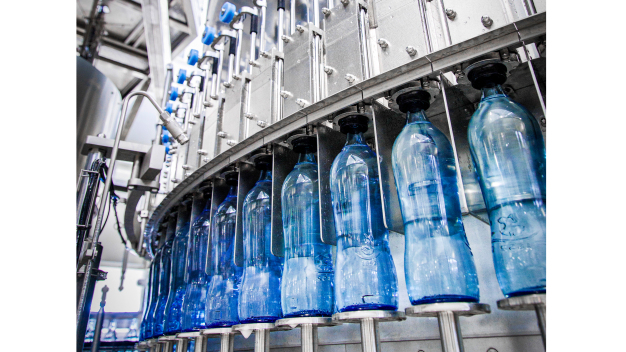
With its new returnable glass line – here the filler carousel on the KHS Innofill Glass DRS – Água de Luso has tripled its capacity. (Copyright: Frank Reinhold)
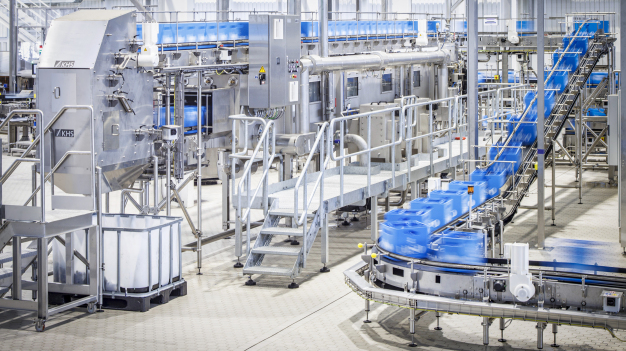
The KHS Innoclean KW crate washer uses residual heat from the washing machine and therefore doesn’t need its own heater. (Copyright: Frank Reinhold)
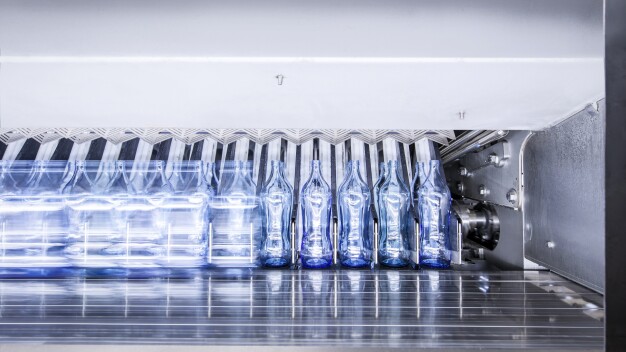
The technical highlight of the new returnable glass line for Água de Luso is the KHS Innoclean Cascade-D bottle washing machine. This sends sanitized bottles directly to the clean room. (Copyright: Frank Reinhold)
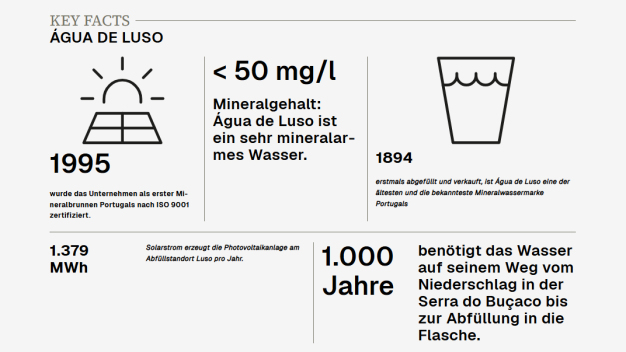
Five facts Água de Luso (Copyright: KHS GmbH)
A Portuguese love brand born of nature: Água de Luso has been refreshing Portugal for more than 170 years. Now, a new KHS returnable glass line fills the mineral water – both still and sparkling – three times faster than before. The journey has been quite a challenge: the purity of the water tests the filler, while a severe storm initially throws the schedule into disarray.
Before the water from Luso becomes known as a beverage, the town first makes a name for itself as a spa: the warm spring is first described as early as 1726. The locals simply call it “Banho.” From the mid-19th century onward, spa guests begin arriving and eventually take the water home with them. Filling and sales begin in 1894. Shortly afterward, a bacteriological analysis certifies that the water is “puríssima,” or extremely pure.
Over the decades, this develops into a national brand: “Today, Água de Luso is considered the best-known still mineral water in Portugal – a true love brand,” says Pedro Sousa. As Support Functions Manager, he is responsible for investments and innovation at Sociedade Central de Cervejas e Bebidas (SCC). The beverage manufacturer, which belongs to the HEINEKEN Group, now has the brand in its portfolio. To ensure that Água de Luso continues to meet consumer expectations in the future, SCC has installed a new KHS returnable glass line at its production site in Vacariça.
Returnables with a future
It replaces a line that had reached the end of its life cycle after around 40 years. At the same time, the market is changing: PET still dominates in Portugal, but the EU Packaging and Packaging Waste Regulation (PPWR), new national laws and deposit-return systems are putting pressure on single-use plastics. Demand for returnable glass is growing. For SCC, the investment is therefore a strategic decision to strengthen its positioning in the premium segment and promote circularity – especially for the important food service business. “Of course, nobody goes jogging with a glass bottle,” Sousa says with a laugh. “Nevertheless, there are many applications in which glass is a competitive option.” The returnable concept also plays an important role with regard to the company’s sustainability goals. “Our returnable glass bottles make an average of 19 cycles in the 1-liter format, and as many as 21 in the 500-milliliter format – so each bottle remains in use over many cycles.”
One line, many goals
With the new acquisition, SCC is pursuing several goals at once: “By tripling output to as many as 40,000 bottles per hour, we wanted to create sufficient capacity for future growth,” explains Sousa. “We placed particular emphasis on the highest possible line efficiency, significantly lower energy consumption and the lowest possible total cost of ownership.”
SCC’s decision to opt for a complete line from a single source was primarily due to the fact that all the machines are integrated into a common network and follow uniform operating standards. This makes it easier to connect to the “Connected Brewery,” HEINEKEN’s digitalization program: IoT sensors collect data from the line and analyze it in dashboards. “With an integrated solution, this runs through a single interface,” explains Sousa. “With standalone machines, it would be much more complex.”
Keeping purity pure
Product quality is always Água de Luso’s top priority. With less than 50 milligrams per liter, the water has an extremely low mineral content. This gives it a particularly neutral, soft taste – and makes it suitable for preparing baby food. On the other hand, this presents a challenge for the filling technology: conventional fill-level probes use the product’s electrical conductivity. At around 60 microsiemens per centimeter, however, Água de Luso’s conductivity is too low for reliable measurement, which requires around 250 microsiemens per centimeter. The solution is provided by KHS’s modular filler platform. It enables a probe filler such as the KHS Innofill Glass DRS to also be configured as a volumetric filler (VF). Instead of being controlled by the fill level, dosing is based on the precisely measured quantity. This allows the filling technology to be flexibly adapted to individual product requirements.
In Vacariça, the rotary filler with 110 filling valves fills up to 40,000 500-milliliter bottles per hour – as well as 1-liter and, in the future, 0.25-liter containers. Both still and carbonated water are processed.
Efficient cleaning
The technical highlight of the line is the KHS Innoclean Cascade-D bottle washer. It washes the bottles returning from the returnable cycle with cleaning solution heated to 70 degrees Celsius – and is also the only heat consumer in the entire line. The KHS Innoclean KW crate washer requires no heating of its own; residual heat from the bottle washer is sufficient. The result: per container, the new line requires 50 percent less thermal energy than the old one. In double-end bottle washers, the heat exchanger for heating is normally located high up in each caustic bath, making access difficult. The straight-tube heat exchanger installed by KHS outside the machine for the first time, alongside it, is easily accessible and thus simplifies operation and maintenance. One heat exchanger can heat up to three caustic baths. The separation also makes it easier for SCC to switch from steam to another heating medium at a later date, such as one from renewable sources like solar thermal energy or heat pumps. The machine operates fully automatically; the clean bottles go directly into the cleanroom.
Acceptance during peak season
The planning alone required considerable coordination: while the line layout was being developed, the associated hall was being built in Vacariça at the same time. SCC was also developing a new beverage crate. The KHS machines had to fit both. At the end of January 2026, the weather thwarted everyone’s plans: Storm Kristin hit Portugal with full force. “The hall was finished and the machines were packed on the truck,” recalls Frank Schneidermann, who has been responsible for the Portuguese market at KHS since 2010. “But many roads had been destroyed, while others had to be closed to heavy-duty transport.”
The delivery was delayed by around six weeks, and the installation team was initially withdrawn. However, some of the delay was made up over the course of the project. Commissioning, optimization and acceptance nevertheless took place during peak season. “For a returnable line, this is a delicate situation, because in summer the empty containers are with customers,” explains Sousa. “It was the first time I had experienced complete optimization under these conditions.” Nevertheless, acceptance was completed – in one of the strongest sales months of the year, of all times. And the time pressure had a positive side: KHS training took place directly under real production conditions. “Our operators and the KHS technicians supported each other,” says Sousa. “That created a genuine bond.” The team also quickly grew accustomed to its new line: “The feedback has been consistently positive. Our people are proud to be working with the best technology on the market,” says Luso.
Mutual trust
After more than 30 years of close partnership, KHS and SCC are connected by much more than individual projects. Three KHS glass lines and one keg line are in operation at the Vialonga brewery near Lisbon. Numerous individual machines have also been installed. On the service side, local technicians who speak the native language are available on site. Schneidermann and Sousa themselves have known each other for around 14 years. “Our partnership is based on mutual trust,” says Sousa. “Even if we sometimes have different points of view, we always find the best solution for both sides in the end.” This could continue for many years to come. At Luso, people are used to thinking in longer time frames anyway.
KHS GmbH
44143 Dortmund
Germany