




- Translated with AI
Nina Passoth, Berlin
International multicenter study on the prevention of nosocomial infections in intensive care units
Antimicrobial copper alloys significantly reduce microbial load and disease cases
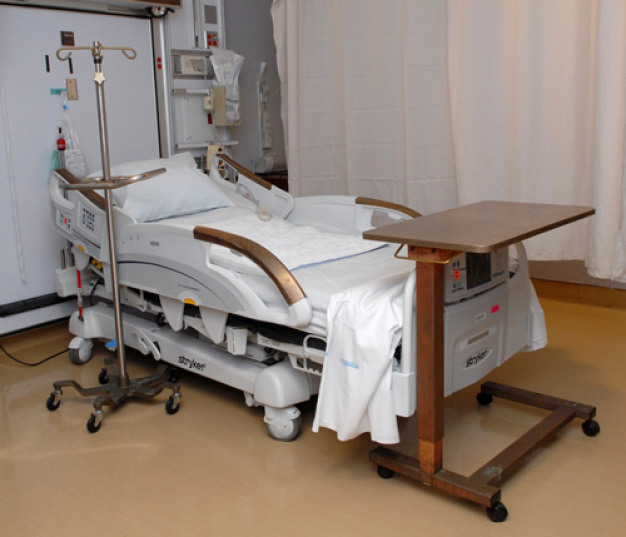
Study room at Ralph H Johnson Veteran Affairs Medical Center in Charleston: Bed handles, side table, and infusion stands made from antimicrobial copper alloys reduce the risk of infection on high-touch contact surfaces (Source: German Copper Institute Professional Association)
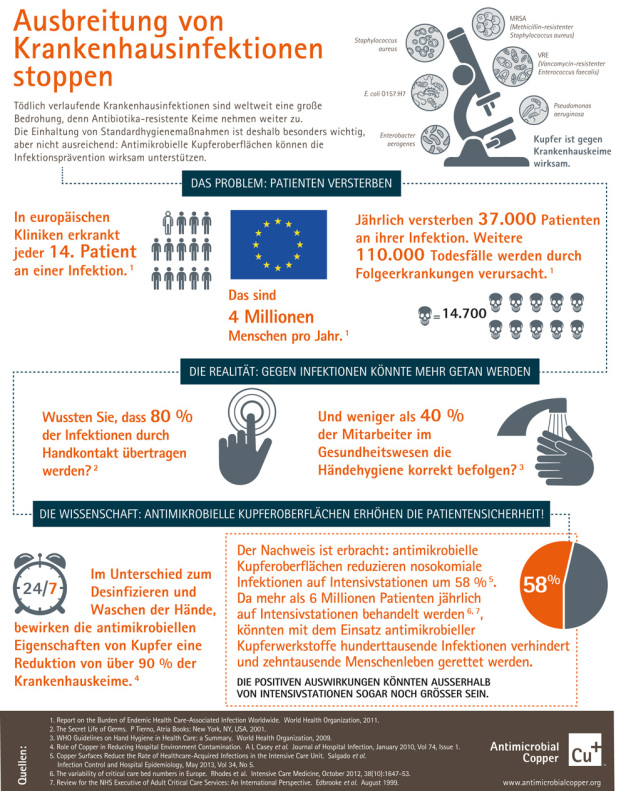
Stop the spread of nosocomial infections (Source: Copper Development Association Inc.)
Current study results from the Medical University of South Carolina demonstrate that the use of antimicrobial copper alloys can reduce the risk of nosocomial infections in intensive care units by 58 percent. This study provided the first clinical evidence that copper materials significantly decrease microbial load on contact surfaces. Copper surfaces not only inactivate antibiotic-resistant germs but also many other pathogens, thereby minimizing infection transmission in healthcare facilities. The benefits of supplementary hygiene measures are confirmed by this international multicenter study.
In Europe, every 14th patient acquires a nosocomial infection during a hospital stay. This leads to an estimated 147,000 deaths annually. A recently completed study, with results to be published in the "Journal of Infection Control and Hospital Epidemiology" in May of this year, shows that antimicrobial copper materials permanently reduce microbial contamination and thus can minimize infection rates. Copper is the only material that sustainably inactivates microorganisms.
Therefore, antimicrobial copper surfaces in hospitals represent an important complementary measure to the Robert Koch Institute’s 4-Square Strategy.
The study was conducted in intensive care units of three major US hospitals: the Medical University of South Carolina, Memorial Sloan-Kettering Cancer Center in New York City, and Ralph H. Johnson Veterans Affairs Medical Center in Charleston, South Carolina. The study was funded by the United States Department of Defense.
Addressing the question of reducing microbial load through the use of copper alloys in hospital rooms, the study builds on international research from Germany, Japan, Chile, and the United Kingdom. The Asklepios Clinic Wandsbek served as the German reference site.
Copper has a lasting antimicrobial effect
"Massive copper alloys offer an alternative to reduce the growing number of nosocomial infections without additional effort for nursing staff and cleaning personnel," explains Professor Dr. Michael Schmidt, co-author of the study and Deputy Head of the Department of Microbiology and Immunology at the Medical University of South Carolina. "Due to the continuous and durable antimicrobial effect of copper, it can be shown that the proliferation of pathogens on these surfaces is significantly reduced. Using copper thus provides a safer environment, especially for already weakened patients."
To determine the effectiveness of massive copper alloys in relation to the rate of nosocomial infections, frequently touched surfaces were replaced with antimicrobial copper equivalents. The study selected intensive care units because patients here have an overall higher risk of infections. Reasons include the severity of their illness, the often invasive procedures, and not least, frequent close contact with healthcare staff.
Patients were randomized and assigned to rooms with or without antimicrobial copper surfaces to compare the rates of nosocomial infections. Between July 2010 and June 2011, a total of 650 patients participated in the study, cared for in 16 rooms (eight equipped with copper and eight standard rooms).
Among the items made from copper materials or part of the standard equipment were bed rails and headboards, bedside tables, infusion stands, call buttons, and door handles. Cleaning routines were the same in both the study and control rooms.
Antimicrobial copper alloys reduce surface microbial load by 83%
The results of the first phase of the study, published in July 2012 in the "Journal of Clinical Microbiology," already showed that antimicrobial copper alloys reduced microbial contamination by an average of 83% over a period of 21 months. The study compared microbial contamination on contact surfaces with and without copper during active patient care, as well as between routine cleaning and disinfection. It was found that two significant antibiotic-resistant germs, methicillin-resistant Staphylococcus aureus (MRSA) and vancomycin-resistant Enterococcus (VRE), were detected with much lower probability on copper surfaces.
As a result of the study, 46 patients developed a nosocomial infection, including 26 patients colonized with MRSA or VRE. In patients housed in rooms with items made from antimicrobial copper alloys, the rate of nosocomial infections was reduced by 58% compared to those in "non-copper" rooms.
The proportion of patients who developed nosocomial infections and/or colonization with MRSA or VRE was significantly lower among patients in rooms with copper surfaces (7.1%) compared to those in traditional rooms (12.3%). The proportion of patients who developed nosocomial infections was significantly lower among those assigned to "copper rooms" (3.4%) compared to those in traditional rooms (8.1%).
Synergy effects in hygiene management promote quality and reduce costs
"Patients suffering from nosocomial diseases stay longer in hospitals, incur higher treatment costs, and have a higher mortality risk due to hospitalization," says Dr. Kassandra D. Salgado, study leader and Assistant Professor at the Medical University of South Carolina. "Our study shows that equipping contact surfaces with antimicrobial materials makes an additional contribution to infection control in intensive care units. On the one hand, nosocomial infections could be contained; on the other hand, colonization with resistant pathogens was also reduced."
In Germany, the hotspots of infection are increasingly coming into focus for hygiene experts. Initial reference projects with an expanded prevention approach and the creation of synergy effects in hygiene management can be found at clinics in Berlin, Hamburg, Hagen, Velbert, and Apolda, as well as nationwide in various medical practices.
How copper works largely unraveled
Why bacteria die on copper surfaces has recently been largely unraveled by biochemists from the University of Bern in collaboration with materials researchers from Saarland University. In laboratory experiments, the team demonstrated that bacteria only die when in direct contact with the copper surface. Individual copper ions in a liquid are often not sufficient. The scientists published their findings in the journal "Applied and Environmental Microbiology" of the American Society for Microbiology.
In the laboratory, the researchers used laser interference technology at the Steinbeis Research Center for Materials Engineering (MECS) in Saarbrücken. A copper plate was coated with a thin plastic layer. Using pulsed laser beams, the researchers drilled tiny holes into this layer, creating a honeycomb pattern. The holes were half a micrometer, a millionth of a meter, smaller than the diameter of bacteria. "The surprising result for us was that bacteria on this surface did not die, even though copper ions were released," explains Professor Dr. Frank Mücklich from MECS. In a comparison test with an uncoated copper plate and the same concentration of copper ions, all bacteria were destroyed after a few hours. "This shows that bacteria mainly die upon direct contact with the copper surface. Apparently, this first attacks the cell wall and thus creates the conditions for copper ions to completely destroy the cells," concludes the interdisciplinary research team. This suggests that complex electrochemical processes between the copper plate and the microbes on the surface play a role.
Sources:
1. Mathews, S.; Hans, M.; Mücklich, F.; Solioz, M. (2013):
Contact Killing of Bacteria on Copper is Suppressed if Bacterial-Metal Contact is Prevented and is Induced on Iron by Copper Ions.
In: Applied and Environmental Microbiology, 79 (8): 2605-2611.
2. Salgado, C. D.; Sepkowitz, K. A.; John, J. F.; Cantey, J. R.; Attaway, H. H;
Freeman, K. D.; Sharpe, P. A.; Michels, H. T.; Schmidt, M. G. (2013):
Copper Surfaces Reduce the Rate of Healthcare-Acquired Infections in the Intensive Care Unit.
In: Infection Control and Hospital Epidemiology, 34 (5): 479-486.
3. Schmidt, M. G.; Attaway, H. H.; Fairey, S. E.; Steed, L. L.; Michels, H. T.;
Salgado, C. D. (2013):
Copper Continuously Limits the Concentration of Bacteria Resident on Bed Rails within the Intensive Care Unit.
In: Infection Control and Hospital Epidemiology, 34 (5): 530-533.
4. Schmidt, M. G.; Attaway, H. H.; Sharpe, P. A.; John Jr., J.; Sepkowitz, K. A.;
Morgan, A.; Fairey, S. E.; Singh, S.; Steed, L. L.; Cantey, J. R.; Freeman, K. D.; Michels, H. T.; Salgado, C. D. (2012):
Sustained Reduction of Microbial Burden on Common Hospital Surfaces through Introduction of Copper.
In: Journal of Clinical Microbiology, 50 (7): 2217-23.
5. World Health Organization (2011):
Report on the Burden of Endemic Health Care-Associated Infection Worldwide.
life sciences communications
14050 Berlin
Germany