




- Translated with AI
Interactions between the fan and the application
The right solution for every installation situation
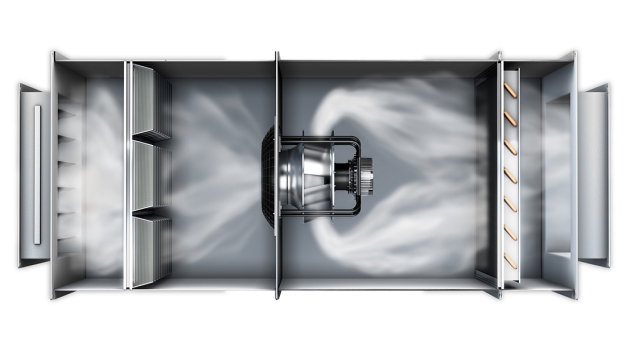
Dampers and filters can obstruct the airflow in HVAC systems, and the distance to walls and heat exchangers as well as the use of protective grilles also have an impact. Therefore, the actual installation situation must be considered early on to achieve an optimal result at the end of development. (Image: ebm-papst)
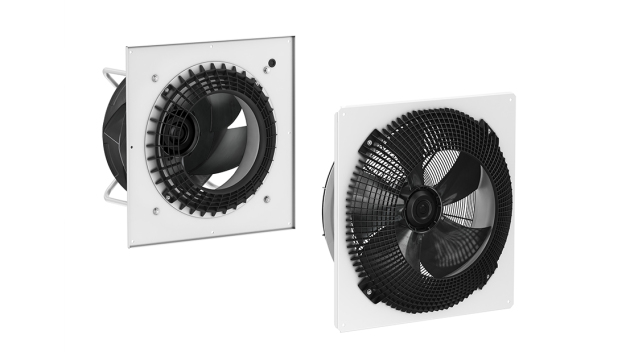
The FlowGrid is suitable for radial fans (left) and axial fans (right) and can reduce unwanted noise effects even when already installed. (Image: ebm-papst)
Fans are complex flow machines, whose behavior during operation is heavily influenced by their installation situation. Often, the fan is not as quiet as hoped or less efficient than the data sheet indicates. To assist in selecting the optimal fan, ebm-papst already supports its customers during device development.
Consider the installation situation during development
Modern radial and axial fans today operate very efficiently and quietly. When installed in an application – or under real installation conditions – their behavior changes if the inlet or outlet conditions are disturbed. Environmental factors such as dampers, filters, or protective grilles can influence the airflow. How these factors actually affect operation can only be estimated to a limited extent with typical selection programs in advance.
Decades of experience in fan development
Therefore, ebm-papst incorporates decades of experience into the development of a fan. The example of the RadiPac fans demonstrates how significantly early consideration of the installation situation influences the results during use. Here, ebm-papst not only optimized the impeller, motor, and control electronics in terms of energy efficiency and noise emission but also took into account the real installation situation in HVAC units to achieve an optimal result (in application).
FlowGrid improves noise behavior
If the selected fan is too loud or not efficient enough, passive components such as the FlowGrid guide vane can mitigate undesirable effects even in the already installed state. Retrofitting axial and radial fans with this reduces the turbulence-induced noise in the inlet airflow drastically without affecting air volume or intake performance.
Optimal results through early collaboration
To be on the safe side from the beginning, the fan manufacturer should be involved early in the development phase of the device. Whether for large or small fans, it can be equally worthwhile to analyze and evaluate the airflow situation in the application carefully, and thereby identify suitable optimization measures or the most suitable fan for the installation situation.
ebm‑papst Mulfingen GmbH & Co. KGaA & Co. KG
74673 Mulfingen
Germany



