

- Translated with AI
Intelligent testing system automatically detects wear phases
Hannover Messe 2021
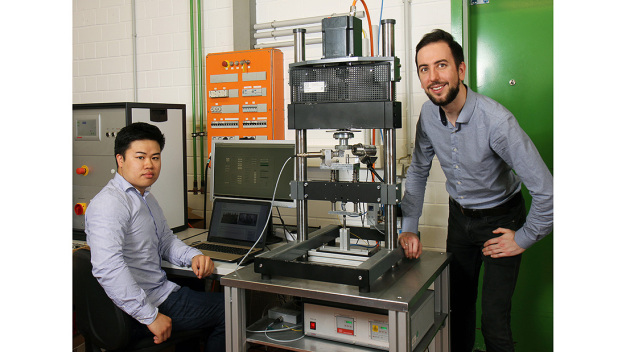
For their testing machine, the researchers developed new software. In the picture are Minh-Hai Le and Sebastian Kamerling. (Photo: Koziel/TUK)
Whether in car tires or gears in production – friction and wear lead to losses. Here in Germany, this results in an annual economic damage amounting to over five percent of the gross domestic product. Therefore, it is important to develop material combinations such as plastic-metal systems with better friction behavior. The so-called tribological testing plays a role here. Researchers from Kaiserslautern have developed a system for the first time that automatically detects wear phases and analyzes data directly. They will present this technology from April 12 to 16 at the digital Hannover Messe at the Research and Innovation Rheinland-Pfalz joint booth.
At the Chair of Composite Materials led by Professor Dr. Alois K. Schlarb at the Technical University of Kaiserslautern (TUK), the researchers are developing innovative materials. They are investigating, among other things, how to increase the lifespan under the influence of friction and wear. Experts refer to this in the context of tribology, the science of friction, wear, and lubrication.
Various testing machines are used for this purpose, such as the pin-on-disc tribometer, also called the pin-on-disc test. A small rectangular sample (pin) is clamped into a holder. A metal disc is placed on top, which directly contacts the sample. In this test stand, the disc can rotate for several hours. The device has sensors that measure the contact and friction forces, and an infrared sensor also records the temperature. "We set the speed using a motor and the contact pressure of the disc with air pressure; the temperature can also be regulated," says doctoral student Sebastian Kamerling. "With this technology, we simulate different conditions to which components are exposed during operation," the engineer continues. "The measurement values help us see how the material pairing behaves. By this, we mean the combination of a base body made of plastic with a counter body made of metal; simply put, a plastic-metal system."
The special feature: for this test, the Kaiserslautern engineers have now developed a unique system worldwide. "It controls the machine on one hand," Kamerling continues. "It detects when a steady phase is reached, meaning when the wear phase relevant to practice begins and the actual measurement can start." Until now, manual control was necessary for this. The technology can also automatically set a new load level. Additionally, the system evaluates the data directly. "With our method, we can measure and analyze significantly more data in a shorter time," the researcher explains. "This also helps us characterize the properties of the material sample much more precisely."
The process is not only interesting for research but also for industry, as such testing techniques play a role in many companies to determine material wear. The technology can help make this work faster and more efficient. The effort involved in testing is significantly reduced with the new method. Material and cost expenditures can also be decreased in this way.
At the digital Hannover Messe, they will present their testing machine and the specially developed control and measurement system.
Questions answered by:
Nicholas Ecke
Chair of Composite Materials
Tel.: 0631 205-5753
Email: nicholas.ecke[at]mv.uni-kl.de
Sebastian Kamerling
Chair of Composite Materials
Tel.: 0631 205-4634
Email: sebastian.kamerling[at]mv.uni-kl.de
Technische Universität Kaiserslautern
67663 Kaiserslautern
Germany