


- R+D & Community of Interest
- Translated with AI
Intelligent robots for targeted combat against viruses and bacteria
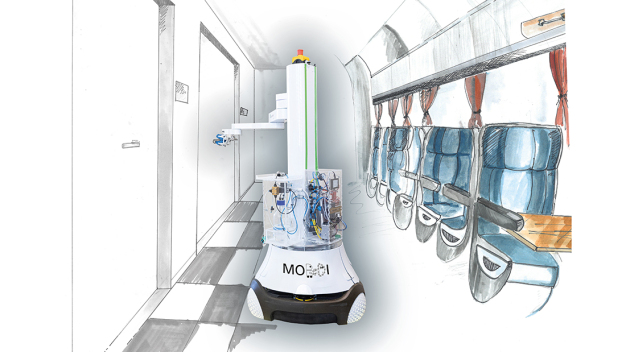
In the MobDi project, disinfection robots are being developed for use in buildings as well as in vehicles. © Fraunhofer IPA / Photo: Rainer Bez and Fraunhofer IMW / Graphic: Stefanie Irrler

Mobile Disinfection – MobDi © Fraunhofer IPA
Service robots can help ensure that buildings and transportation vehicles are cleaned and disinfected regularly and with consistently high quality. Since October 2020, twelve institutions of the Fraunhofer Society have been working on developing new technologies for this application field. Led by Fraunhofer IPA, the partners are pooling their expertise in the research project "Mobile Disinfection" (MobDi) to contribute to a safe "New Normal" during pandemic times. The project is part of the action program "Fraunhofer vs. Corona".
One key in the fight against COVID-19 is minimizing the risk of infection. The "Mobile Disinfection" (MobDi) project addresses this challenge by developing new hardware and software solutions for mobile service robots. These are intended to enable, on the one hand, targeted and gentle disinfection of potentially contaminated surfaces in buildings and vehicles with a robot. On the other hand, the developments aim to automate material transport in hospitals, thereby preventing the spread of germs by staff.
New Disinfection and Transport Robots
For disinfection in buildings and vehicles, the project partners are developing specialized service robots. The technical basis for disinfection in buildings is the "DeKonBot" from Fraunhofer IPA, which the institute developed last year in the predecessor project of the same name. The researchers will further improve its wiping disinfection tool and optimize the platform as a whole for later series production. The robot for disinfection in vehicles is being developed at Fraunhofer IFAM. Developing a modular drive support system to overcome gaps and steps is particularly challenging. The project partners are creating various tools for both robots, which disinfect through wiping, spraying, UV, or plasma treatment. These robots can automatically switch between tools as needed.
Fraunhofer IPA is also developing a new transport robot capable of carrying different trolleys typically used in hospitals. Compared to existing products, this new development features compact dimensions and a highly maneuverable chassis. Fraunhofer IVV supports the hygienic design of the various robots. Additionally, the institute is developing concepts for their self-cleaning, preventing the machines from becoming contamination risks themselves.
Enhanced Perception Capabilities
Thanks to intelligent perception functions, the disinfection robots will be able to clean targeted areas. A new multimodal 3D sensor from Fraunhofer IOF is used for this purpose. During startup, the robots autonomously recognize all objects to be disinfected and determine the material they are made of. The object recognition from Fraunhofer IPA and the material recognition from Fraunhofer IPM analyze the sensor data using machine learning methods. This ensures robust detection even if objects look slightly different in each environment.
A multi-layer environmental model from Fraunhofer IOSB consolidates all necessary information, allowing the robots to independently plan cleaning procedures. It contains a map of the environment, the position of all objects to be cleaned, and their materials. Environmental data do not always need to be manually input; based on work by Fraunhofer Italia, it will be possible to automatically load this information from the so-called "Building Information Modeling" (BIM), which is a digital representation of building features already existing in many structures.
In future regular operation, perception functions will also be used before disinfecting individual objects: based on the level of contamination, robots will optimize cleaning and verify its success. Fraunhofer FEP is conducting initial fundamental studies on how these contaminations could be detected.
Analysis of Cleaning Methods
For targeted and gentle cleaning, the project partners are conducting experiments with various cleaning and disinfection procedures on common surface types such as stainless steel and plastics. In addition to analyzing individual methods, they are also investigating combinations of different cleaning and disinfection techniques. For example, robots could initially wipe a door handle and then use UV light to neutralize germs in hard-to-reach areas. Fraunhofer ILT will analyze the combined use of UV and plasma sources specifically.
For these procedures, researchers from Fraunhofer FEP and IFAM evaluate disinfection success based on bacterial and viral contamination samples. Fraunhofer IST also examines potential material damage, and Fraunhofer IWS studies the formation of harmful decomposition products. The goal is to develop a methodology to select the most suitable procedures depending on material and contamination level for each disinfection process.
Needs-Based Development
The technical developments in MobDi are based on requirements, benefits, and cost-effectiveness analyses led by Fraunhofer IMW. To adapt the robots to practical needs, the project partners, together with users, developed scenarios at the very beginning of the project that the robots should implement, deriving the technical requirements from these. They held numerous discussions with logistics and hygiene experts in hospitals, as well as operators and cleaning staff in buildings and public transportation. Users are also involved in the project to develop intuitive user interfaces for setting up and operating the robots daily.
By the end of the project in September 2021, the developed robots will also be practically evaluated. The project partners will initially test them in their respective laboratories and then in realistic deployment environments such as public buildings, public transportation, or hospitals. The results will be compared with so-called "Key Performance Indicators" (KPIs). These KPIs, criteria for successful robot deployment in the respective application field, were already identified with potential users at the start of the project.
Participation Opportunities
Since the robots are modular and use standard interfaces, the technologies developed in MobDi can be easily transferred to other machines and robots. This supports rapid transfer of research and development results into practice. Interested manufacturers are welcome to contact the project partners if they wish to participate in development. In addition to transferring individual technologies into existing products, it is also possible to integrate the developed robots as a complete system into a new product.
Fact Sheet
Full Project Title: Mobile Disinfection – MobDi
Duration: 01.10.2020 to 30.09.2021
Funding: The project is part of the action program "Fraunhofer vs. Corona", which supports numerous other initiatives for pandemic control.
Project Partners and Their Contributions
- Fraunhofer Institute for Production Technology and Automation IPA: Project management, development of the new transport robot, integration of new technologies and functionalities into the disinfection robot for use in public buildings, (further) development of navigation and object recognition software
- Fraunhofer Center for International Management and Knowledge Economy IMW: Process and needs analyses, identification of relevant performance parameters, user evaluation, and economic analyses
- Fraunhofer Institute for Optronics, System Technologies and Image Exploitation IOSB: 3D environment mapping, layer-based environment model, development and design of UV-C sources
- Fraunhofer Institute for Manufacturing Technology and Applied Material Research IFAM: Development of a disinfection robot for public passenger transport, a modular drive support system for overcoming gaps and steps, and a cleaning end-effector, validation of disinfection success
- Fraunhofer Institute for Surface Engineering and Thin Film Technologies IST: Development of plasma sources for cleaning and disinfection, evaluation of effects and material compatibility of disinfection methods
- Fraunhofer Institute for Organic Electronics, Electron Beam and Plasma Technology FEP: Contamination detection, surface treatment with UV, validation of disinfection success
- Fraunhofer Institute for Applied Optics and Precision Engineering IOF: Development of a multimodal 3D sensor for reliable data delivery on different materials
- Fraunhofer Institute for Material and Beam Technology IWS: Post-cleaning concepts for removing reaction and decomposition products from the air
- Fraunhofer Institute for Physical Measurement Techniques IPM: Material recognition
- Fraunhofer Institute for Laser Technology ILT: Development of combined UV/plasma radiation sources
- Fraunhofer Institute for Process Engineering and Packaging IVV: Hygienic design concepts for newly developed hardware solutions
- Fraunhofer Italia Research Consortium GmbH: Integration of Building Information Modeling (BIM) with the layer-based environment model

Fraunhofer-Institut für Produktionstechnik und Automatisierung IPA
Nobelstraße 12
70569 Stuttgart
Germany
Phone: +49 711 970 1667
email: joerg-dieter.walz@ipa.fraunhofer.de
Internet: http://www.ipa.fraunhofer.de