


- Industry 4.0
- Translated with AI
Andreas Bühring
Intelligent networking and IoT bring efficiency improvements in all areas
Digitization in the Cleanroom

Connected smart buildings create the foundation for digital transformation in clean rooms. (Source: Siemens AG)
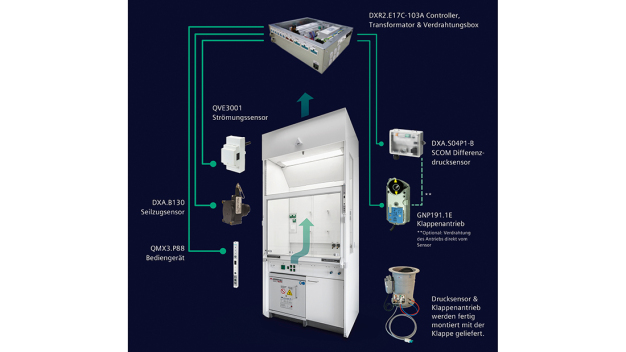
Flexible Digestorium with native BACnet/IP connection to building automation (with and without labeling). (Source: Siemens AG)
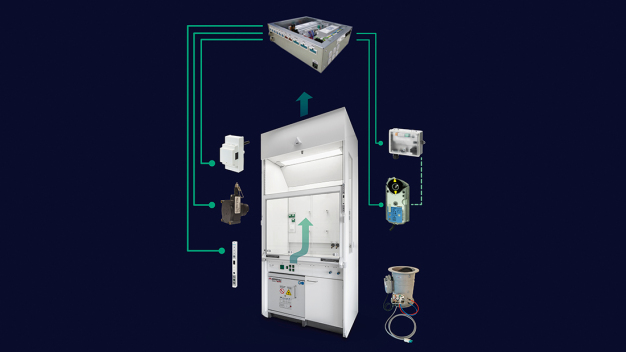
Flexible Digestorium with native BACnet/IP connection to building automation (with and without labeling). (Source: Siemens AG)

Andreas Bühring, Vertical Sales Life Science / Pharma, Siemens Smart Infrastructure, Germany (Source: Siemens AG)
The cleanroom is protected from external influences, but digitalization also does not stop at the strongest barriers. And that is quite good, because in the life sciences environment, the digital transformation towards "Cleanroom 4.0" offers operators new possibilities and numerous advantages to sustainably succeed in a demanding market environment.
The digitalization of cleanrooms is inseparably linked to future-proof interconnected buildings, so-called smart buildings: Through intelligent, cross-disciplinary building automation, they are capable of harmonizing and automating operational processes, centrally storing information, making it accessible from anywhere, and saving energy. The cleanroom is especially in focus: It is characterized by a large number of measurement, control, regulation, and system technology systems, as well as high energy consumption. Engaging with the digital transformation in the cleanroom is therefore particularly worthwhile, as it represents one of the most effective levers for "Operational Excellence" in both food & beverage and pharmaceutical environments.
Successful digitalization is quick and flexible
From conception and planning to the end of the building's lifecycle: Speed and flexibility are crucial when it comes to harnessing the potentials of digitalization. The development and production processes of pharmaceutical products are highly regulated and accordingly lengthy and costly. Solutions that can be quickly deployed during ongoing operation and integrated pre-fabricated into existing buildings are especially helpful. Even inconspicuous components like digesters can now be easily integrated into building automation via plug-&-play solutions through an IP-based interface.
Whether individual components like laboratory exhausts, system parts like cleanrooms, or entire disciplines – networking relies on the digital twin. It represents the digital counterpart to objects in the physical world. Production and research are already supported by Building Information Modeling (BIM) in planning: For example, a planning twin allows simulating the building's later energy consumption before construction or ensuring escape routes are not overloaded in case of evacuation. Once the system is in regular operation, an operational twin connects static data with dynamic data – such as the building layout with real-time sensor data. This enables continuous monitoring and optimization of the building throughout its lifecycle.
Transformable systems for shorter innovation cycles
The automation pressure increases the need for digital sensors to keep track. As research and production cycles become shorter, disciplines in research and manufacturing must be highly flexible: Change throughout the entire lifecycle requires regular adjustments to user requirements. A segmented approach is recommended: For instance, a laboratory or cleanroom is divided into multiple segments during planning to ensure that, in case of a change of use during operation, several small work units can be created from a large laboratory. Segment-based automation maximizes the flexibility of the disciplines. If space becomes tight, complete laboratories and cleanrooms in the form of ready-made container solutions can fill the gap – equipped with systems from energy distribution to room automation. The digital building concept complements the overall package: Even before construction begins, questions such as the networking and interaction of disciplines, as well as potential synergies, are addressed within this framework.
The IoT promotes efficiency and collaboration
Not only the production equipment but also the working methods are changing: In offices, laboratories, and cleanrooms, collaboration and shared work facilities are gaining increasing importance. Digitalization also offers comfort and efficiency here. Personal assistants like cloud-based applications communicate in real-time with room regulation systems, enabling employees to book rooms intelligently and set personal room parameters.
To enable successful collaboration and support energy efficiency, real-time sensor data are indispensable, such as presence detectors. KNX-capable field devices, with additional sensors for temperature, humidity, and CO2, help regulate the laboratory or cleanroom perfectly while saving energy. KNX-capable field devices make the Internet of Things (IoT) particularly straightforward to implement in the laboratory: Additionally, intelligent parameterization of room controllers spares users the usual ETS programming. This already saves time and costs during commissioning. Corresponding applications can also set up automation stations within the shortest time via WLAN connection.
Central building management on an integrated platform
To ensure that not only employees but also management benefit from efficiency and flexibility, all data from the smart building are collected and visualized on a building management platform. Intelligent building management platforms offer operators the ability to log (validated) data points. For example, with GxP monitoring, critical and non-critical system areas can be separated directly on the management platform. Authentication, validation, and versioning ensure a tamper-proof system operation.
The integration of monitoring functions also offers numerous advantages in daily operations: Open interfaces enable the integration of additional systems and remote access to all buildings from anywhere at any time. Technical monitoring based on building data in a cloud-based system helps continuously monitor and improve operations. This effectively supports operators in system oversight: The system can detect early signs of wear and help increase performance throughout the building's lifecycle.
Safety and security for all system areas
Comprehensive security functions are also included. For example, if a fire source occurs in a laboratory or cleanroom, it is not only immediately reported to the fire brigade after detection by smoke detectors, but voice alarms also instruct users to evacuate the building; room automation raises blinds; extinguishing or sprinkler systems halt the fire development. Cameras provide rescue teams with insights into the conditions on-site even before entering the building. The operator has a quick overview and access to all disciplines via a system.
To ensure that the smart building is not only efficient but also securely networked, high priority should be given to cybersecurity. All products and solutions meet the highest requirements for encryption and protection against manipulation or theft. Siemens is a member of the Charter of Trust for Cybersecurity, founded in 2018 with the involvement of TÜV SÜD, making significant contributions to protecting critical systems and sensitive data.
Smart Building – the foundation for Cleanroom 4.0
The transformation affecting the pharmaceutical / life sciences environment is significantly driven by digitalization. With the right solutions and a reliable partner, networking all levels in cleanrooms becomes a powerful lever to increase productivity, optimize energy efficiency, and significantly enhance safety. Shorter time-to-market, modularity, miniaturization, and efficient interdisciplinary collaboration are possible – with the smart building as a solid foundation.
Siemens AG
80333 München
Germany