

- Translated with AI
Innovation for image capture
Researchers develop electrically controllable gradient filter
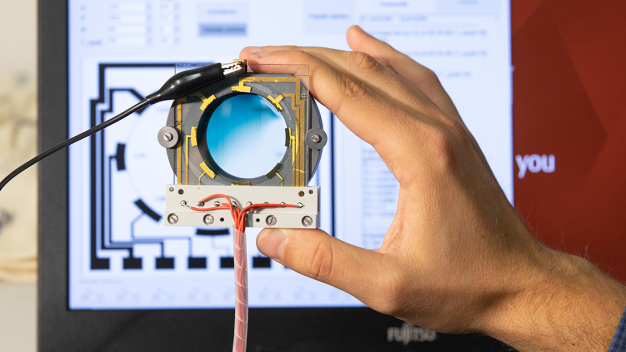
The innovative gradient filter allows for the electrochemical regulation of the spatial absorption profile, enabling flexible response to changing lighting conditions — for example, during photography. (Reiner Voß, TU Kaiserslautern)
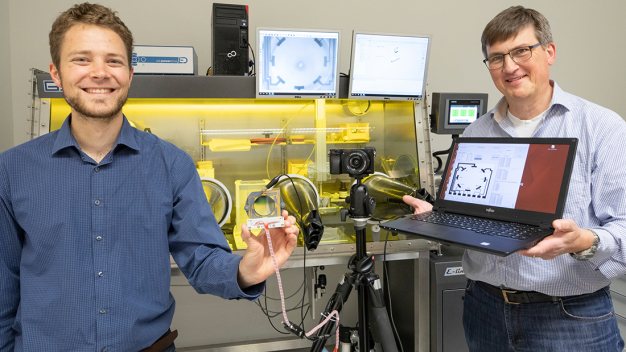
Dipl.-Phys. Alexander Hein (left) and Professor Dr. Egbert Oesterschulze are working on electrically controllable gradient filters within the framework of the BMBF joint project "gradEC". (Reiner Voß, TU Kaiserslautern)
Compensating for overexposure when photographing – without manually attaching and adjusting filters: Thanks to a new technology developed by physicists at the Technical University of Kaiserslautern (TUK), this is now possible. The electrically controllable gradient filters use a so-called electrochromic component with a multi-electrode arrangement. When appropriate voltages are applied to the electrodes, an absorption profile is established that can be adjusted almost arbitrarily in its strength and direction. The researchers present their work in the journals "Solar Energy Materials and Solar Cells" and "Optics Express".
To optimally photograph under different lighting conditions, such as a dark landscape with a sunny sky, it is helpful to reduce the brightness in brighter image areas. Professional photographers and videographers use so-called gradient filters for this purpose, i.e., glass plates with a light-dark gradient. However, such a filter only offers a fixed predetermined color and absorption profile. Therefore, gradient filters with varying degrees of gradient are needed to respond to changing lighting conditions. The appropriate filter must be mounted in front of the lens and manually adjusted: a very time-consuming and cumbersome process.
At TUK, the team led by Professor Dr. Egbert Oesterschulze and doctoral candidate Dipl.-Phys. Alexander Hein is working on electrically controllable gradient filters within the framework of the BMBF joint project "gradEC". The physicists use a layer of semiconductor nanoparticles. Electrochromic molecules are bound to this layer, whose optical absorption can be controlled electrochemically. "We have used a multi-electrode system in these components, which are manufactured in a cleanroom (Nano Structuring Center), to be able to very flexibly adjust the spatial absorption profile," explains Professor Oesterschulze, who holds the chair for Physics and Technology of Nanostructures. When a current flows through the nanoparticle layer, a controllable coloration of the molecules occurs depending on the local potential, forming the desired absorption gradient. The scientists are able to adjust both the strength and the direction of the gradient. This technology could potentially be used in cameras or display technology in the future.
The researchers at TUK are developing the innovative gradient filters in close collaboration with the following partners: Jos. Schneider Optische Werke GmbH in Bad Kreuznach (Dipl.-Phys. Haag-Pichl), University of Osnabrück (Prof. M. Haase, Institute for Chemistry of New Materials), Fraunhofer-CAN (Center for Applied Nanotechnology) in Hamburg (Dr. Ch. Gimmler, Dr. Th. Schotten), and Matthews International GmbH (Dr. G. Jenke) in Vreden.
The study has been published in the journals "Solar Energy Materials and Solar Cells" (DOI: https://doi.org/10.1016/j.solmat.2020.110549) and "Optics Express" (DOI: https://doi.org/10.1364/OE.393212).
Questions answered by:
Prof. Dr. Egbert Oesterschulze
Physics and Technology of Nanostructures
Tel.: 0631 205-2680
Email: oester@physik.uni-kl.de
Technische Universität Kaiserslautern
67663 Kaiserslautern
Germany