

- Know How, Institute
- Translated with AI
Improvement of inhalation therapy through non-stick surfaces
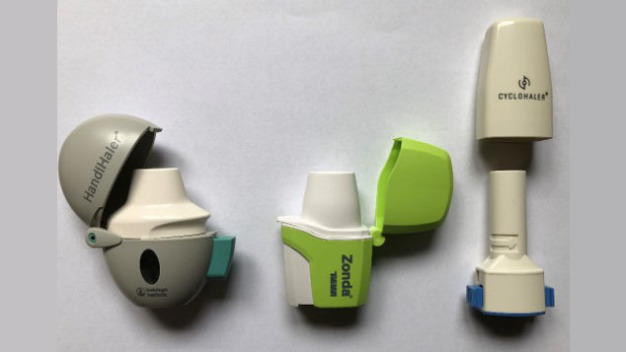
Inhaler © Fraunhofer IST
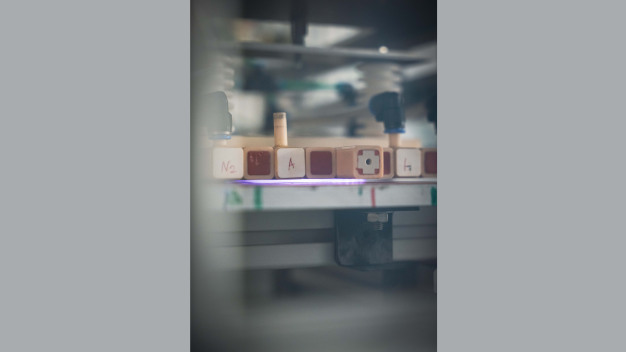
Plasma Coating - Non-stick Surface © Fraunhofer IST
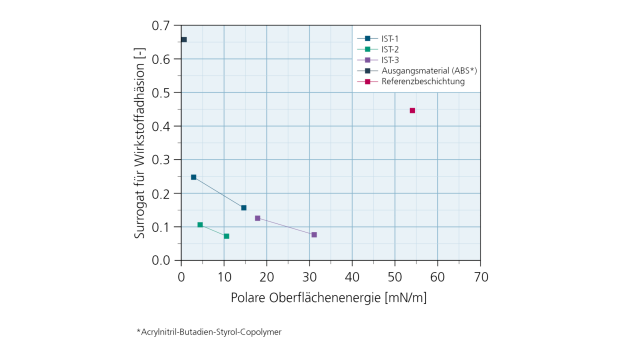
Polar surface energy © Fraunhofer IST
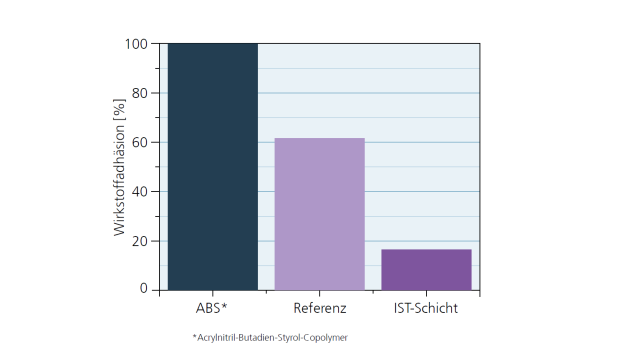
Relative active ingredient adhesion © Fraunhofer IST
Especially for chronic lung diseases such as asthma, many people use inhalers to keep their airways clear. However, a portion of the particles to be inhaled often remains in the device itself. Through an optimized ultra-fine coating of plastic surfaces in inhalers, Fraunhofer IST demonstrated that the surface properties of inhalers can be specifically adjusted. The coating also significantly reduces the adhesion of the finest active ingredient particles on the surface. This can greatly enhance the safety of inhaler use as well as the effective utilization of active ingredient doses.
Small particles - large interactions: Losses of active ingredients during use
For the delivery of active ingredients into the lungs, they must be administered as a mist or particle aerosol with a particle size smaller than 5 µm to reach their target site deep in the airways. However, due to their small size, the active ingredient particles tend to adhere strongly, especially to the surfaces of the inhalers used for their application. This can lead to a reduced or fluctuating dose of the active ingredient delivered to patients, thereby jeopardizing therapy safety.
Custom-tailored ultra-fine coatings decisively prevent adhesion of active ingredients
By functional coating of the inner plastic surfaces of inhalers, their physicochemical properties can be controlled so that the interaction potentials are aligned with the properties of the active ingredient particles, thereby knowledge-based reduction of adhesion tendency. The chemical precursors used for the coating and the parameters of the coating process are used to control the layer properties.
Reduce losses - improve therapy - protect the environment
By specifically reducing the deposition of active ingredient particles, the dose of medication delivered to patients becomes significantly more precise and reproducible, increasing therapy safety. Additionally, active ingredient quantities that would otherwise remain in the inhaler can be saved, cleaning effort for the inhaler is reduced, and environmental impact from unused active ingredients released from the inhaler is minimized.
Part of a whole - pharmaceutical research at IST
Research on the interaction adjustment between dosage forms and surfaces is part of the still young application field of medical and pharmaceutical technology at Fraunhofer IST. It is located within the Medical and Pharmaceutical Technology Center, where IST collaborates actively with the Fraunhofer Institute for Toxicology and Experimental Medicine ITEM and the Institute for Personalized and Cell-Based Medicine IMTE. Other application areas at Fraunhofer IST include coating and functionalization of pharmaceutical particle systems, development of adhesion- and wear-resistant layers for process equipment and tools, functional coatings for primary packaging materials, and vaccine development.
Outlook
The solution approach for adhesion control in inhalers can be almost universally transferred to other application fields in the pharmaceutical industry and beyond, to tailor the deposition of fine particles according to their properties. In combination with the functional coating of active ingredient particles, not only can application safety be improved, but also the release and thus the temporal profile of drugs can be extended or programmed to release in response to specific stimuli.
Fraunhofer-Institut für Schicht- und Oberflächentechnik IST
38108 Braunschweig
Germany