
- Translated with AI
Improved joint liability in polycarbonates through plasma treatment
Research
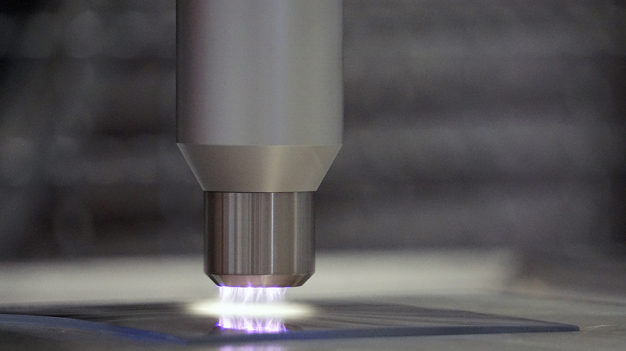
Fig. 1: Atmosphere pressure plasma treatment of a polycarbonate sheet
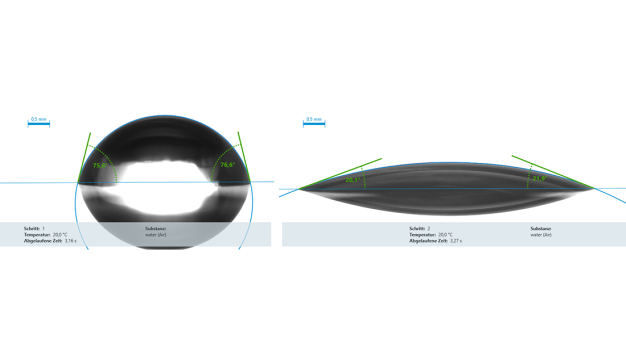
Fig. 2 (left): Water droplets on PC without atmospheric pressure plasma treatment, (right): Water droplets on PC after atmospheric pressure plasma treatment; Effects of atmospheric pressure plasma treatment of polycarbonate: An initial test shows a significant reduction in contact angles with water = this suggests improved wettability as a prerequisite for bonding adhesion to reactive coatings.
A new research project at the Plastics Center in Leipzig (KUZ) investigates how highly transparent, scratch-sensitive polycarbonates (PC) can be surface-finished. The goal is to achieve a direct coating with solvent-free "self-healing" reaction clear coats with good adhesion.
Polycarbonates in high-transparency quality are gaining an increasing market share in the field of optical components. An important market focus is the automotive industry. For example, replacing glass car windows with plastic materials allows for weight savings of the vehicle and thus provides a means to reduce fuel consumption. A disadvantage in everyday use of PC-formed parts and design elements is their scratch-sensitive surface, which often requires protective paint layers to be applied in subsequent processing steps.
"Self-healing" reaction clear coats for sensitive surfaces
To reduce the susceptibility of plastic surfaces in vehicle interiors to scratches, a further approach is emerging. Since the surfaces of molded parts covered with hard coats, such as control elements or displays, cannot withstand the demands of use in the vehicle interior permanently, coating with "self-healing" reaction clear coats based on polyurethane (PUR) or polyurea (PUA) offers significant advantages as an alternative.
Challenges of direct coating in the mold with PC
For successful technological implementation, the established process of "direct coating in the mold" is suitable. Currently, sufficiently polar plastics, such as PC/ABS blends, SAN and ASA types, as well as selected polyesters, are permanently surface-finished through direct mold coating in injection molding tools. In contrast, investigations at KUZ have shown that various PC compound materials have so far not been broadly suitable as molded substrates for direct mold coating with solvent-free PUR or PUA reaction coats. The application of such surface-finished PC parts has so far failed due to insufficient layer adhesion, which under various realistic climate conditions quickly leads to failure of the substrate-reaction coat bond.
Atmospheric pressure plasma treatment improves adhesion
The research project "PC-AdPro2RIM" experimentally investigates how freshly molded polycarbonate parts can be surface-treated in the injection molding process using atmospheric pressure plasma and qualified as thermoplastic carriers for the "direct coating in the mold" process with VOC-free PUR or PUA coats. The chemically reactive groups generated by atmospheric pressure plasma treatment are to be detected via selective color reactions, and for the first time, surface-related statements about the type, coverage density, and homogeneity of the surface activation are to be made. By varying the plasma treatment parameters, the surface activation will be optimally adapted to meet the different requirements of solvent-free PUR or PUA clear coats.
Objective of the research project
The targeted solution focuses on the production of high-quality consumer products and design elements. The application of the research results is not limited solely to coating and finishing of PC parts. It is quite conceivable and desirable to adapt the technology for other technically significant but problematic thermoplastics that are directly coated, such as PMMA, COC, among others. The initial target markets for implementing the R&D results into manufacturing include:
- Automotive supplier industry and OEMs,
- Manufacturers of high-quality consumer electronics,
- Companies involved in injection molding processing.
Contact person: Jens Müller, Tel. 0341 4941605, mueller@kuz-leipzig.de
Funding agency: BMWi, FKZ: 49MF200040
Kunststoff-Zentrum in Leipzig gGmbH
04229 Leipzig
Germany