



- Translated with AI
Identification of the right cargo handling system for individual applications and cleanliness requirements
(Source: Kögel GmbH)
(Source: AUER Packaging GmbH)
(Source: Kögel GmbH)
(Source: Kögel GmbH)
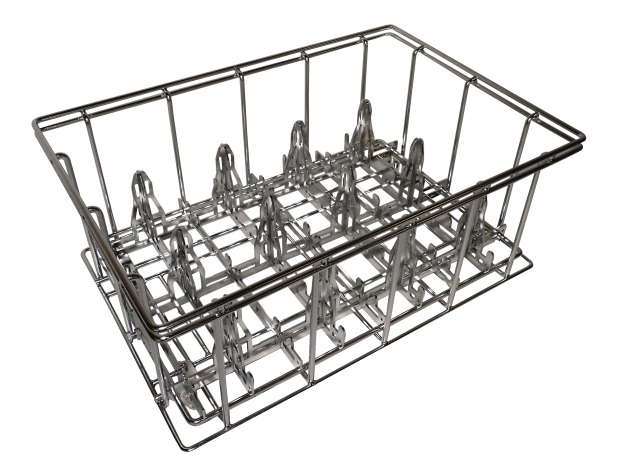
(Source: Kögel GmbH)
Today's industrial components, for example in the automotive sector, are subjected to increasingly higher loads, tighter tolerances, and more delicate designs – all while facing rising material and manufacturing costs. The assemblies are highly sensitive to even the smallest contaminants, so that even individual particles can cause failures. Against this background, component cleanliness during the manufacturing process assumes an important role. Manufacturing companies are gradually recognizing this as a value-adding process that is essential for meeting customer requirements.
Manufacturers must therefore identify as early as possible all factors that could lead to potential component contamination, define precise purity requirements, and establish the optimal structural design of the component. Once the manufacturing processes are determined, contamination with residues such as chips or cutting fluids resulting from the process can be derived, and necessary procedures can be planned to achieve the required technical cleanliness.
Tasks from Transport to Cleaning
Since each component is transported through all manufacturing steps and must be assembled with the required cleanliness levels, the design of cleaning-compatible transport containers is of particular importance, alongside component batch sizing, cleaning system technology, and cleaning chemicals used. The task of the transport systems is to hold the parts in such a way that they can be transferred without loss or damage from the first manufacturing step through all subsequent steps, ultimately reaching assembly with the specified cleanliness.
In each manufacturing step, the transport containers fulfill different tasks. These range from simple transportation and positioning for the next process to fixing the components for cleaning. Since there is a risk of damage or recontamination with manufacturing residues during reloading or transferring parts into different containers, it is advisable to examine the available container and packaging systems in detail. An ideal container is one in which the parts pass through the entire manufacturing chain to prevent additional contamination.
To optimally design the container, the following project parameters should be specified:
- Component geometry
- Component weight
- Throughput
- Manufacturing process
- Required cleanliness
- Cleaning system and medium
- Handling / loading systems
If a cleaning system is already available within the company, the following additional information is helpful for further considerations:
- Dimensions of the cleaning batch (outer dimensions of the container)
- Required material of the container (suitable for aqueous cleaning and/or solvents)
- Handling / loading system (at the system and/or in manufacturing)
- Identification method at the system and/or in manufacturing (e.g., barcode or RFID)
From the geometry and the surface-defined cleanliness levels, it can be determined whether the parts can be cleaned as bulk material or as individual units.
Bulk Material: Many Workpiece Carriers Available
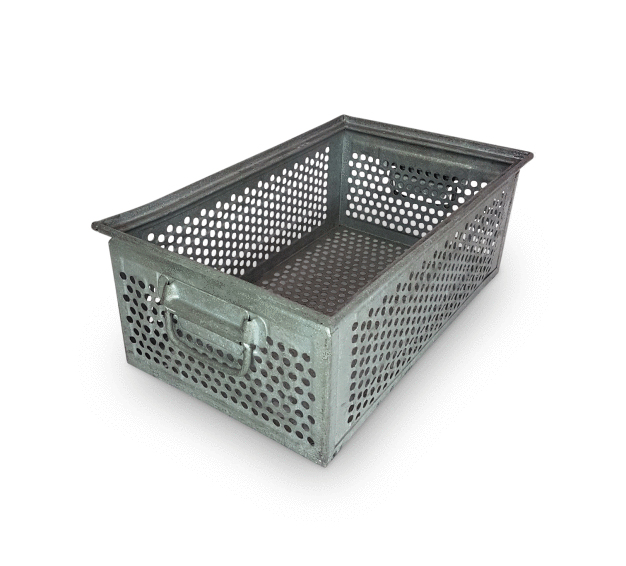
Bulk material can usually be cleaned in standard baskets with the appropriate mesh size or in specialized racks combined with fine-mesh bulk baskets. Common containers for this purpose include sheet metal boxes in closed or perforated form made of galvanized steel or stainless steel. This is a cost-effective and robust solution. These boxes have been used for a long time for both transport and cleaning of components. However, they have the disadvantage that particulate contamination cannot be reliably removed due to the large closed surfaces and edges. They are therefore only suitable if no specific cleanliness requirements exist.
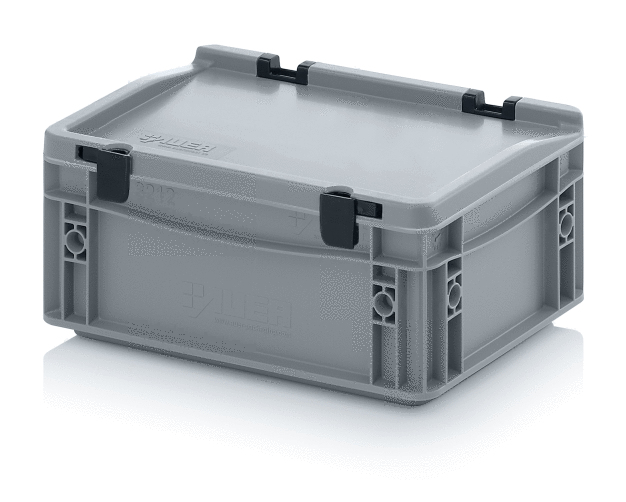
An alternative are plastic boxes. These come in closed versions – so-called small load carriers (SLC) – as well as with handle openings. They are almost exclusively used for transport and storage and are very suitable as secondary packaging with lids to handle transport containers with parts while excluding environmental influences.
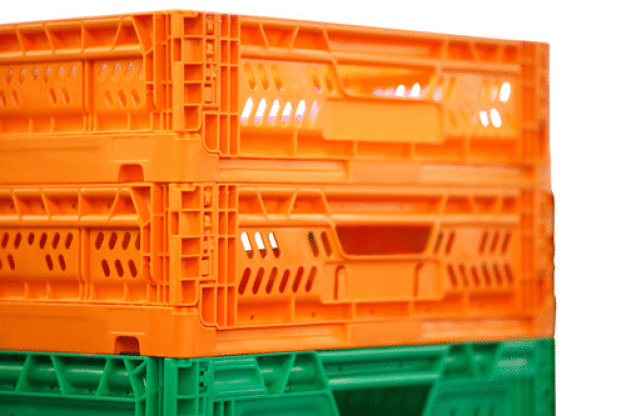
Additionally, perforated plastic baskets are increasingly used due to their low cost, both as transport containers and for cleaning. However, it should be noted that plastics are exposed to temperatures and chemicals during cleaning that can affect their strength and stability. At the same time, plastic solutions may also influence ultrasonic performance.
Since these baskets have many openings, parts can be well rinsed and dirt can be flushed out during cleaning. They are generally used for intermediate cleaning processes where the final cleanliness levels are not yet required.
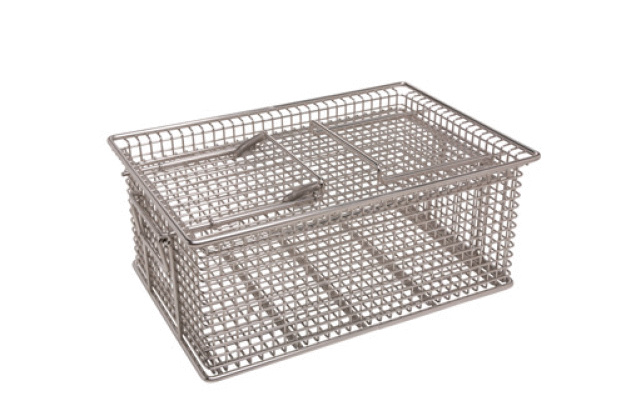
Wire baskets made of galvanized steel or stainless steel are well suited for achieving high cleanliness levels due to their excellent permeability. For cost reasons, these baskets are almost exclusively used for cleaning tasks. The highest cleanliness levels are reserved for stainless steel wire baskets.
In all the aforementioned containers, components can be handled as bulk material and also cleaned. However, the achievable cleanliness levels can only be determined through cleaning tests.
If a defined technical cleanliness is required, components generally need to be individually set. This is referred to as set-piece. From their geometry and the surface-defined cleanliness levels, it can be determined whether and how the components need to be moved during cleaning and drying. This makes it necessary to supplement the containers with suitable separation systems so that the parts are fixed individually. Many different options are available in metal and plastics for this purpose.
Set-piece: Fixed in Space or Plane
In addition to the common containers described earlier, which can be modified for set-piece, there are also component-specific special containers based on standardized base carriers, which can be equipped with interchangeable mounts for various components.
When designing a container for set-piece, it is necessary to determine whether the components only need to be fixed in a plane or also in space. For example, in a swiveling cleaning process with a tilt angle of 30°, fixing in a plane is sufficient – unless the cleaning mechanism is so large that parts could be pushed out of the fixation.
However, if the components are also cleaned while rotating, fixing in space is necessarily required. Based on the component geometry, the dimensions of the cleaning batch, and the throughput, it can be calculated whether the parts need to be set in one or multiple planes.
One Plane:
- Fixation via lid on the container
- Fixation via lid in the cleaning chamber
- Fixation via fastening elements
Two or More Planes:
- Fixation via the container placed on top and a lid on the container at the top
- Fixation via the container placed on top and a lid in the cleaning chamber at the top
- Fixation via the fastening elements
From the geometry and the surface-defined cleanliness levels, it is determined how and where the components can be fixed in the plane. For internally guided components, the surface distribution within the container can be quite precisely defined. It results from a top view of the component distributed across the surface with enough free space between parts for good flow.
For externally guided components, depending on the mass of the component, the necessary free space for fixing must be considered in the surface distribution within the container. Therefore, a top view of the component as well as the fixing elements distributed across the surface with enough free space between parts is required for good flow.
If no cleaning system is yet available in the company and it is also part of the project planning, the required dimensions of the cleaning batch must first be determined from the following data:
- Component geometry
- Component weight
- Throughput
- Manufacturing process
- Required cleanliness
- Cleaning system and medium
- Handling / loading system
Solution Approach:
Based on the geometry, weight, and throughput, it can be calculated what volume needs to be cleaned within a specific period.
Example / Assumption:
The weight of a considered component is 0.120 kg, and the permissible total weight for manual handling is 15 kg.
From this, the maximum fill quantity of 125 parts per container can be determined. The container's own weight (e.g., approx. 3 kg) should be subtracted, resulting in an approximate capacity of 100 parts per container.
With a target throughput of 1,000 parts per hour and 100 parts per container, the total requirement is 10 containers per hour.
Furthermore, assuming the geometry of the sample component encompasses a volume of 0.24 dm³, a target throughput of 1,000 parts per hour results in a necessary batch volume of 240 dm³ per hour. Additionally, a free space of about 35% should be added for good flow and possible fixings, resulting in a total calculated volume of approximately 324 dm³ per hour.
From the volume requirement of 324 dm³ per hour and a throughput of 10 containers per hour, the necessary volume per container can be calculated as approximately 33 dm³.
Based on this calculation, an initial specification for the cleaning system can be derived: "Which cleaning system with a batch size of at least 33 dm³ can clean 10 batches per hour or 5 batches with a batch size of at least 66 dm³?"
Common standard dimensions for batch sizes in cleaning systems today are:
- 480 x 320 x H200 mm = usable volume 22 dm³
- 480 x 320 x H300 mm = usable volume 34 dm³
- 530 x 320 x H200 mm = usable volume 24 dm³
- 530 x 320 x H300 mm = usable volume 38 dm³
- 670 x 480 x H300 mm = usable volume 73 dm³
Using these considerations, the required cleaning system can be narrowed down to:
Basket size 480/530 x 320 x H300 mm with a throughput of 10 batches per hour
or basket size 670 x 480 x H300 mm with a throughput of 5 batches per hour
The choice of the "correct" cleaning process—considering ecological and economic aspects—can usually only be determined through detailed cleaning tests.
Almost all cleaning system manufacturers offer facilities for component-specific washing tests.
The goal should be to use the identified "correct" container early on to quickly verify that the required technical cleanliness is maintained and that the project can be successfully implemented.
Kögel GmbH
75038 Obererdingen
Germany