

- Products, devices, systems, plants for applications
- Translated with AI
Hygiene, process safety, and gentle part handling in focus
Köberlein Technologies: Feeding systems for medical technology
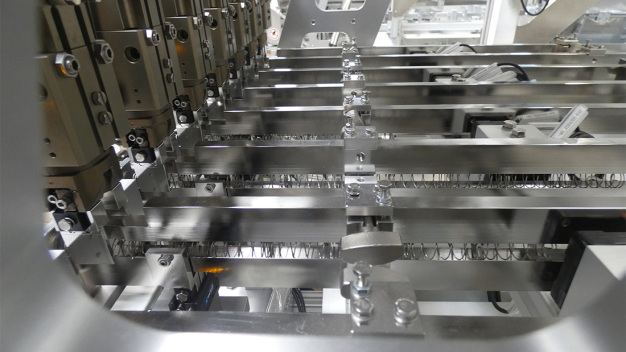
Processes in the field of medical technology place special demands on feeding technology. Köberlein Technologies develops and manufactures feeding systems for medical components and supports customers from initial feasibility testing to commissioning, maintenance, and optimization. The image shows a part of a spring feeding system with a maximum feeding capacity of 220 springs per minute. (Image: Köberlein Technologies)
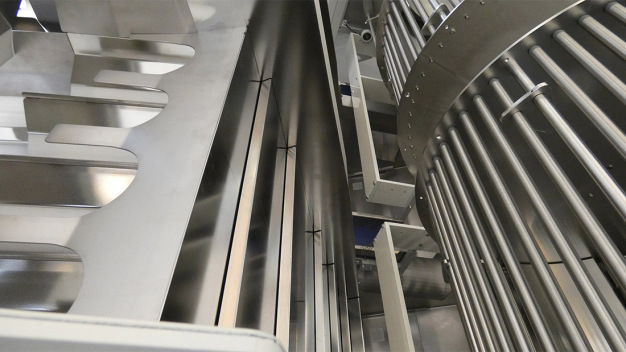
The feed must supply or transfer components from bulk material to the subsequent process in a defined position, quantity, and cycle time. Köberlein Technologies relies on the step conveyor and subsequent vibration chutes for many applications. (Image: Köberlein Technologies)
Processes in the field of medical technology place special demands on feeding technology. Hygiene, cleanability, process safety, and gentle handling of parts must be considered in the design. Köberlein Technologies develops and manufactures feeding systems for medical components and supports customers from initial feasibility testing to commissioning, maintenance, and optimization.
Feeding technology for medical technology is subject to special hygienic requirements. The systems must be easy to clean and withstand the use of cleaning agents over the long term. Contamination nests and static electricity should be avoided, and the guidelines from the GMP (Good Manufacturing Practice) guidelines should be considered during design. This results in specific requirements for the execution, e.g., sealed weld seams and suitable connection elements. Furthermore, easily accessible areas for quick cleaning and easy operation play an important role. Additionally, requirements arising from the automated assembly process must be met. The feeder must supply or transfer parts from bulk material to the subsequent process in a defined position, quantity, and cycle time. At the same time, sensitive parts and surfaces must not be damaged. For different parts or variants, suitable orientation concepts are also required.
Feeding solutions with high conveying capacity
As a custom machine manufacturer, Köberlein Technologies develops feeding solutions for components needed in the mechanical elements of the housing, function, or packaging of a medical product or medication. The range of supplied parts includes, among others, springs, push buttons, detent pins, housings, lids, and pins. The use of step conveyor technology enables very high throughput depending on the size of the component. A multi-track design can further increase output. If different parts are to be fed, adjustable or interchangeable orientation elements are used.
Ergonomics is also considered in the design. The filling heights are low, and adjustment screws on the orientation units are easily accessible. Step conveyors and linear vibration conveyors also enable gentle transport. Low fall heights, short chutes, and reduced speeds for returning parts help prevent damage. Since no high-frequency vibration drives are used, the systems also operate with comparatively low noise levels.
Sensors complement mechanical orientation
Fundamentally, Köberlein utilizes the properties of a component—such as center of gravity or special geometric features—to mechanically achieve orientation. If a clear position cannot be established this way, sensors can be used. Vision sensors or other position detection systems recognize the position of a component. Subsequently, it can be mechanically sorted out, returned, or its position adjusted. AI can also be used to recognize and evaluate different situations. According to Köberlein, artificial intelligence will play a larger role in component recognition in the future and will also become easier to operate and program.
Köberlein supports projects from the initial inquiry through concept, design, and manufacturing to commissioning and beyond, including service cases. During component design, tests can already show how well a part can be fed and what performance can be expected. Design and manufacturing are carried out in-house at the facility in Grabfeld, Thuringia.
Köberlein Technologies GmbH
98631 Grabfeld
Germany