




- Flow rate (air volume flow)
- Translated with AI
How much trust does a simulation deserve?
Why developers need to understand uncertainties before virtual models become a basis for decision-making
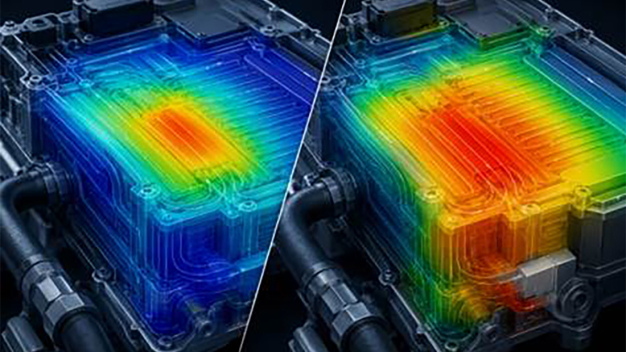
How reliable is a simulation result? Variations in boundary conditions, material properties, or operating parameters can already alter the assessment of a design. Sensitivity analyses help to identify the key influencing factors.

Dipl.-Ing. (TU) Stefan Merkle, Managing Partner of Merkle CAE Solutions GmbH.
A simulation result of 78 °C with an allowable component temperature of 80 °C appears straightforward. But is the component truly designed safely based on this? What happens if power loss, material properties, flow volume, or heat transfer vary within their real ranges? The more virtual models influence development decisions, the more important a question has become that was often underestimated: How reliable is the result really?
The relevance is also reflected in standardization. In February 2026, NASA published a new guideline for good modeling and simulation practices with NASA-HDBK-7009B. The ASME is also expanding its regulations on Verification, Validation, and Uncertainty Quantification (VVUQ). This indicates a fundamental shift: It is no longer the simulation result that appears most precise that determines the quality of a model, but its proven credibility for the intended application.
Precise calculation does not automatically mean reliable
"The most dangerous simulation result is not necessarily a false one, but one that looks precise and therefore is no longer questioned," says Dipl.-Ing. (TU) Stefan Merkle, managing partner of Merkle CAE Solutions GmbH. "Experience also shows in recognizing which assumptions dominate a result and where an apparently comfortable safety margin can suddenly become critical."
In multiphysics models, this question becomes even more important. Uncertainties can propagate across multiple physical disciplines: For example, a deviation in power loss changes the temperature field, which influences material properties and thermal expansion, ultimately affecting stresses or deformations.
From 78 °C to a reliable decision
For the developer, this means a shift in perspective. Instead of merely calculating a nominal value, relevant input parameters are systematically varied. Parameter and sensitivity analyses show whether, for example, coolant flow, contact resistance, or power loss significantly influence the result.
The statement "78 °C" thus becomes a much more valuable technical piece of information: Under what conditions does the concept reach its limit, and when does it not? Immediate decisions can be derived from this: change the cooling channel, adjust pump power, tighten tolerances, switch materials, or deliberately approve the existing design.
More simulation requires more engineering expertise
Verification checks whether the mathematical model is solved numerically correctly. Validation examines how well it describes the real application. Uncertainty Quantification finally assesses how uncertainties in input parameters and the model influence the result. This distinction becomes increasingly important as simulations are complemented by physical tests.
It is important to note: A more complex model is not automatically a better model. Especially in coupled multiphysics simulations, the proper choice of boundary conditions, material models, coupling methods, and meaningful simplifications determines the validity of the results. The goal is not maximum model complexity, but a model whose accuracy and limitations are known for the specific development decision.
This leads to a pragmatic approach for development departments: First, define the decision to be made with the simulation. Second, identify relevant uncertainties and influencing factors. Third, specifically verify those parameters through experiments that truly dominate the result. Simulation and physical testing are thus not seen as alternatives but as an iterative process: measurement data validate and improve the model; the model, in turn, indicates which tests yield the greatest insights.
This alignment between virtual model and reality is crucial. In practice at Merkle CAE, simulation methods are deliberately compared with test data and further developed. This creates a reliable basis for decision-making from a computational result.
Because ultimately, only one question matters: "Has my model been validated for the exact decision I want to make?"
Merkle CAE Solutions GmbH
89518 Heidenheim
Germany